Centre for Biological Sciences, Southampton General Hospital, University of Southampton, Mail Point 840, LD80B, South Lab and Path Block, SO16 6YD Southampton, UK.
Semin Immunopathol. 2013 Sep;35(5):601-12. doi: 10.1007/s00281-013-0382-8. Epub 2013 Jun 4.
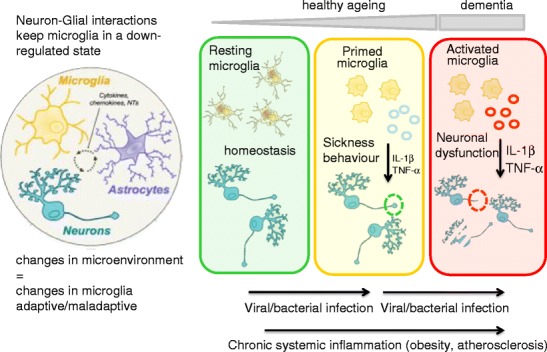
Microglia, the resident immune cells of the central nervous system (CNS), play an important role in CNS homeostasis during development, adulthood and ageing. Their phenotype and function have been widely studied, but most studies have focused on their local interactions in the CNS. Microglia are derived from a particular developmental niche, are long-lived, locally replaced and form a significant part of the communication route between the peripheral immune system and the CNS; all these components of microglia biology contribute to maintaining homeostasis. Microglia function is tightly regulated by the CNS microenvironment, and increasing evidence suggests that disturbances, such as neurodegeneration and ageing, can have profound consequences for microglial phenotype and function. We describe the possible biological mechanisms underlying the altered threshold for microglial activation, also known as 'microglial priming', seen in CNS disease and ageing and consider how priming may contribute to turning immune-to-brain communication from a homeostatic pathway into a maladaptive response that contributes to symptoms and progression of diseases of the CNS.
小胶质细胞是中枢神经系统 (CNS) 的固有免疫细胞,在 CNS 的发育、成年和衰老过程中发挥着重要作用。它们的表型和功能已被广泛研究,但大多数研究都集中在它们在 CNS 中的局部相互作用上。小胶质细胞来源于特定的发育龛位,寿命长,局部替换,并构成了外周免疫系统与 CNS 之间的重要通讯途径的一部分;小胶质细胞生物学的所有这些组成部分都有助于维持内稳态。小胶质细胞的功能受到 CNS 微环境的严格调控,越来越多的证据表明,神经退行性变和衰老等紊乱可能对小胶质细胞的表型和功能产生深远影响。我们描述了 CNS 疾病和衰老中小胶质细胞激活阈值改变(也称为“小胶质细胞预激活”)的潜在生物学机制,并探讨了预激活如何导致免疫向脑的通讯从稳态途径转变为适应性反应,从而导致 CNS 疾病的症状和进展。