Experimental Psychology/Helmholtz Institute, Utrecht University, Utrecht, The Netherlands.
PLoS One. 2013 May 29;8(5):e64602. doi: 10.1371/journal.pone.0064602. Print 2013.
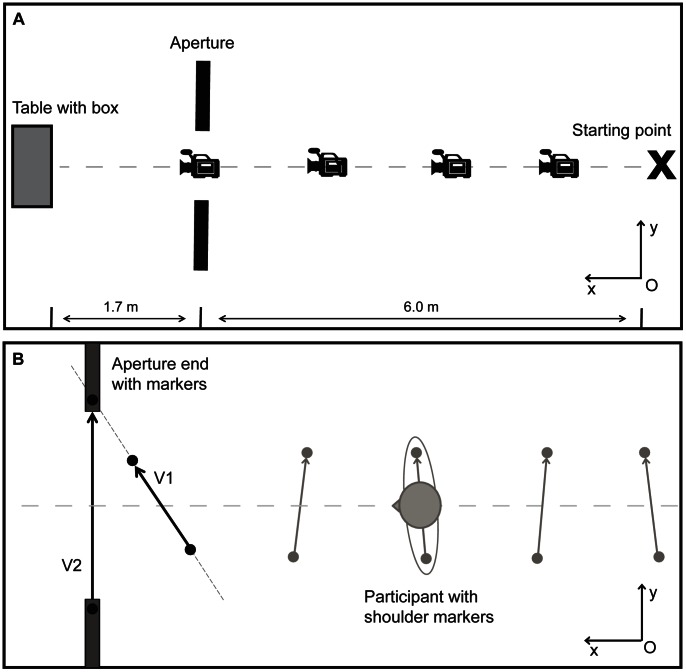
To date, research on the disturbed experience of body size in Anorexia Nervosa (AN) mainly focused on the conscious perceptual level (i.e. body image). Here we investigated whether these disturbances extend to body schema: an unconscious, action-related representation of the body. AN patients (n = 19) and healthy controls (HC; n = 20) were compared on body-scaled action. Participants walked through door-like openings varying in width while performing a diversion task. AN patients and HC differed in the largest opening width for which they started rotating their shoulders to fit through. AN patients started rotating for openings 40% wider than their own shoulders, while HC started rotating for apertures only 25% wider than their shoulders. The results imply abnormalities in AN even at the level of the unconscious, action oriented body schema. Body representation disturbances in AN are thus more pervasive than previously assumed: They do not only affect (conscious) cognition and perception, but (unconscious) actions as well.
迄今为止,对神经性厌食症(AN)中身体大小的紊乱体验的研究主要集中在有意识的感知层面(即身体意象)。在这里,我们研究了这些干扰是否会扩展到身体图式:一种无意识的、与动作相关的身体表示。我们比较了 19 名 AN 患者和 20 名健康对照组(HC)在身体尺度动作上的表现。参与者在执行转移任务时穿过宽度不同的门形开口。AN 患者和 HC 在开始旋转肩膀以适应通过的最大开口宽度上存在差异。AN 患者开始旋转的开口比他们自己的肩膀宽 40%,而 HC 患者开始旋转的开口仅比他们的肩膀宽 25%。研究结果表明,即使在无意识的、面向动作的身体图式层面,AN 中也存在异常。因此,AN 中的身体表示障碍比之前假设的更为普遍:它们不仅影响(有意识的)认知和感知,而且还影响(无意识的)动作。