Klinik und Poliklinik für Neurologie, Universität Leipzig, Leipzig, Germany.
Obesity and Diabetes Clinical Research Section, NIDDK-NIH, DHHS, Phoenix, AZ, USA.
Int J Obes (Lond). 2014 Feb;38(2):243-51. doi: 10.1038/ijo.2013.85. Epub 2013 May 23.
Obesity is the result of chronic positive energy balance. The mechanisms underlying the regulation of energy homeostasis and food intake are not understood. Despite large increases in fat mass (FM), recent evidence indicates that fat-free mass (FFM) rather than FM is positively associated with intake in humans.
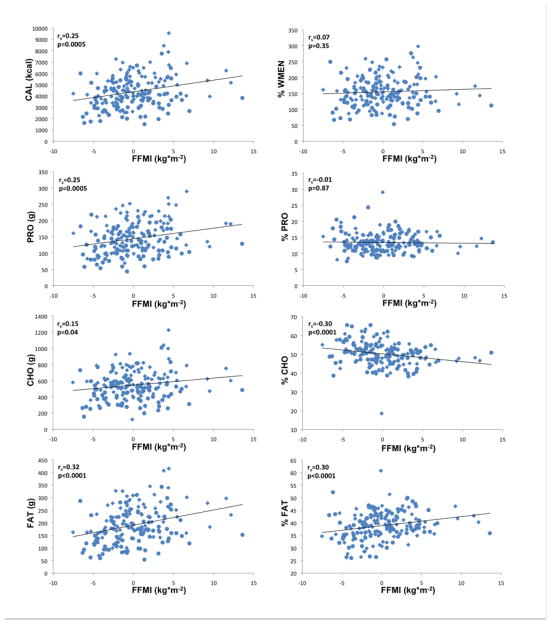
In 184 humans (73 females/111 males; age 34.5±8.8 years; percentage body fat: 31.6±8.1%), we investigated the relationship of FFM index (FFMI, kg m(-2)), FM index (FMI, kg m(-2)); and 24-h energy expenditure (EE, n=127) with ad-libitum food intake using a 3-day vending machine paradigm. Mean daily calories (CAL) and macronutrient intake (PRO, CHO, FAT) were determined and used to calculate the relative caloric contribution of each (%PRO, %CHO, %FAT) and percent of caloric intake over weight maintaining energy needs (%WMENs).
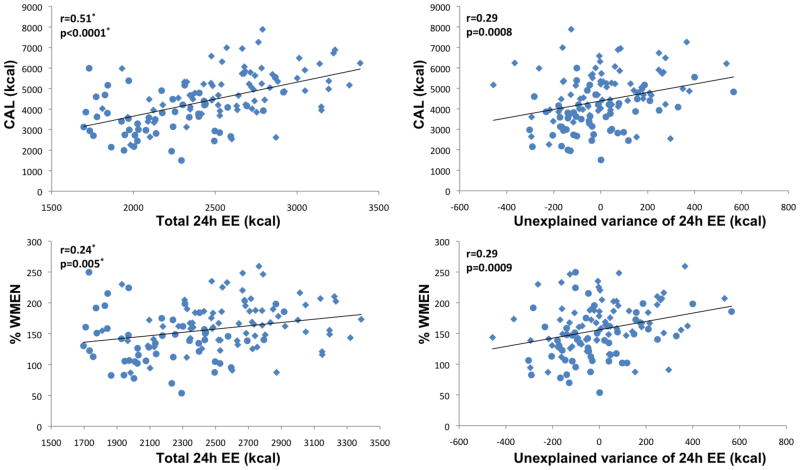
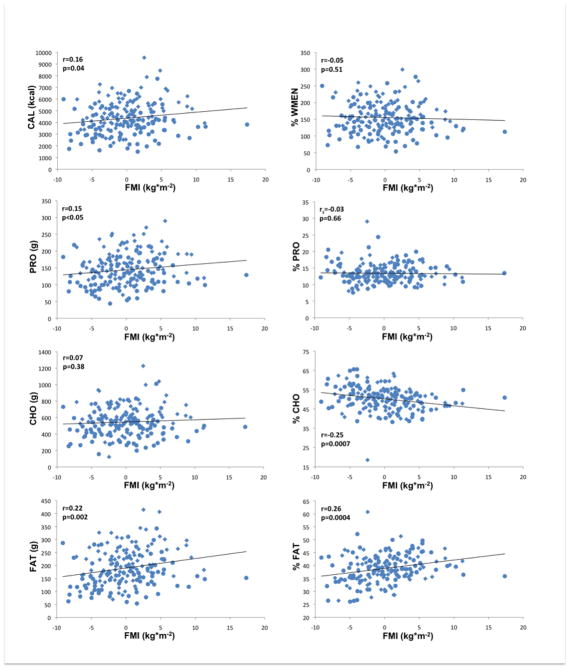
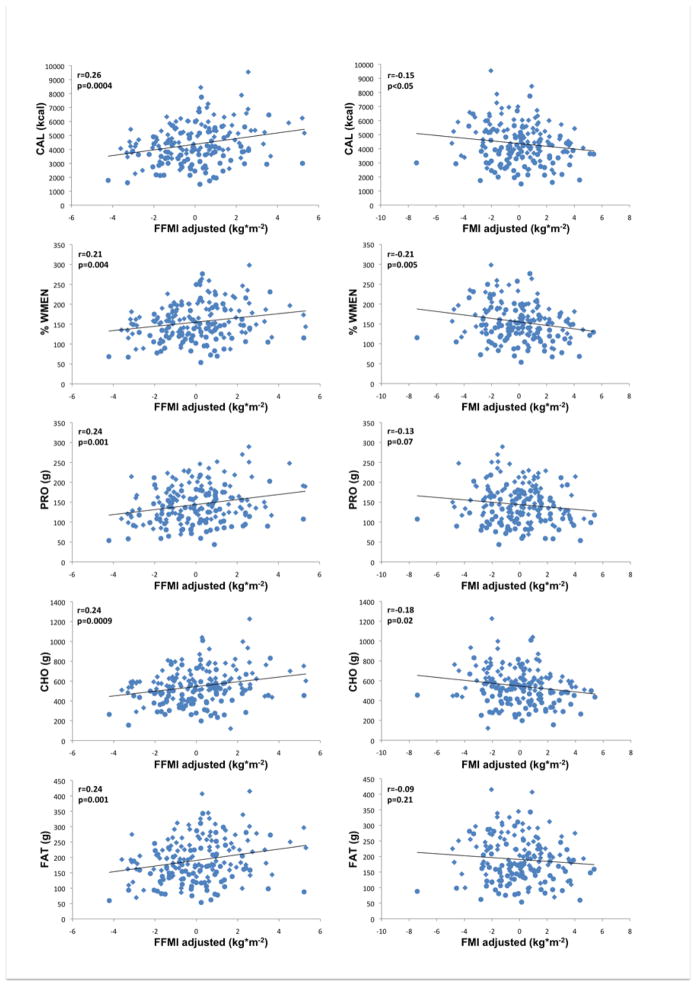
FFMI was positively associated with CAL (P<0.0001), PRO (P=0.0001), CHO (P=0.0075) and FAT (P<0.0001). This remained significant after adjusting for FMI. Total EE predicted CAL and macronutrient intake (all P<0.0001). FMI was positively associated with CAL (P=0.019), PRO (P=0.025) and FAT (P=0.0008). In models with both FFMI and FMI, FMI was negatively associated with CAL (P=0.019) and PRO (P=0.033). Both FFMI and FMI were negatively associated with %CHO and positively associated with %FAT (all P<0.001). EE and FFMI (adjusted for FMI) were positively (EE P=0.0085; FFMI P=0.0018) and FMI negatively (P=0.0018; adjusted for FFMI) associated with %WMEN.
Food and macronutrient intake are predicted by FFMI and to a lesser degree by FMI. FFM and FM may have opposing effects on energy homeostasis.
肥胖是慢性能量正平衡的结果。能量平衡和食物摄入调节的机制尚不清楚。尽管脂肪量(FM)大量增加,但最近的证据表明,在人类中,瘦体重(FFM)而不是 FM 与摄入量呈正相关。
在 184 名成年人(73 名女性/111 名男性;年龄 34.5±8.8 岁;体脂百分比:31.6±8.1%)中,我们使用三天自动售货机范式调查了 FFM 指数(FFMI,kg·m^(-2))、FM 指数(FMI,kg·m^(-2))与随意食物摄入的关系;24 小时能量消耗(EE,n=127)。确定了平均每日卡路里(CAL)和宏量营养素摄入量(PRO、CHO、FAT),并用于计算每种卡路里的相对卡路里贡献(%PRO、%CHO、%FAT)和卡路里摄入量占维持体重所需能量的百分比(%WMENs)。
FFMI 与 CAL(P<0.0001)、PRO(P=0.0001)、CHO(P=0.0075)和 FAT(P<0.0001)呈正相关。在调整 FMI 后,这仍然是显著的。总 EE 预测 CAL 和宏量营养素摄入量(均 P<0.0001)。FMI 与 CAL(P=0.019)、PRO(P=0.025)和 FAT(P=0.0008)呈正相关。在同时包含 FFMI 和 FMI 的模型中,FMI 与 CAL(P=0.019)和 PRO(P=0.033)呈负相关。FFMI 和 FMI 均与 %CHO 呈负相关,与 %FAT 呈正相关(均 P<0.001)。EE 和 FFMI(调整 FMI)与 %WMEN 呈正相关(EE P=0.0085;FFMI P=0.0018),而 FMI 与 %WMEN 呈负相关(P=0.0018;调整 FFMI)。
FFMI 和 FMI 对食物和宏量营养素摄入有预测作用。FFM 和 FM 可能对能量平衡有相反的影响。