University of Wisconsin, Madison, WI, USA,
Qual Life Res. 2014 Feb;23(1):119-27. doi: 10.1007/s11136-013-0444-3. Epub 2013 Jun 6.
As many as 3 million US residents are injured in traffic-related incidents every year leaving many victims with disabling conditions. To date, limited numbers of studies have examined the effects of traffic-related injuries on self-reported health. This study aims to examine the association between health-related quality of life (HRQOL) and traffic-related injuries longitudinally in a nationally representative sample of US adult population.
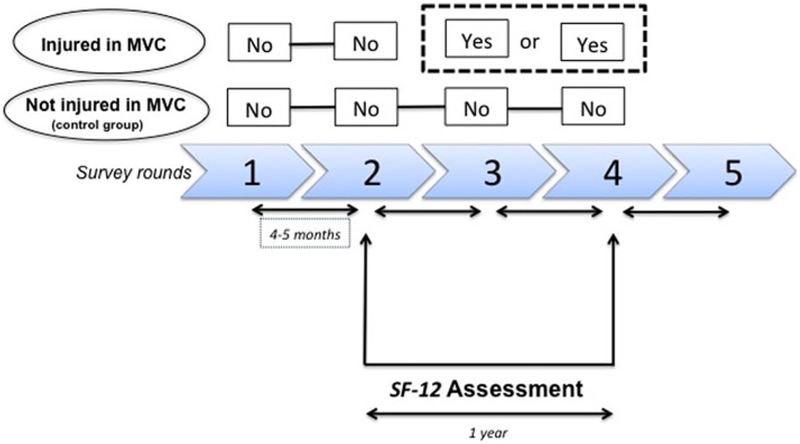
METHODS/APPROACH: This is a longitudinal study of adult participants (age ≥18) from seven panels (2000-2007) of the Medical Expenditure Panel Survey. The dependent variables included the physical and mental components of the SF-12, a measure of self-reported health. The outcome was assessed twice during the follow-up period: round 2 (4-5 months into the study) and round 4 (18 months into the study) for 62,298 individuals. Two methods estimate the association between traffic-related injuries and HRQOL: a within person change using paired tests and a between person change using multivariable regression adjusting for age, sex, income and educational level.
Nine hundred and ninety-three participants reported traffic-related injuries during the follow-up period. Compared to their pre-crash HRQOL, these participants lost 2.7 of the physical component score while their mental component did not change. Adjusted results showed significant deficits in the physical component (-2.84, p value = <.001) but not the mental component (-0.07, p value = .83) of HRQOL after controlling for potential confounders.
Traffic injuries were significantly associated with the physical component of HRQOL. These findings highlight the individual and societal burden associated with motor vehicle crash-related disability in the United States.
每年有多达 300 万美国居民在与交通相关的事件中受伤,导致许多受害者出现残疾状况。迄今为止,对交通相关伤害对自我报告健康的影响进行研究的数量有限。本研究旨在使用全国代表性的美国成年人群体样本,从纵向角度研究与健康相关的生活质量(HRQOL)与交通相关伤害之间的关联。
方法/方法:这是一项对成人参与者(年龄≥18 岁)的纵向研究,参与者来自医疗支出面板调查的七个面板(2000-2007 年)。因变量包括 SF-12 的身体和心理成分,这是自我报告健康的一种衡量标准。在随访期间对结果进行了两次评估:第 2 轮(研究开始后约 4-5 个月)和第 4 轮(研究开始后约 18 个月),共有 62298 人参加。有两种方法可以估计交通相关伤害与 HRQOL 之间的关联:使用配对测试进行个体内变化,以及使用多变量回归调整年龄、性别、收入和教育水平后进行个体间变化。
993 名参与者在随访期间报告了交通相关伤害。与他们在事故前的 HRQOL 相比,这些参与者在身体成分方面损失了 2.7 分,而他们的心理成分没有变化。调整后的结果显示,在控制了潜在混杂因素后,HRQOL 的身体成分明显存在缺陷(-2.84,p 值<.001),而心理成分则没有缺陷(-0.07,p 值=.83)。
交通伤害与 HRQOL 的身体成分显著相关。这些发现强调了美国与机动车碰撞相关残疾相关的个人和社会负担。