University of California, Santa Barbara, CA 93106, USA.
Psychol Sci. 2013 Jul 1;24(7):1216-25. doi: 10.1177/0956797612471684. Epub 2013 Jun 5.
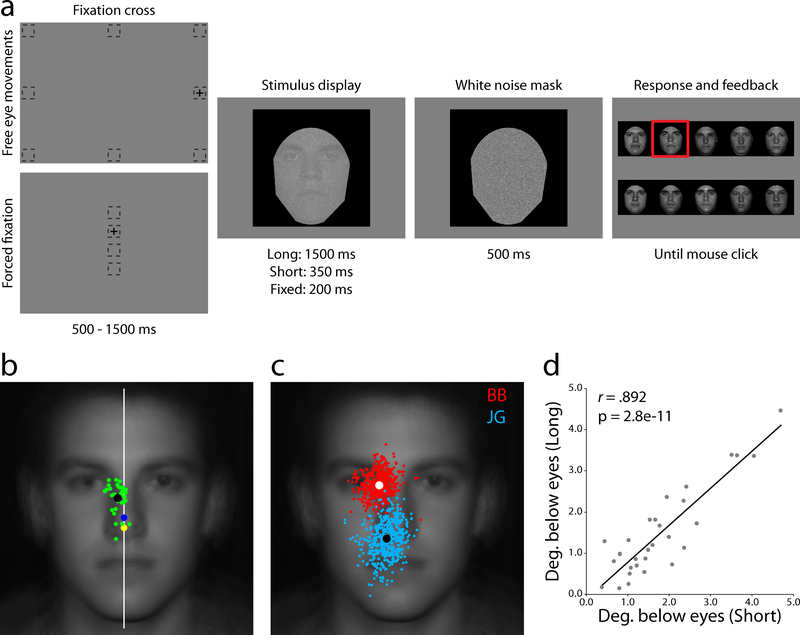
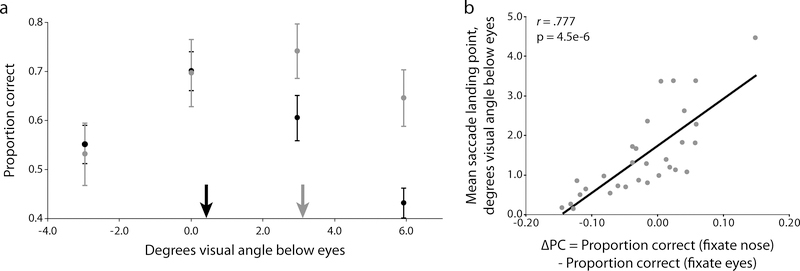
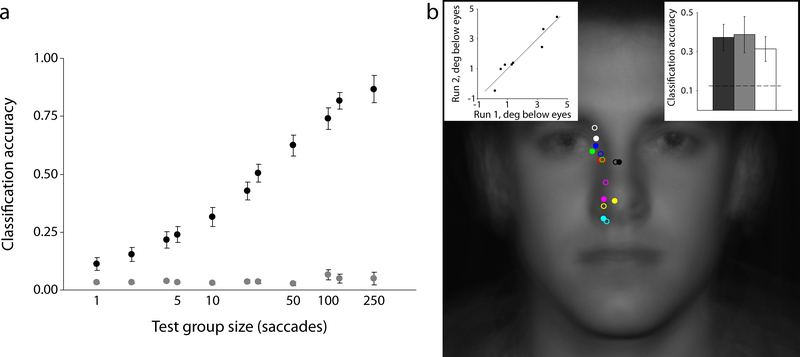
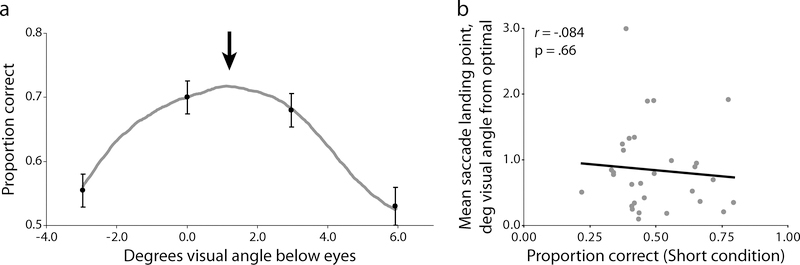
In general, humans tend to first look just below the eyes when identifying another person. Does everybody look at the same place on a face during identification, and, if not, does this variability in fixation behavior lead to functional consequences? In two conditions, observers had their free eye movements recorded while they performed a face-identification task. In another condition, the same observers identified faces while their gaze was restricted to specific locations on each face. We found substantial differences, which persisted over time, in where individuals chose to first move their eyes. Observers' systematic departure from a canonical, theoretically optimal fixation point did not correlate with performance degradation. Instead, each individual's looking preference corresponded to an idiosyncratic performance-maximizing point of fixation: Those who looked lower on the face performed better when forced to fixate the lower part of the face. The results suggest an observer-specific synergy between the face-recognition and eye movement systems that optimizes face-identification performance.
一般来说,人类在识别另一个人时往往会先看眼睛下方。在识别过程中,每个人都会看向面部的同一个位置吗?如果不是,这种注视行为的可变性是否会导致功能后果?在两种情况下,观察者在执行面部识别任务时记录了他们的自由眼动。在另一种情况下,相同的观察者在限制他们的目光只能在每个面部的特定位置时识别面部。我们发现,个体选择首先移动眼睛的位置存在很大差异,且这种差异会随着时间的推移而持续存在。观察者系统地偏离了一个规范的、理论上最优的注视点,但与表现的下降并没有相关性。相反,每个人的注视偏好对应于一个独特的、表现最佳的注视点:当被迫注视面部下部时,那些看向面部下方的人表现得更好。研究结果表明,在面部识别和眼球运动系统之间存在一种特定于观察者的协同作用,这种协同作用可以优化面部识别的表现。