Department of Epidemiology, Johns Hopkins Bloomberg School of Public Health, Baltimore, MD, USA.
Int J Tuberc Lung Dis. 2013 Jul;17(7):866-77. doi: 10.5588/ijtld.12.0573.
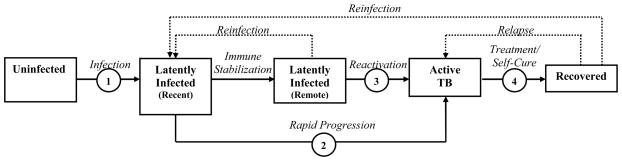
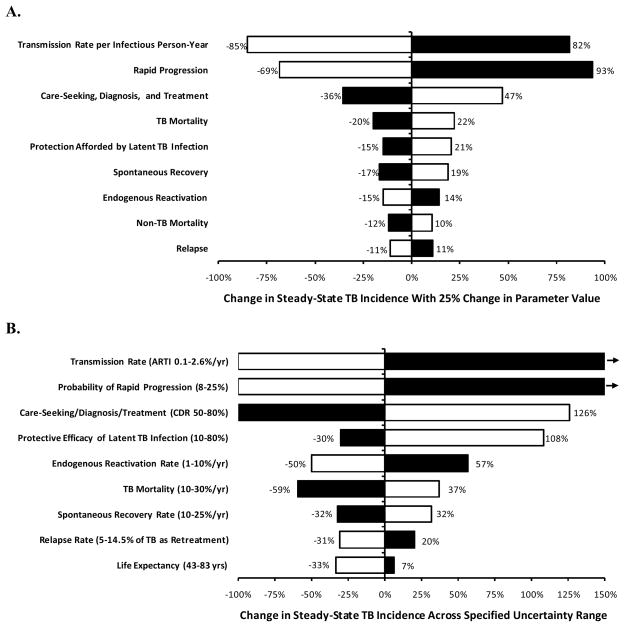
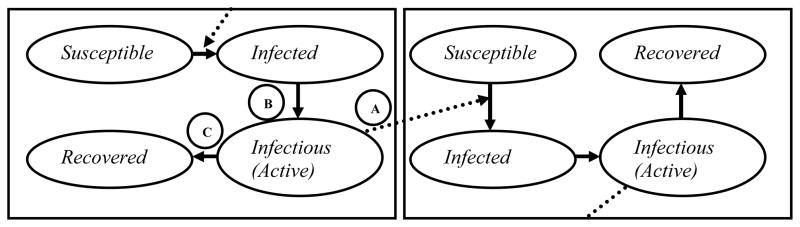
Infectious disease models are important tools for understanding epidemiology and supporting policy decisions for disease control. In the case of tuberculosis (TB), such models have informed our understanding and control strategies for over 40 years, but the primary assumptions of these models--and their most urgent data needs--remain obscure to many TB researchers and control officers. The structure and parameter values of TB models are informed by observational studies and experiments, but the evidence base in support of these models remains incomplete. Speaking from the perspective of infectious disease modelers addressing the broader TB research and control communities, we describe the basic structure common to most TB models and present a 'wish list' that would improve the evidence foundation upon which these models are built. As a comprehensive TB research agenda is formulated, we argue that the data needs of infectious disease models--our primary long-term decision-making tools--should figure prominently.
传染病模型是理解流行病学和支持疾病控制政策决策的重要工具。在结核病 (TB) 的情况下,这些模型已经为我们提供了 40 多年的理解和控制策略,但这些模型的主要假设——以及它们最迫切的数据需求——对许多结核病研究人员和控制官员来说仍然不清楚。TB 模型的结构和参数值是由观察性研究和实验提供的,但支持这些模型的证据基础仍然不完整。我们从传染病建模者的角度出发,面向更广泛的结核病研究和控制社区,描述了大多数 TB 模型共有的基本结构,并提出了一个“愿望清单”,以改善这些模型的构建基础。随着全面的结核病研究议程的制定,我们认为传染病模型的数据需求——我们的主要长期决策工具——应该占据重要地位。