Department of Physiology, Gdansk University of Physical Education and Sport, Kazimierza Górskiego 1, 80-336, Gdansk, Poland.
J Physiol Sci. 2013 Sep;63(5):333-43. doi: 10.1007/s12576-013-0269-4. Epub 2013 Jun 7.
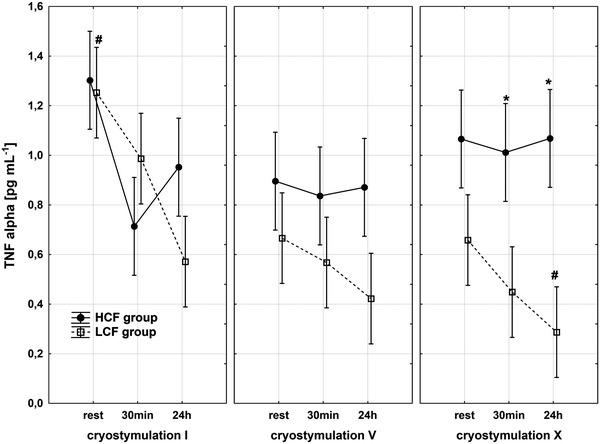
This study was aimed to evaluate anti-inflammatory effect of the whole body cryostimulation in obese men. Fourteen subjects (BMI >30 kg m(-2)), divided into two subgroups according to cardiorespiratory fitness: higher (HCF) or lower (LCF), have been exposed to 10 sessions in a cryogenic chamber (-110 °C). Blood samples were collected before, 30 min and 24 h after the first, fifth and last cryostimulation. Coldness exposures affected blood cytokine profile; however, the response depended on subjects' fitness capacity. Concentrations of pro-inflammatory cytokines in the LCF decreased by 19, 6.8, and 7.4 % in IL-6, resistin, and visfatin, respectively. TNFα in the LCF dropped 4.3-fold compared to baseline, while in the HCF, changes were smaller, yet significant. Anti-inflammatory cytokine IL-10 increased in both groups. No changes in adiponectin and leptin were observed in either group. Obtained results suggest that whole body cryostimulation can be a supplementary method for obese in reducing systemic inflammation.
这项研究旨在评估全身冷冻刺激对肥胖男性的抗炎作用。14 名受试者(BMI>30kg/m²)根据心肺功能分为两组:较高(HCF)或较低(LCF),在冷冻室中暴露于 10 个疗程(-110°C)。在第一次、第五次和最后一次冷冻刺激前、30 分钟和 24 小时采集血样。寒冷暴露会影响血液细胞因子谱;然而,反应取决于受试者的适应能力。LCF 中的促炎细胞因子 IL-6、抵抗素和内脂素分别降低了 19%、6.8%和 7.4%。与基线相比,LCF 中的 TNFα 下降了 4.3 倍,而在 HCF 中,变化虽小,但仍有统计学意义。两组的抗炎细胞因子 IL-10 均增加。两组的脂联素和瘦素均无变化。研究结果表明,全身冷冻刺激可能是肥胖患者减少全身炎症的一种补充方法。