Department of Hematology/Oncology, Comprehensive Cancer Center, Charité - Universitätsmedizin Berlin Berlin, Germany.
Front Physiol. 2013 May 24;4:118. doi: 10.3389/fphys.2013.00118. eCollection 2013.
Genetic risk factors for sporadic pancreatic cancer are largely unknown but actually under high exposure. Findings of correlations between the AB0 blood group system (Chromosome 9q34,1-q34,2) and the risk of pancreatic cancer (PC) in patients from Asia, America and south Europe have already been published. So far it is unclear, whether this correlation between blood group an PC incidence can be found in German patients as well.
One hundred and sixty-six patients who underwent a resection of PC were evaluated in a period between 2000 and 2010. Blood group reference distribution for the German population is given as: 0: 41%; A: 43%; B: 11%; AB: 5%; Rhesus positive: 85%; Rhesus negative: 15%. Analyses were done using the non-parametric Chi(2)-test (p-value two sided; SPSS 19.0).
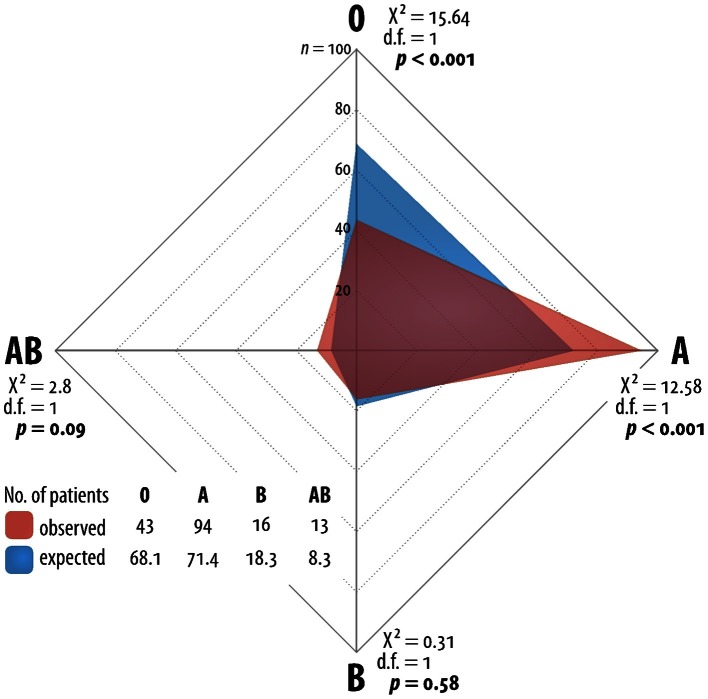
Median age was 62 (34-82) years. Gender: female 73/44%; male: 93/56%. Observed blood group proportions: 0: 43 (25.9%)/A: 94 (56.6%)/B: 16 (9.6%)/AB: 13 (7.8%)/Rhesus positive: 131 (78.9%)/negative: 35 (21.1%). We detected a significant difference to the German reference distribution of the AB0 system (Chi(2) 19.34, df 3, p < 0.001). Rhesus factor has no impact on AB0-distribution (Chi(2) 4.13, df 3, p = 0.25), but differs significantly from reference distribution-probably due to initial AB0-variation (Chi(2) 4.82, df 1, p = 0.028). The odds ratio for blood group A is 2.01 and for blood group 0 is 0.5.
The incidence of PC in the German cohort is highly associated with the AB0-system as well. More patients with blood group A suffer from PC (p < 0.001) whereas blood group 0 was less frequent in patients with PC (p < 0.001). Thus, our findings support the results from other non-German surveys. The causal trigger points of this carcinogenesis correlation are still not known.
散发性胰腺癌的遗传风险因素很大程度上是未知的,但实际上处于高暴露状态。已经发表了关于 AB0 血型系统(染色体 9q34、1-q34、2)与亚洲、美洲和南欧胰腺癌(PC)患者风险之间的相关性的发现。到目前为止,尚不清楚这种血型与 PC 发病率之间的相关性是否也能在德国患者中找到。
我们评估了 2000 年至 2010 年间接受胰腺切除术的 166 名 PC 患者。德国人群的血型参考分布为:0 型:41%;A 型:43%;B 型:11%;AB 型:5%;Rh 阳性:85%;Rh 阴性:15%。使用非参数 Chi(2)-检验(双侧 p 值;SPSS 19.0)进行分析。
中位年龄为 62(34-82)岁。性别:女性 73/44%;男性:93/56%。观察到的血型比例:0 型:43(25.9%)/A 型:94(56.6%)/B 型:16(9.6%)/AB 型:13(7.8%)/Rh 阳性:131(78.9%)/Rh 阴性:35(21.1%)。我们检测到 AB0 系统与德国参考分布之间存在显著差异(Chi(2) 19.34,df 3,p < 0.001)。Rh 因子对 AB0 分布没有影响(Chi(2) 4.13,df 3,p = 0.25),但与参考分布显著不同-可能是由于初始 AB0 变异(Chi(2) 4.82,df 1,p = 0.028)。血型 A 的优势比为 2.01,血型 0 的优势比为 0.5。
德国队列中 PC 的发病率与 AB0 系统高度相关。患有 A 型血的 PC 患者更多(p < 0.001),而患有 PC 的 0 型血患者较少(p < 0.001)。因此,我们的研究结果支持来自其他非德国调查的结果。这种癌变相关性的因果触发因素尚不清楚。