School of Psychology, Cardiff University, Cardiff, Wales, United Kingdom.
Hippocampus. 2013 Dec;23(12):1162-78. doi: 10.1002/hipo.22154. Epub 2013 Jul 10.
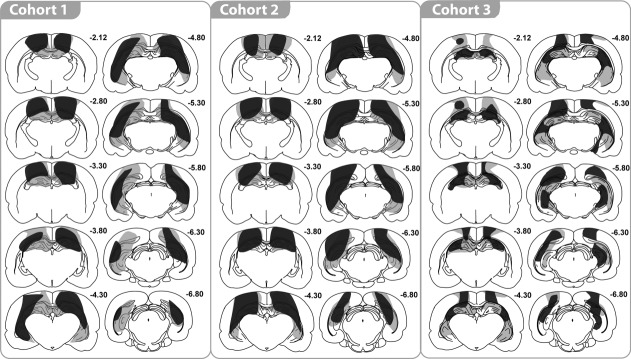
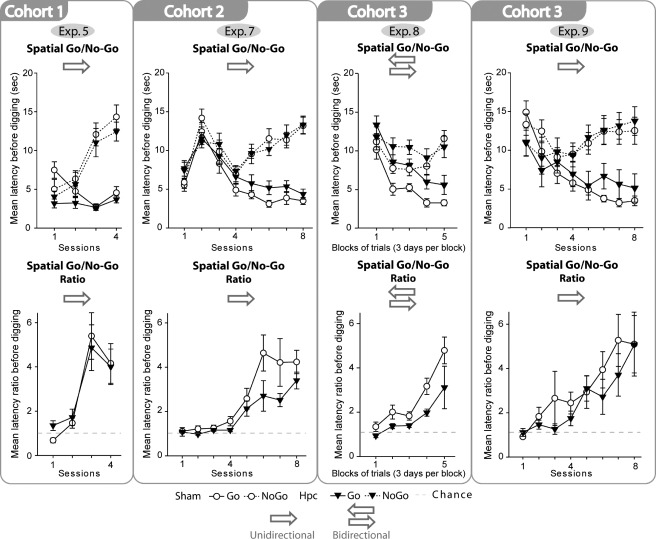
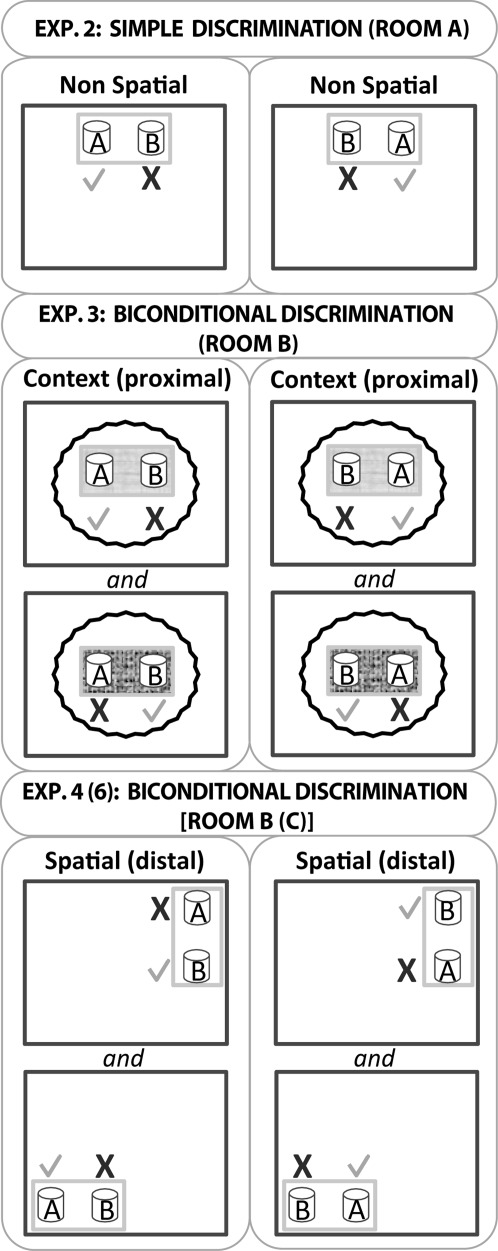
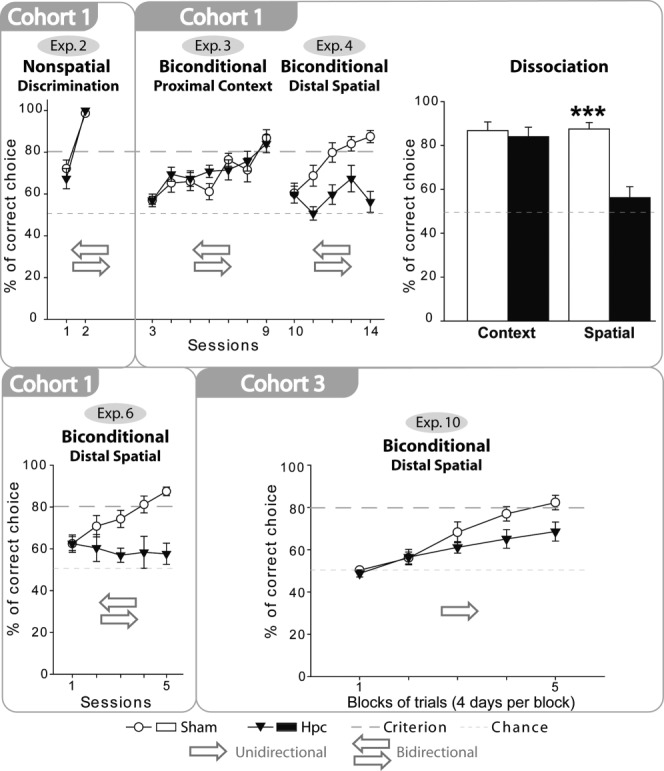
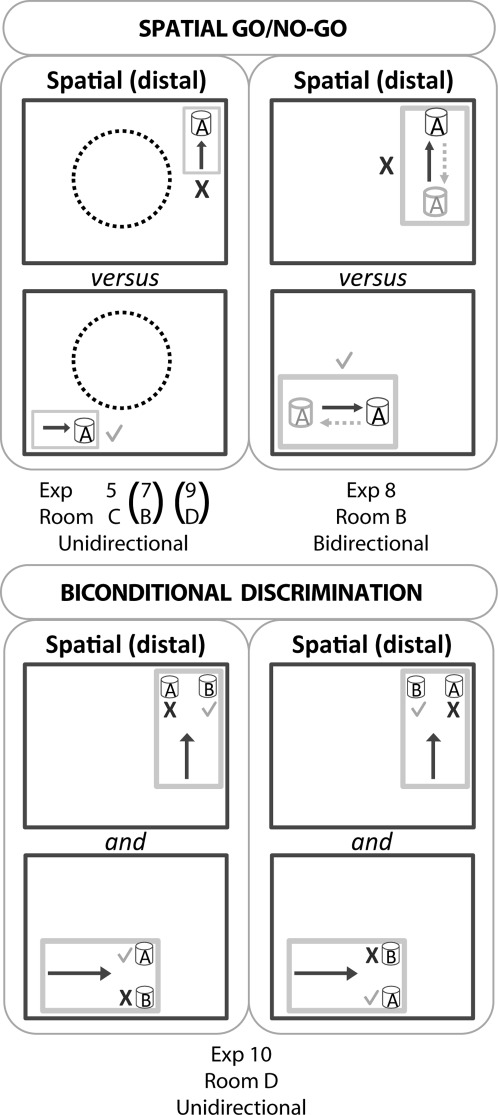
Three cohorts of rats with extensive hippocampal lesions received multiple tests to examine the relationships between particular forms of associative learning and an influential account of hippocampal function (the cognitive map hypothesis). Hippocampal lesions spared both the ability to discriminate two different digging media and to discriminate two different room locations in a go/no-go task when each location was approached from a single direction. Hippocampal lesions had, however, differential effects on a more complex task (biconditional discrimination) where the correct response was signaled by the presence or absence of specific cues. For all biconditional tasks, digging in one medium (A) was rewarded in the presence of cue C, while digging in medium B was rewarded in the presences of cue D. Such biconditional tasks are "configural" as no individual cue or element predicts the solution (AC+, AD-, BD+, and BC-). When proximal context cues signaled the correct digging choice, biconditional learning was seemingly unaffected by hippocampal lesions. Severe deficits occurred, however, when the correct digging choice was signaled by distal room cues. Also, impaired was the ability to discriminate two locations when each location was approached from two directions. A task demand that predicted those tasks impaired by hippocampal damage was the need to combine specific cues with their relative spatial positions ("structural learning"). This ability makes it possible to distinguish the same cues set in different spatial arrays. Thus, the hippocampus appears necessary for configural discriminations involving structure, discriminations that potentially underlie the creation of cognitive maps.
三组海马广泛损伤的大鼠接受了多项测试,以检验特定形式的联想学习与海马功能的一种有影响力的解释(认知图假说)之间的关系。海马损伤既不影响大鼠区分两种不同挖掘介质的能力,也不影响大鼠在单一方向接近时区分两个不同房间位置的能力,但却对更复杂的任务(双条件辨别)产生了不同的影响,在这种任务中,正确的反应由特定线索的存在或缺失来指示。对于所有的双条件任务,在 C 线索存在的情况下,大鼠在 A 介质中挖掘会得到奖励,而在 D 线索存在的情况下,大鼠在 B 介质中挖掘会得到奖励。这种双条件任务是“构型”的,因为没有单个线索或元素可以预测解决方案(AC+,AD-,BD+和 BC-)。当近端上下文线索指示正确的挖掘选择时,双条件学习似乎不受海马损伤的影响。然而,当正确的挖掘选择由远端房间线索指示时,就会出现严重的缺陷。此外,当每个位置从两个方向接近时,区分两个位置的能力也会受损。一种任务需求,即预测那些受海马损伤影响的任务的需求,是需要将特定线索与其相对空间位置结合起来(“结构学习”)。这种能力使我们能够区分不同空间排列中的相同线索集。因此,海马体似乎是涉及结构的构型辨别所必需的,而这种辨别可能是认知图形成的基础。