Kim Ji Hye, Seo Joo Wan, Mok Jeong Ha, Kim Mi Hyun, Cho Woo Hyun, Lee Kwangha, Kim Ki Uk, Jeon Doosoo, Park Hye-Kyung, Kim Yun Seong, Kim Hyung Hoi, Lee Min Ki
Department of Internal Medicine, Pusan National University School of Medicine, Busan, Korea.
Tuberc Respir Dis (Seoul). 2013 May;74(5):207-14. doi: 10.4046/trd.2013.74.5.207. Epub 2013 May 31.
Community-acquired pneumonia (CAP) is one of the leading causes of death among the elderly. Several studies have reported the clinical usefulness of serum procalcitonin, a biomarker of bacterial infection. However, the association between the levels of procalcitonin and the severity in the elderly with CAP has not yet been reported. The aim of this study was to evaluate usefulness of procalcitonin as a predictor of severity and mortality in the elderly with CAP.
This study covers 155 CAP cases admitted to Pusan National University Hospital between January 2010 and December 2010. Patients were divided into two groups (≥65 years, n=99; <65 years, n=56) and were measured for procalcitonin, C-reactive protein (CRP), white blood cell, confusion, uremia, respiratory rate, blood pressure, 65 years or older (CURB-65) and pneumonia severity of index (PSI).
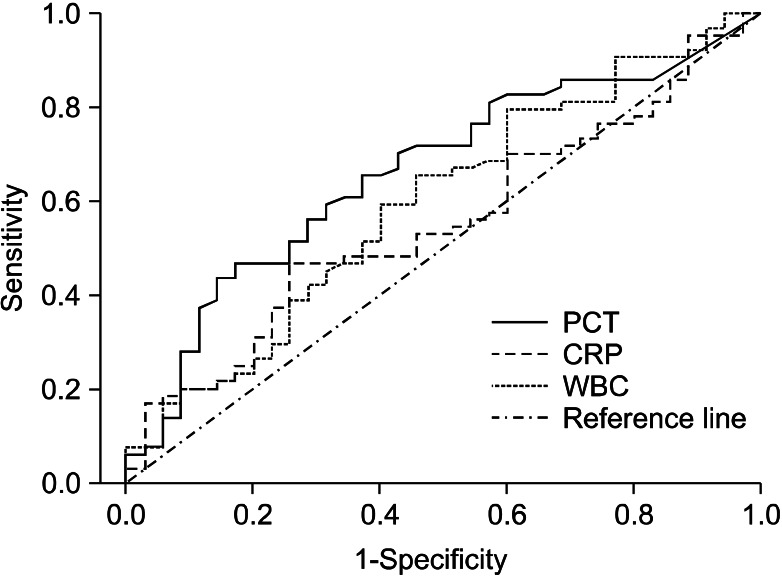
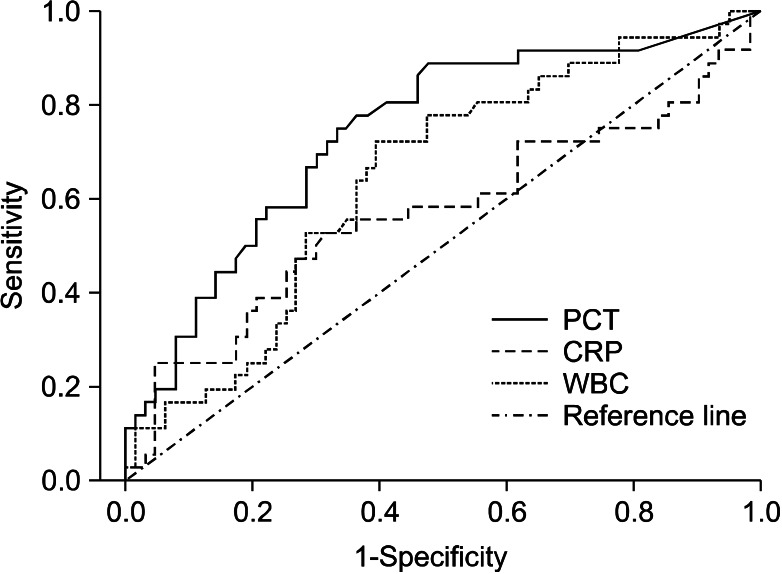
The levels of procalcitonin were significantly correlated with the CURB-65, PSI in totals. Especially stronger correlation was observed between the levels of procalcitonin and CURB-65 in the elderly (procalcitonin and CURB-65, ρ=0.408 with p<0.001; procalcitonin and PSI, ρ=0.293 with p=0.003; procalcitonin and mortality, ρ=0.229 with p=0.023). The correlation between the levels of CRP or WBC and CAP severity was low. The existing cut-off value of procalcitonin was correlated with mortality rate, however, it was not correlated with mortality within the elderly.
The levels of procalcitonin are more useful than the levels of CRP or WBC to predict the severity of CAP. However, there was no association between the levels of procalcitonin and mortality in the elderly.
社区获得性肺炎(CAP)是老年人主要死因之一。多项研究报道了血清降钙素原作为细菌感染生物标志物的临床应用价值。然而,降钙素原水平与老年CAP患者病情严重程度之间的关联尚未见报道。本研究旨在评估降钙素原作为老年CAP患者病情严重程度及死亡率预测指标的应用价值。
本研究纳入了2010年1月至2010年12月在釜山国立大学医院收治的155例CAP患者。患者分为两组(≥65岁,n = 99;<65岁,n = 56),检测降钙素原、C反应蛋白(CRP)、白细胞、意识障碍、尿毒症、呼吸频率、血压、65岁及以上患者的CURB - 65评分和肺炎严重指数(PSI)。
降钙素原水平与总体CURB - 65评分、PSI显著相关。尤其是在老年人中,降钙素原水平与CURB - 65评分之间的相关性更强(降钙素原与CURB - 65评分,ρ = 0.408,p < 0.001;降钙素原与PSI,ρ = 0.293,p = 0.003;降钙素原与死亡率,ρ = 0.229,p = 0.023)。CRP或白细胞水平与CAP严重程度的相关性较低。现有的降钙素原临界值与死亡率相关,但与老年患者的死亡率无关。
降钙素原水平在预测CAP严重程度方面比CRP或白细胞水平更有用。然而,降钙素原水平与老年患者死亡率之间无关联。