Reiss Renate, Ihssen Julian, Richter Michael, Eichhorn Eric, Schilling Boris, Thöny-Meyer Linda
Laboratory for Biomaterials, Empa, Swiss Federal Laboratories for Materials Science and Technology, St Gallen, Switzerland.
PLoS One. 2013 Jun 3;8(6):e65633. doi: 10.1371/journal.pone.0065633. Print 2013.
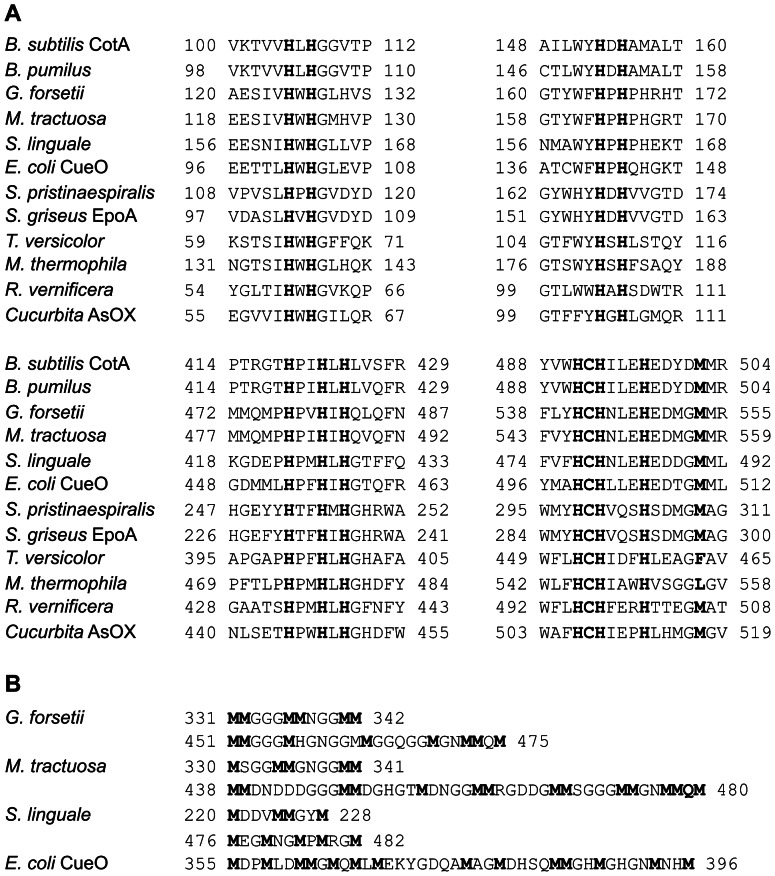
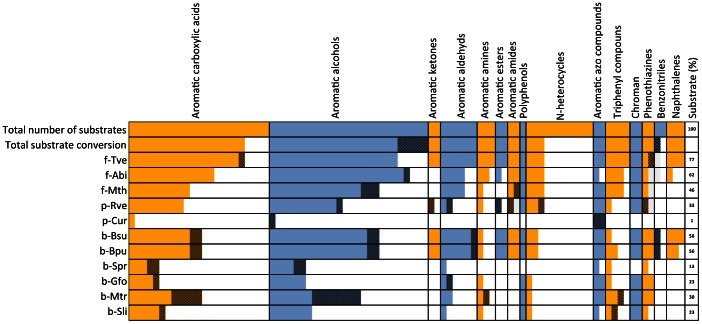
Laccases (EC 1.10.3.2) are multi-copper oxidases that catalyse the one-electron oxidation of a broad range of compounds including substituted phenols, arylamines and aromatic thiols to the corresponding radicals. Owing to their broad substrate range, copper-containing laccases are versatile biocatalysts, capable of oxidizing numerous natural and non-natural industry-relevant compounds, with water as the sole by-product. In the present study, 10 of the 11 multi-copper oxidases, hitherto considered to be laccases, from fungi, plant and bacterial origin were compared. A substrate screen of 91 natural and non-natural compounds was recorded and revealed a fairly broad but distinctive substrate spectrum amongst the enzymes. Even though the enzymes share conserved active site residues we found that the substrate ranges of the individual enzymes varied considerably. The EC classification is based on the type of chemical reaction performed and the actual name of the enzyme often refers to the physiological substrate. However, for the enzymes studied in this work such classification is not feasible, even more so as their prime substrates or natural functions are mainly unknown. The classification of multi-copper oxidases assigned as laccases remains a challenge. For the sake of simplicity we propose to introduce the term "laccase-like multi-copper oxidase" (LMCO) in addition to the term laccase that we use exclusively for the enzyme originally identified from the sap of the lacquer tree Rhus vernicifera.
漆酶(EC 1.10.3.2)是多铜氧化酶,可催化多种化合物(包括取代酚、芳胺和芳香硫醇)单电子氧化为相应的自由基。由于其广泛的底物范围,含铜漆酶是通用的生物催化剂,能够氧化众多天然和与工业相关的非天然化合物,且仅以水作为副产物。在本研究中,对11种多铜氧化酶中的10种进行了比较,这些酶迄今被认为是漆酶,分别来源于真菌、植物和细菌。记录了对91种天然和非天然化合物的底物筛选情况,结果显示这些酶具有相当广泛但独特的底物谱。尽管这些酶共享保守的活性位点残基,但我们发现各个酶的底物范围差异很大。酶的国际酶学委员会(EC)分类是基于所进行的化学反应类型,酶的实际名称通常指其生理底物。然而,对于本研究中的酶而言,这种分类并不可行,尤其是因为它们的主要底物或天然功能大多未知。将多铜氧化酶归类为漆酶仍然是一项挑战。为了简便起见,我们建议除了将漆酶一词专门用于最初从漆树漆液中鉴定出的酶之外,引入“类漆酶多铜氧化酶”(LMCO)这一术语。