Division of Human Nutrition, Wageningen University, Wageningen, The Netherlands.
Nutr J. 2013 Jun 7;12:75. doi: 10.1186/1475-2891-12-75.
Invalid information on dietary intake may lead to false diet-disease associations. This study was conducted to examine the relative validity of the food frequency questionnaire (FFQ) used to assess dietary intake in the Leiden Longevity Study.
A total of 128 men and women participating in the Leiden Longevity Study were included in the present validation study. The performance of the FFQ was evaluated using the mean of three 24-hour recalls as the reference method. Evaluation in estimating dietary intake at the group level was done by paired t-tests. The relative validity of the individual energy adjusted level of intake was assessed with correlation analyses (Pearson's), with correction for measurement error.
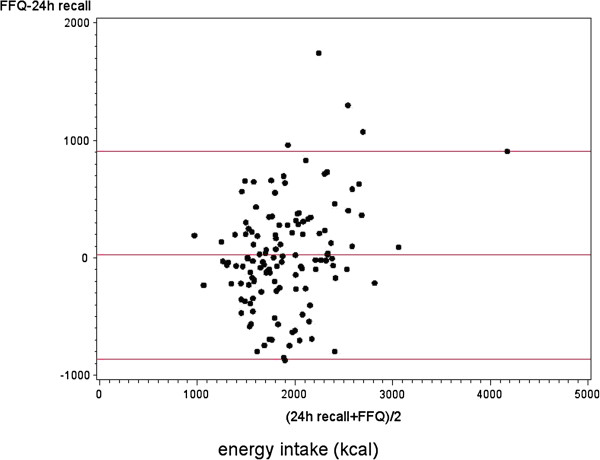
On group level, the FFQ overestimated as well as underestimated absolute intake of various nutrients and foods. The Bland and Altman plot for total energy intake showed that the agreement between the FFQ and the 24-hour recalls was dependent of intake level. Pearson correlation coefficients ranged from 0.21 (alpha linolenic acid) to 0.78 (ethanol) for nutrients and from -0.02 (legumes, non-significant) to 0.78 (alcoholic beverages) for foods. Adjustment for energy intake slightly lowered the correlation coefficients for nutrients (mean coefficient: 0.48 versus 0.50), while adjustment for within-subject variation in the 24-h recalls resulted in higher correlation coefficients for both nutrients and foods (mean coefficient: 0.69 for nutrients and 0.65 for foods).
For most nutrients and foods, the ability of the FFQ to rank subjects was acceptable to good.
饮食摄入的无效信息可能导致错误的饮食与疾病关联。本研究旨在检验莱顿长寿研究中用于评估饮食摄入的食物频率问卷(FFQ)的相对有效性。
本验证研究共纳入了 128 名参与莱顿长寿研究的男性和女性。使用 3 天 24 小时回顾法的平均值作为参考方法,评估 FFQ 的性能。通过配对 t 检验评估 FFQ 在估计组内饮食摄入水平方面的表现。采用皮尔逊相关分析(Pearson's)评估个体能量校正摄入量的相对有效性,并进行测量误差校正。
在组水平上,FFQ 高估和低估了各种营养素和食物的绝对摄入量。总能量摄入的 Bland 和 Altman 图显示,FFQ 与 24 小时回顾法之间的一致性取决于摄入量水平。对于营养素,皮尔逊相关系数范围从 0.21(α-亚麻酸)到 0.78(乙醇),对于食物,从 -0.02(豆类,无显著意义)到 0.78(含酒精饮料)。调整能量摄入略微降低了营养素的相关系数(平均系数:0.48 对 0.50),而调整 24 小时回顾法内个体差异则导致营养素和食物的相关系数均升高(营养素的平均系数为 0.69,食物的平均系数为 0.65)。
对于大多数营养素和食物,FFQ 对受试者进行排序的能力可接受至良好。