Université Pierre et Marie Curie-Paris VI, Groupe Hospitalier Pitié-Salpêtrière, 91 boulevard de l'Hôpital, Paris 75013, France.
Nutrients. 2013 May 28;5(6):1840-55. doi: 10.3390/nu5061840.
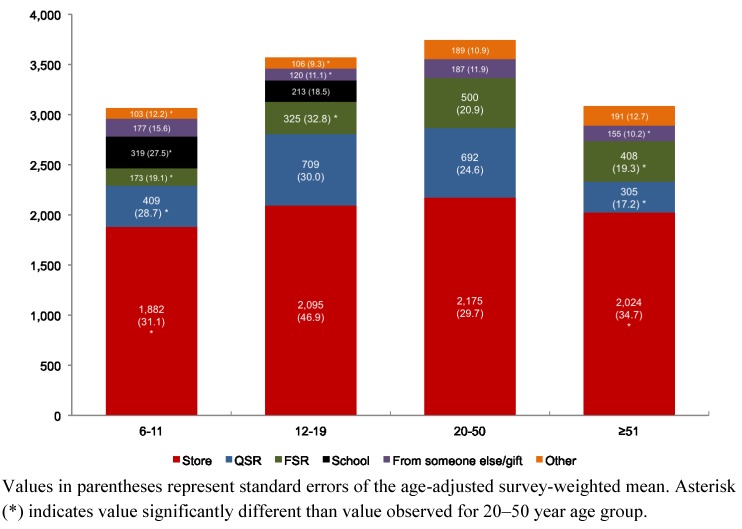
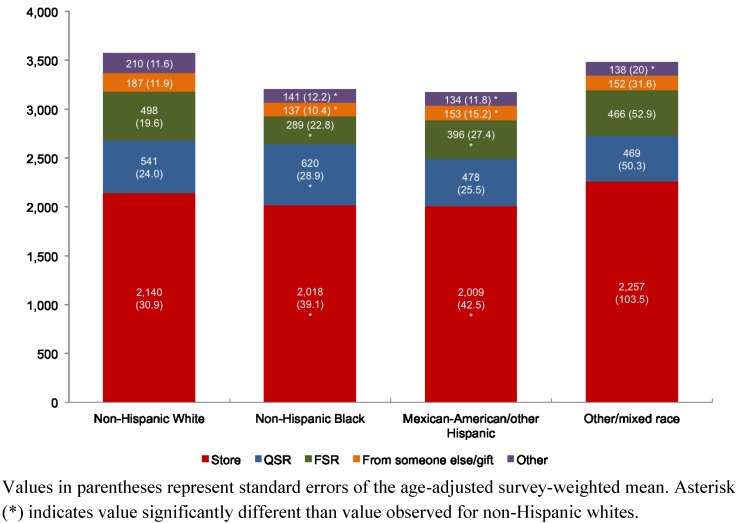
Sodium intakes, from foods and beverages, of 22,852 persons in the National Health and Nutrition Examination Surveys (NHANES 2003-2008) were examined by specific food source and by food location of origin. Analyses were based on a single 24-h recall. Separate analyses were conducted for children (6-11 years of age), adolescents (12-19), and adults (20-50 and ≥51 years). Grouping of like foods (e.g., food sources) used a scheme proposed by the National Cancer Institute, which divides foods/beverages into 96 food subgroups (e.g., pizza, yeast breads or cold cuts). Food locations of origin were stores (e.g., grocery, convenience and specialty stores), quick-service restaurant/pizza (QSR), full-service restaurant (FSR), school, or other. Food locations of sodium were also evaluated by race/ethnicity amongst adults. Stores provided between 58.1% and 65.2% of dietary sodium, whereas QSR and FSR together provided between 18.9% and 31.8% depending on age. The proportion of sodium from QSR varied from 10.1% to 19.9%, whereas that from FSR varied from 3.4% to 13.3%. School meals provided 10.4% of sodium for 6-11 year olds and 6.0% for 12-19 year olds. Pizza from QSR, the top away from home food item, provided 5.4% of sodium in adolescents. QSR pizza, chicken, burgers and Mexican dishes combined provided 7.8% of total sodium in adult diets. Most sodium came from foods purchased in stores. Food manufacturers, restaurants, and grocery stores all have a role to play in reducing the amount of sodium in the American diet.
通过特定的食物来源和食物产地,对 22852 名参加国家健康和营养检查调查(NHANES 2003-2008)的人的钠摄入量进行了检查。分析基于单一的 24 小时回忆。分别对儿童(6-11 岁)、青少年(12-19 岁)和成年人(20-50 岁和≥51 岁)进行了分析。相似食物(如食物来源)的分组使用了美国国家癌症研究所提出的方案,该方案将食物/饮料分为 96 个食物亚组(如披萨、酵母面包或冷切)。食物产地为商店(如杂货店、便利店和专卖店)、快餐/披萨(QSR)、全方位服务餐厅(FSR)、学校或其他。在成年人中,还根据种族/族裔评估了食物中钠的来源。商店提供的钠占饮食中钠的 58.1%-65.2%,而 QSR 和 FSR 提供的钠分别占 18.9%-31.8%,具体取决于年龄。QSR 提供的钠比例从 10.1%到 19.9%不等,而 FSR 提供的钠比例从 3.4%到 13.3%不等。学校餐为 6-11 岁的儿童提供 10.4%的钠,为 12-19 岁的儿童提供 6.0%的钠。QSR 披萨是最受欢迎的外出就餐食品,为青少年提供 5.4%的钠。QSR 披萨、鸡肉、汉堡和墨西哥菜的总和为成人饮食提供了 7.8%的总钠。大多数钠来自商店购买的食物。食品制造商、餐馆和杂货店都可以在减少美国家庭饮食中的钠含量方面发挥作用。