Johns Hopkins Global Center on Childhood Obesity and Center for Human Nutrition, Department of International Health, Johns Hopkins Bloomberg School of Public Health, Baltimore, Maryland, United States of America.
PLoS One. 2013 Jun 10;8(6):e65361. doi: 10.1371/journal.pone.0065361. Print 2013.
Few studies have examined parent-child resemblance in body weight status using nationally representative data for the US.
We analyzed Body Mass Index (BMI), weight status, and related correlates for 4,846 boys, 4,725 girls, and their parents based on US nationally representative data from the 2006 and 2007 Medical Expenditure Panel Survey (MEPS). Pearson partial correlation coefficients, percent agreement, weighted kappa coefficients, and binary and multinomial logistic regression were used to examine parent-child resemblance, adjusted for complex sampling design.
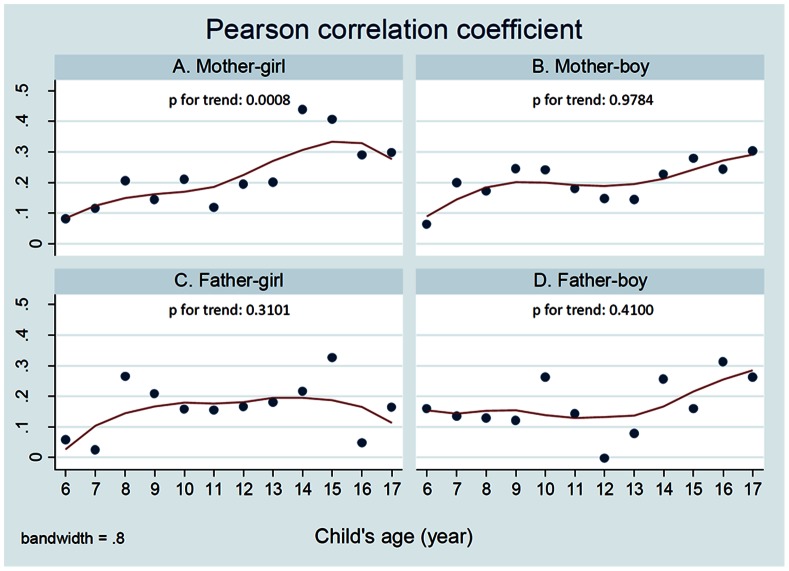
Pearson partial correlation coefficients between parent and child's BMI measures were 0.15 for father-son pairs, 0.17 for father-daughter pairs, 0.20 for mother-son pairs, and 0.23 for mother-daughter pairs. The weighted kappa coefficients between BMI quintiles of parent and child ranged from -0.02 to 0.25. Odds ratio analyses found children were 2.1 (95% confidence interval (CI): 1.6, 2.8) times more likely to be obese if only their father was obese, 1.9 (95% CI: 1.5, 2.4) times more likely if only their mother was obese, and 3.2 (95% CI: 2.5, 4.2) times more likely if both parents were obese.
Parent-child resemblance in BMI appears weak and may vary across parent-child dyad types in the US population. However, parental obesity status is associated with children's obesity status. Use of different measures of parent-child resemblance in body weight status can lead to different conclusions.
利用美国全国代表性数据,很少有研究检查体重状况的父母-子女相似性。
我们根据美国 2006 年和 2007 年医疗支出面板调查(MEPS)的全国代表性数据,分析了 4846 名男孩、4725 名女孩及其父母的体重指数(BMI)、体重状况及相关指标。使用 Pearson 偏相关系数、一致性百分比、加权 kappa 系数以及二项和多项逻辑回归来检验父母-子女之间的相似性,调整了复杂抽样设计。
父亲-儿子、父亲-女儿、母亲-儿子和母亲-女儿配对的父母和子女 BMI 测量值之间的 Pearson 偏相关系数分别为 0.15、0.17、0.20 和 0.23。父母和子女 BMI 五分位的加权 kappa 系数范围为-0.02 至 0.25。比值比分析发现,如果仅父亲肥胖,子女肥胖的可能性是肥胖父亲子女的 2.1 倍(95%置信区间(CI):1.6,2.8);如果仅母亲肥胖,子女肥胖的可能性是肥胖母亲子女的 1.9 倍(95%CI:1.5,2.4);如果父母双方都肥胖,子女肥胖的可能性是肥胖父母子女的 3.2 倍(95%CI:2.5,4.2)。
美国人群中 BMI 显示父母-子女相似性较弱,且可能因父母-子女对子类型而异。然而,父母肥胖状况与子女肥胖状况相关。使用体重状况的父母-子女相似性的不同衡量标准可能会得出不同的结论。