Punbusayakul Niramol, Talapatra Saikat, Ajayan Pulickel M, Surareungchai Werasak
School of Agro-Industry, Mae Fah Luang University, Chiang Rai 57100, Thailand.
Department of Physics, Southern Illinois University Carbondale, Carbondale, IL 62901, USA.
Chem Cent J. 2013 Jun 14;7:102. doi: 10.1186/1752-153X-7-102. eCollection 2013.
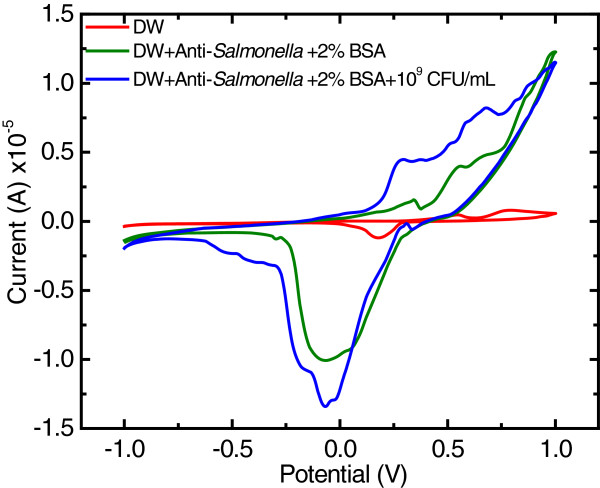
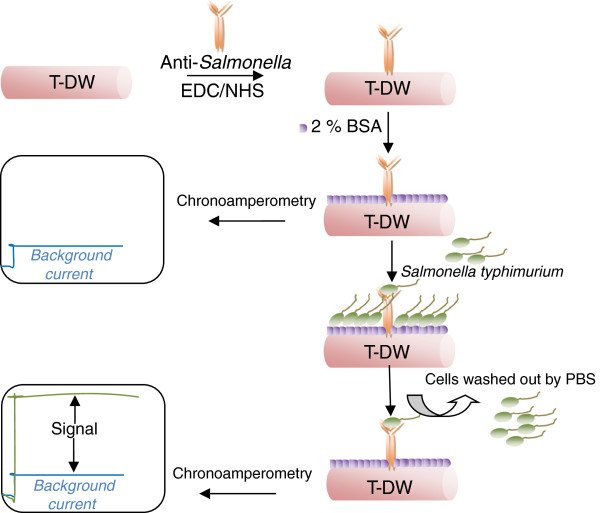
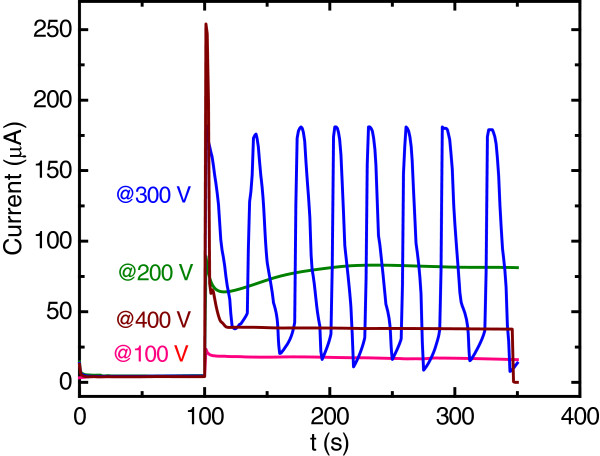
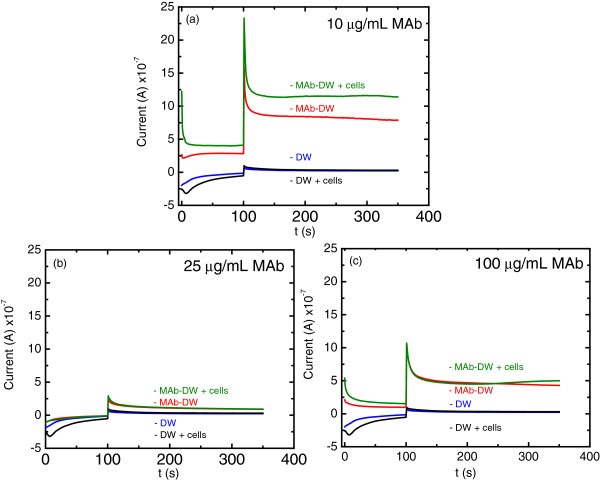
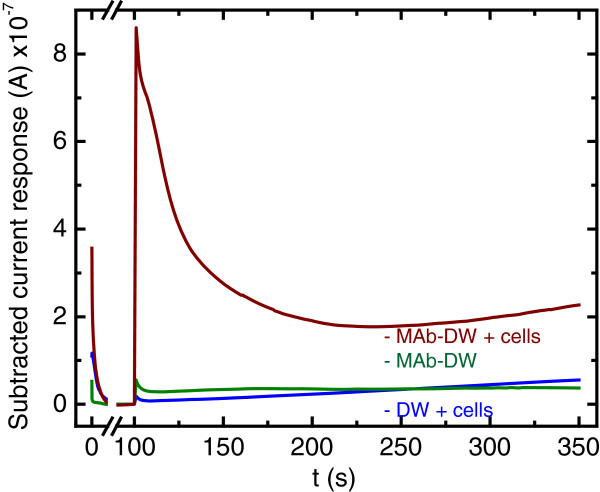
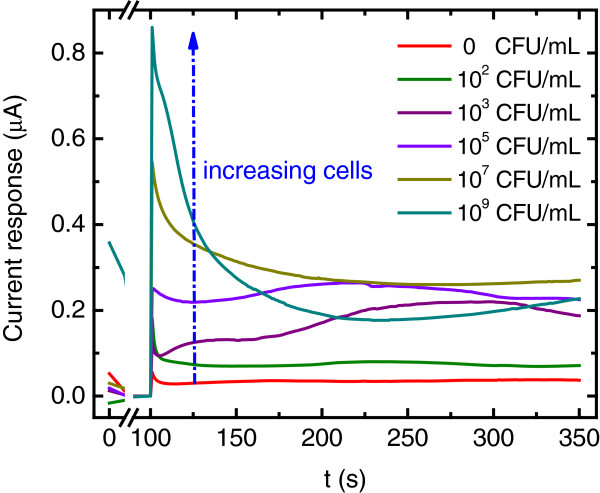
A label-free immunosensor from as-grown double wall carbon nanotubes (DW) bundles was developed for detecting Salmonella typhimurium. The immunosensor was fabricated by using the as-grown DW bundles as an electrode material with an anti-Salmonella impregnated on the surface. The immunosensor was electrochemically characterized by cyclic voltammetry. The working potential (100, 200, 300 and 400 mV vs. Ag/AgCl) and the anti-Salmonella concentration (10, 25, 50, 75, and 100 μg/mL) at the electrode were subsequently optimized. Then, chronoamperometry was used with the optimum potential of 100 mV vs. Ag/AgCl) and the optimum impregnated anti-Salmonella of 10 μg/mL to detect S. typhimurium cells (0-10(9) CFU/mL).
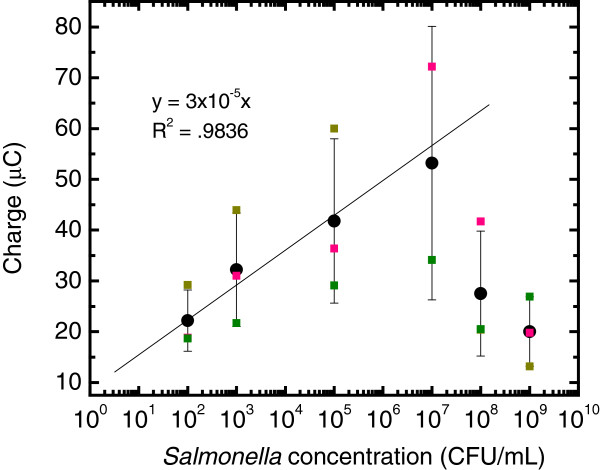
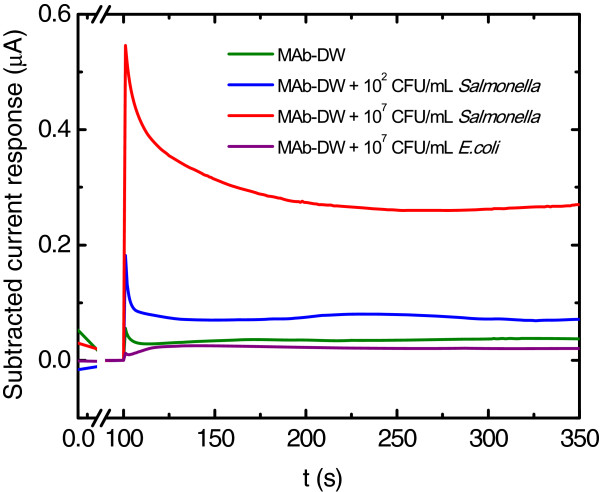
The DW immunosensor exhibited a detection range of 10(2) to 10(7) CFU/mL for the bacteria with a limit of detection of 8.9 CFU/mL according to the IUPAC recommendation. The electrode also showed specificity to S. typhimurium but no current response to Escherichia coli.
These findings suggest that the use of a label-free DW immunosensor is promising for detecting S. typhimurium.
开发了一种基于原位生长的双壁碳纳米管(DW)束的无标记免疫传感器,用于检测鼠伤寒沙门氏菌。该免疫传感器通过使用原位生长的DW束作为电极材料,并在其表面浸渍抗沙门氏菌抗体来制备。通过循环伏安法对该免疫传感器进行电化学表征。随后对电极的工作电位(相对于Ag/AgCl为100、200、300和400 mV)和电极上抗沙门氏菌的浓度(10、25、50、75和100μg/mL)进行了优化。然后,使用计时电流法,在相对于Ag/AgCl为100 mV的最佳电位和10μg/mL的最佳浸渍抗沙门氏菌浓度下,检测鼠伤寒沙门氏菌细胞(0 - 10⁹CFU/mL)。
根据国际纯粹与应用化学联合会(IUPAC)的建议,DW免疫传感器对细菌的检测范围为10²至10⁷CFU/mL,检测限为8.9 CFU/mL。该电极对鼠伤寒沙门氏菌也具有特异性,但对大肠杆菌无电流响应。
这些发现表明,使用无标记的DW免疫传感器检测鼠伤寒沙门氏菌具有广阔前景。