Department of Chemical Science and Technology, University of Rome "Tor Vergata", Via della Ricerca Scientifica 1, 00133 Rome, Italy.
Department of Veterinary Public Health and Food Safety, Istituto Superiore di Sanità, Viale Regina Elena 299, 00161 Rome, Italy.
Sensors (Basel). 2017 Aug 18;17(8):1910. doi: 10.3390/s17081910.
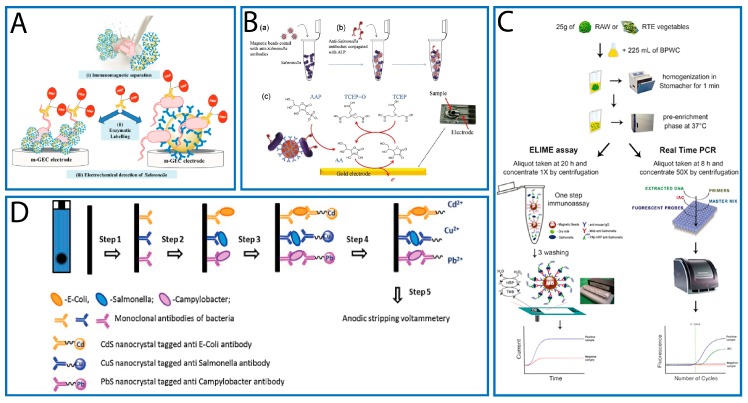
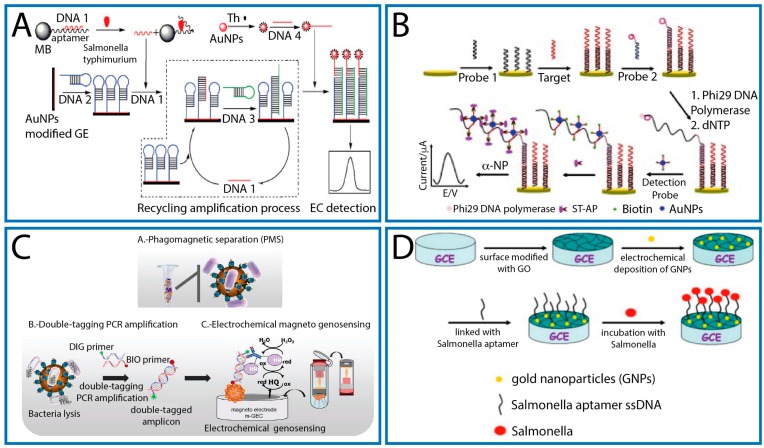
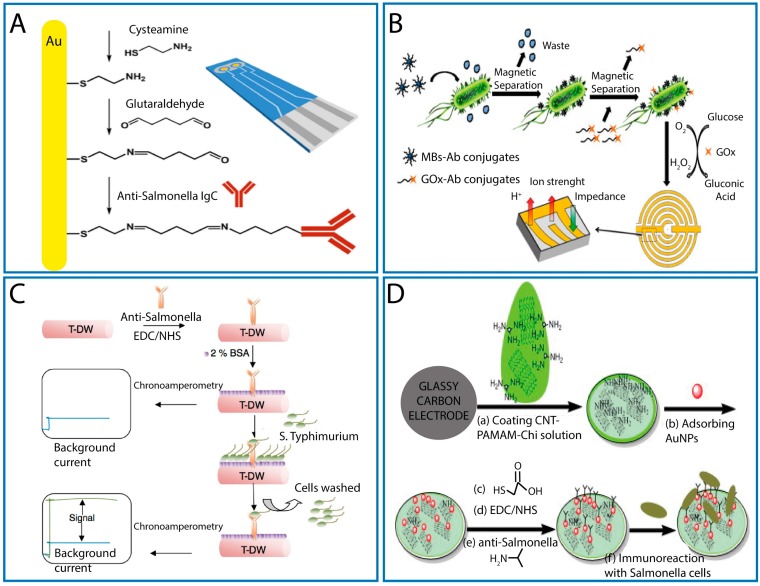
has represented the most common and primary cause of food poisoning in many countries for at least over 100 years. Its detection is still primarily based on traditional microbiological culture methods which are labor-intensive, extremely time consuming, and not suitable for testing a large number of samples. Accordingly, great efforts to develop rapid, sensitive and specific methods, easy to use, and suitable for multi-sample analysis, have been made and continue. Biosensor-based technology has all the potentialities to meet these requirements. In this paper, we review the features of the electrochemical immunosensors, genosensors, aptasensors and phagosensors developed in the last five years for Salmonella detection, focusing on the critical aspects of their application in food analysis.
这种细菌至少在 100 多年来一直是许多国家最常见和主要的食物中毒原因。它的检测仍然主要基于传统的微生物培养方法,这些方法既费时费力,又非常耗时,不适合检测大量样本。因此,人们一直在努力开发快速、灵敏和特异性的方法,这些方法易于使用,适合多样本分析。基于生物传感器的技术具有满足这些要求的所有潜力。在本文中,我们回顾了过去五年中用于沙门氏菌检测的电化学免疫传感器、基因传感器、适体传感器和噬菌传感器的特点,重点介绍了它们在食品分析中的应用的关键方面。