Swamidoss Issac Niwas, Kårsnäs Andreas, Uhlmann Virginie, Ponnusamy Palanisamy, Kampf Caroline, Simonsson Martin, Wählby Carolina, Strand Robin
Department of Electronics and Communication Engineering, National Institute of Technology (NIT), Tiruchirappalli, Tamil Nadu, India ; Centre for Image Analysis (CBA) and SciLife Lab, Uppsala University, Uppsala, Sweden.
J Pathol Inform. 2013 Mar 30;4(Suppl):S14. doi: 10.4103/2153-3539.109881. Print 2013.
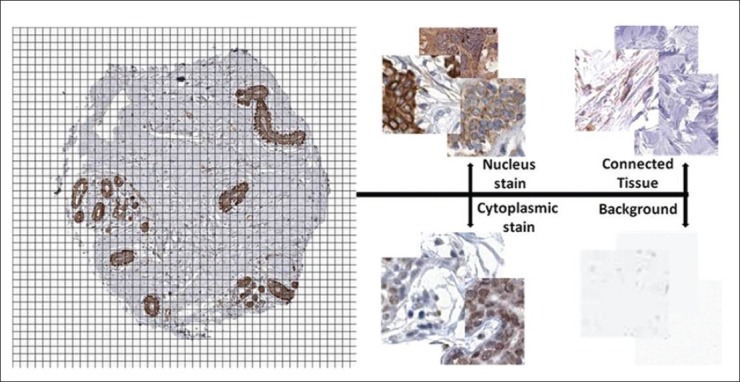
The Human Protein Atlas (HPA) is an effort to map the location of all human proteins (http://www.proteinatlas.org/). It contains a large number of histological images of sections from human tissue. Tissue micro arrays (TMA) are imaged by a slide scanning microscope, and each image represents a thin slice of a tissue core with a dark brown antibody specific stain and a blue counter stain. When generating antibodies for protein profiling of the human proteome, an important step in the quality control is to compare staining patterns of different antibodies directed towards the same protein. This comparison is an ultimate control that the antibody recognizes the right protein. In this paper, we propose and evaluate different approaches for classifying sub-cellular antibody staining patterns in breast tissue samples.
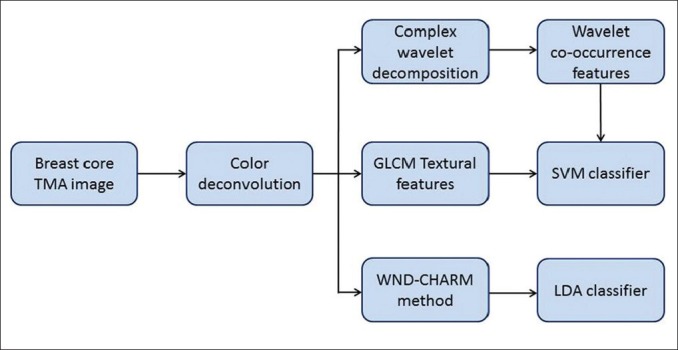
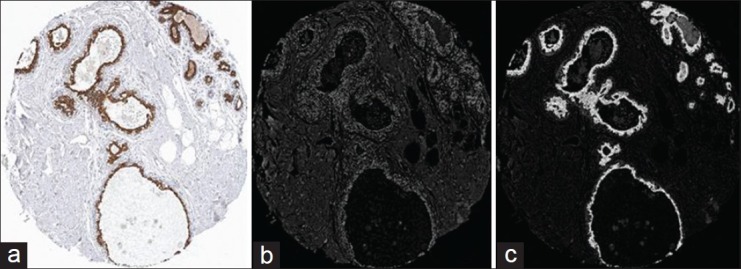
The proposed methods include the computation of various features including gray level co-occurrence matrix (GLCM) features, complex wavelet co-occurrence matrix (CWCM) features, and weighted neighbor distance using compound hierarchy of algorithms representing morphology (WND-CHARM)-inspired features. The extracted features are used into two different multivariate classifiers (support vector machine (SVM) and linear discriminant analysis (LDA) classifier). Before extracting features, we use color deconvolution to separate different tissue components, such as the brownly stained positive regions and the blue cellular regions, in the immuno-stained TMA images of breast tissue.
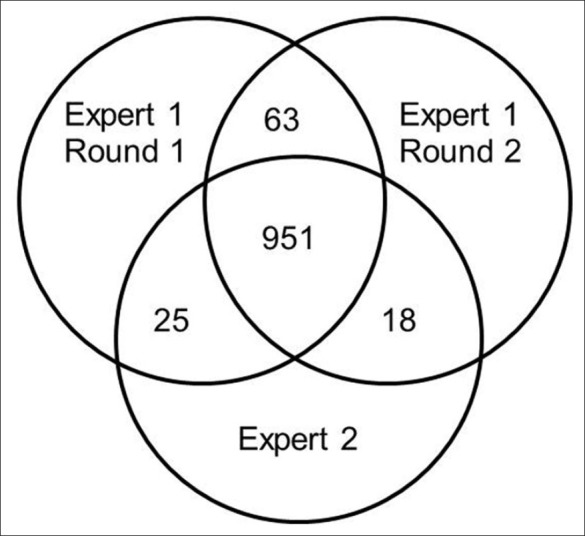
We present classification results based on combinations of feature measurements. The proposed complex wavelet features and the WND-CHARM features have accuracy similar to that of a human expert.
Both human experts and the proposed automated methods have difficulties discriminating between nuclear and cytoplasmic staining patterns. This is to a large extent due to mixed staining of nucleus and cytoplasm. Methods for quantification of staining patterns in histopathology have many applications, ranging from antibody quality control to tumor grading.
人类蛋白质图谱(HPA)致力于绘制所有人类蛋白质的位置(http://www.proteinatlas.org/)。它包含大量人体组织切片的组织学图像。组织微阵列(TMA)通过载玻片扫描显微镜成像,每张图像代表一个组织芯的薄片,带有深棕色抗体特异性染色和蓝色复染。在生成用于人类蛋白质组蛋白质谱分析的抗体时,质量控制中的一个重要步骤是比较针对同一蛋白质的不同抗体的染色模式。这种比较是对抗体识别正确蛋白质的最终控制。在本文中,我们提出并评估了用于对乳腺组织样本中的亚细胞抗体染色模式进行分类的不同方法。
所提出的方法包括计算各种特征,包括灰度共生矩阵(GLCM)特征、复小波共生矩阵(CWCM)特征以及使用表示形态学的算法复合层次结构的加权邻域距离(WND-CHARM)启发的特征。提取的特征被用于两种不同的多变量分类器(支持向量机(SVM)和线性判别分析(LDA)分类器)。在提取特征之前,我们使用颜色反卷积来分离乳腺组织免疫染色TMA图像中的不同组织成分,如棕色染色的阳性区域和蓝色细胞区域。
我们展示了基于特征测量组合的分类结果。所提出的复小波特征和WND-CHARM特征的准确性与人类专家相似。
人类专家和所提出的自动化方法在区分核染色模式和细胞质染色模式方面都存在困难。这在很大程度上是由于细胞核和细胞质的混合染色。组织病理学中染色模式定量方法有许多应用,从抗体质量控制到肿瘤分级。