Fabrizio Cecilia S, Lam Tai Hing, Hirschmann Malia R, Stewart Sunita M
School of Public Health, The University of Hong Kong, 5/F William MW Mong Block, Room 5-05, 21 Sassoon Road, Pokfulam, Hong Kong.
J Child Fam Stud. 2013 Jul;22(5):603-613. doi: 10.1007/s10826-012-9614-0.
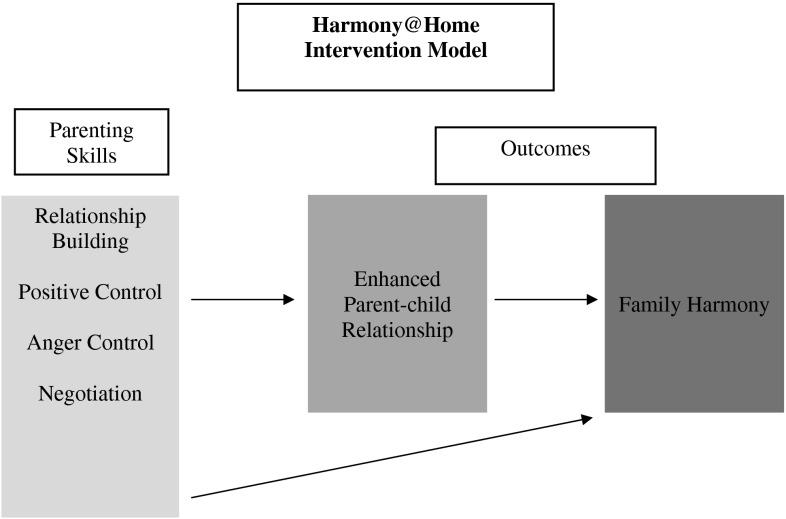
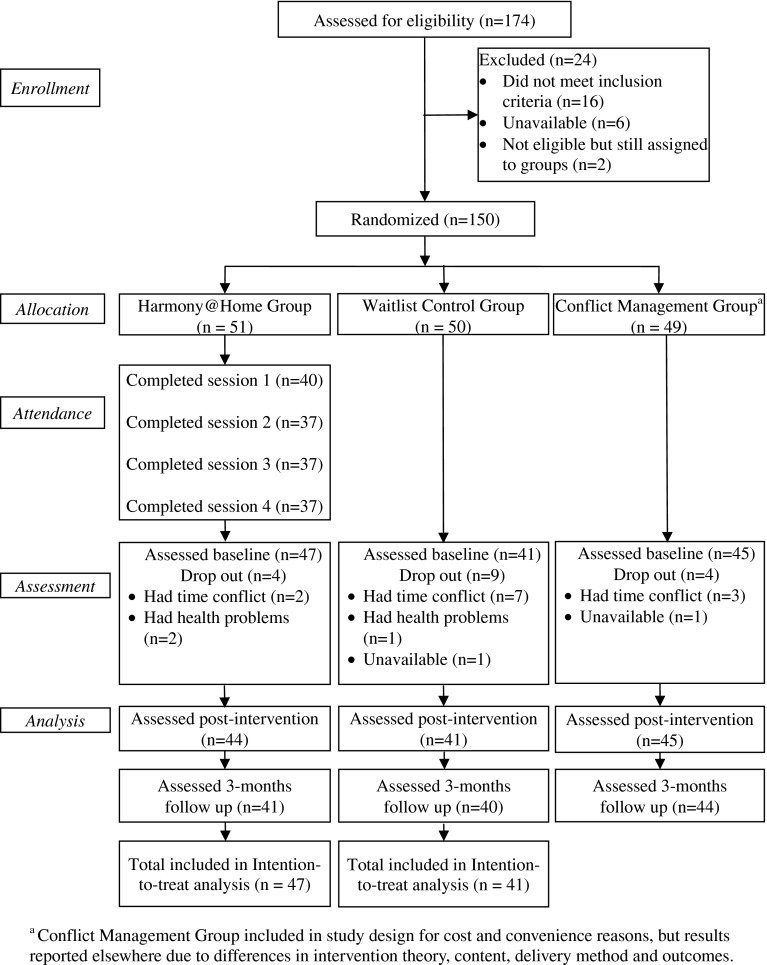
There is a dearth of high-level evidence for brief programs designed to promote positive parent-child relationships in nonwestern cultures. We present a pilot randomized controlled trial of a four-session intervention to enhance the parenting skills that promote a positive relationship with pre-adolescent children in Hong Kong. Our intervention, Harmony@Home, utilized Cunningham's culturally appropriate coping modeling, problem-solving approach to change parental behavior. Our objective was to evaluate the feasibility, acceptability and initial evidence of benefit of the intervention. We blindly randomized 150 Hong Kong parents of children 10-13 years of age to (a) a Harmony@Home intervention group, (b) a waitlist control group, or (c) a third active intervention which shared the control group. Immediately following the intervention, we report increases in satisfaction with the parent-child relationship, one of the targeted parenting behaviors and family harmony, for the Harmony@Home group versus control group. However, only the results from satisfaction with the parent-child relationship were significant at 3-months post intervention. Most respondents reported high levels of program satisfaction. The results provide preliminary evidence that this parenting intervention is culturally acceptable for a nonwestern general population, is feasible for implementation in a community setting and shows evidence of benefit. This intervention is concordant with public health priorities because of the global importance of the parent-child relationship as a protective factor for adolescent outcomes, the need for culturally-appropriate interventions for nonwestern populations, and design characteristics that promote dissemination.
对于旨在促进非西方文化中积极亲子关系的简短项目,缺乏高水平的证据。我们开展了一项初步随机对照试验,采用一个为期四节的干预措施,以提高香港地区与青春期前儿童建立积极关系的育儿技能。我们的干预措施“家庭和谐计划”(Harmony@Home)采用了坎宁安(Cunningham)基于文化适宜性的应对示范和解决问题的方法来改变父母的行为。我们的目标是评估该干预措施的可行性、可接受性以及初步的益处证据。我们将150名10至13岁孩子的香港家长随机分为三组:(a)“家庭和谐计划”干预组;(b)等待名单对照组;(c)与对照组共享的第三种积极干预组。干预结束后,我们报告称,与对照组相比,“家庭和谐计划”组在亲子关系满意度、目标育儿行为之一以及家庭和谐方面均有所提高。然而,仅亲子关系满意度的结果在干预后3个月时具有显著性。大多数受访者表示对该项目满意度较高。结果提供了初步证据,表明这种育儿干预措施在非西方普通人群中具有文化可接受性,在社区环境中实施可行,并显示出有益效果。由于亲子关系作为青少年成长结果的保护因素具有全球重要性、非西方人群需要文化适宜的干预措施以及该干预措施具有促进传播的设计特点,所以该干预措施符合公共卫生优先事项。