Centre for Economic Demography, Lund University, Lund, Sweden.
PLoS One. 2013 Jun 12;8(6):e65611. doi: 10.1371/journal.pone.0065611. Print 2013.
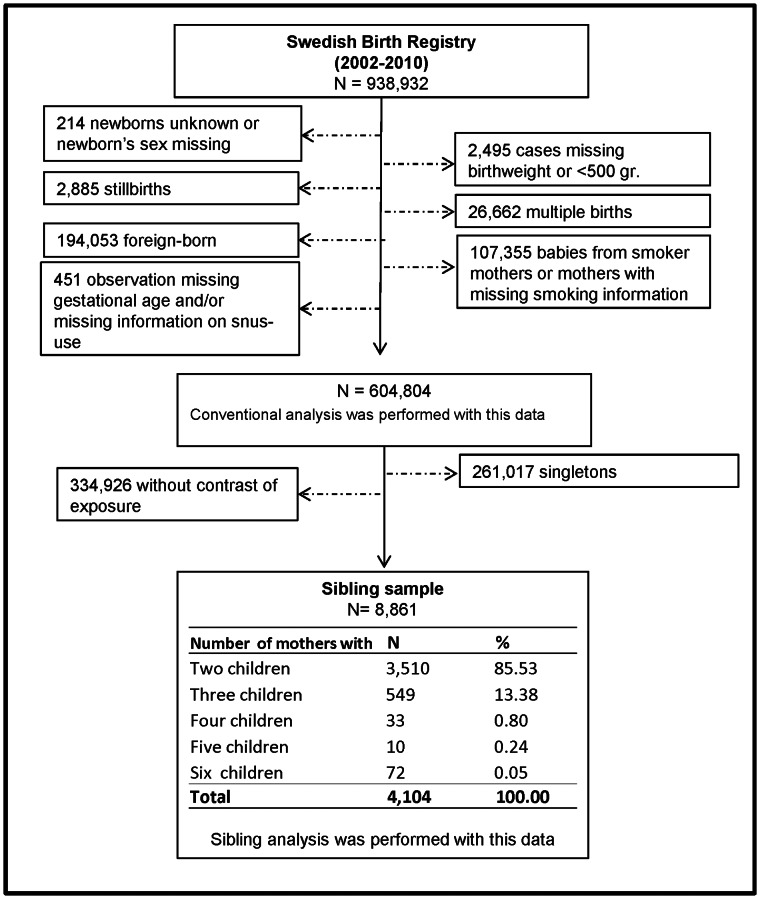
Current observational evidence indicates that maternal smoking during pregnancy is associated with reduced birthweight in offspring. However, less is known about the effect of smokeless tobacco on birthweight and about the possible mechanisms involved in this relationship. This paper studies the effect of Swedish smokeless tobacco (snus) on offspring birthweight comparing the results obtained from a conventional linear regression analysis and from a quasi-experimental sibling design using a multilevel linear regression analysis. From the Swedish Medical Birth Register, we investigated 604,804 singletons born between 2002 and 2010. From them, we isolated 8,861 siblings from 4,104 mothers with discrepant snus-use habits (i.e., women who had at least one pregnancy during which they used snus and at least one other pregnancy in which they did not). The conventional analysis shows that continuous snus use throughout the pregnancy reduces birthweight in 47 g while quitting or relapsing snus has a minor and statistically non-significant effect (-6 g and -4 g, respectively). However, using a sibling analysis the effect observed for mothers who continue to use snus during pregnancy is less intense than that observed with previous conventional analyses (-20 g), and this effect is not statistically significant. Sibling analysis shows that quitting or relapsing snus use after the first trimester slightly reduces birthweight (14 g). However, this small change is not statistically significant. The sibling analysis provides strong causal evidence indicating that exposure to snus during pregnancy has a minor effect on birthweight reduction. Our findings provide a new piece of causal evidence concerning the effect of tobacco on birthweight and support the hypothesis that the harmful effect of smoking on birthweight is not mainly due to nicotine.
目前的观察证据表明,孕妇吸烟与后代出生体重降低有关。然而,关于无烟烟草对出生体重的影响以及这种关系中涉及的可能机制知之甚少。本文通过传统线性回归分析和使用多层次线性回归分析的准实验兄弟姐妹设计,比较了瑞典无烟烟草(鼻烟)对后代出生体重的影响。我们从瑞典医学出生登记处调查了 2002 年至 2010 年间出生的 604804 名单胎。从他们中,我们从 4104 名母亲中分离出 8861 对有差异的鼻烟使用习惯的兄弟姐妹(即至少有一次怀孕期间使用过鼻烟,至少有一次怀孕期间未使用过鼻烟的母亲)。常规分析表明,整个怀孕期间持续使用鼻烟会使出生体重降低 47 克,而戒烟或复吸鼻烟的影响较小且无统计学意义(分别为-6 克和-4 克)。然而,使用兄弟姐妹分析,在怀孕期间继续使用鼻烟的母亲观察到的效果不如以前的常规分析观察到的效果强烈(-20 克),并且该效果没有统计学意义。兄弟姐妹分析表明,在孕早期后戒烟或复吸鼻烟会略微降低出生体重(14 克)。然而,这种微小的变化没有统计学意义。兄弟姐妹分析提供了有力的因果证据,表明怀孕期间接触鼻烟会对出生体重降低产生轻微影响。我们的研究结果提供了关于烟草对出生体重影响的新的因果证据,并支持了这样的假设,即吸烟对出生体重的有害影响并非主要归因于尼古丁。