Environmental Risk and Health, Flemish Institute for Technological Research (VITO), Mol, Belgium.
Environ Health Perspect. 2013 Sep;121(9):1011-6. doi: 10.1289/ehp.1205721. Epub 2013 Jun 18.
Microcirculation plays an important role in the physiology of cardiovascular health. Air pollution is an independent risk factor for the development and progression of cardiovascular diseases, but the number of studies on the relation between air pollution and the microcirculation is limited.
We examined the relationship between short-term changes in air pollution and microvascular changes.
We measured retinal microvasculature using fundus image analysis in a panel of 84 healthy adults (52% female), 22-63 years of age, during January-May 2012. Blood vessels were measured as central retinal arteriolar/venular equivalent (CRAE/CRVE), with a median of 2 measurements (range, 1-3). We used monitoring data on particulate air pollution (PM10) and black carbon (BC). Mixed-effect models were used to estimate associations between CRAE/CRVE and exposure to PM10 and BC using various exposure windows.
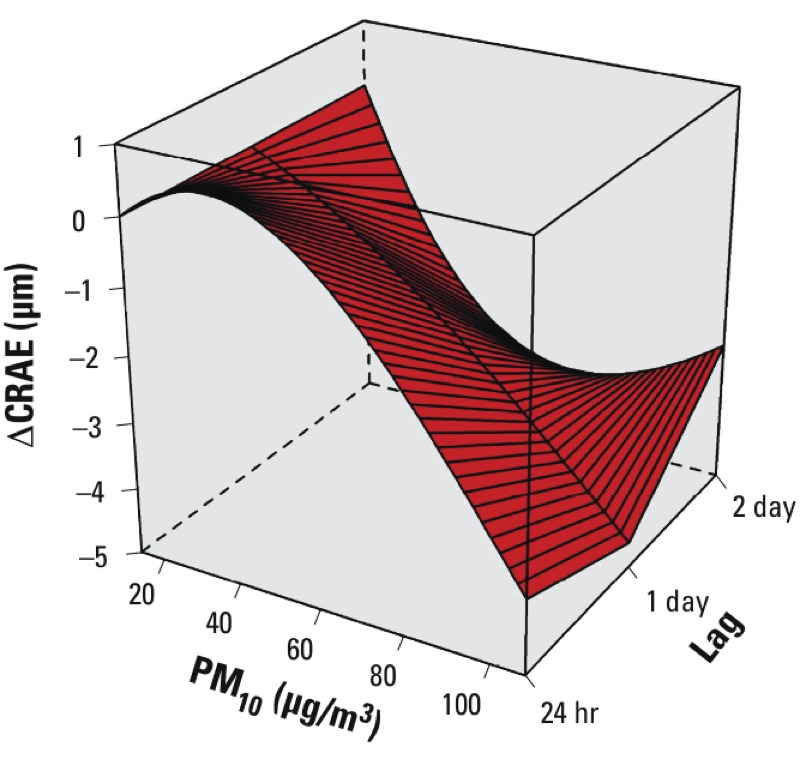
CRAE and CRVE were associated with PM10 and BC concentrations, averaged over the 24 hr before the retinal examinations. Each 10-µg/m3 increase in PM10 was associated with a 0.93-µm decrease (95% CI: -1.42, -0.45; p = 0.0003) in CRAE and a 0.86-µm decrease (95% CI: -1.42, -0.30; p = 0.004) in CRVE after adjusting for individual characteristics and time varying conditions such as ambient temperature. Each 1-µg/m3 increase in BC was associated with a 1.84-µm decrease (95% CI: -3.18, -0.51; p < 0.001) in CRAE.
Our findings suggest that the retinal microvasculature responds to short-term changes in air pollution levels. These results support a mechanistic pathway through which air pollution can act as a trigger of cardiovascular events at least in part through effects on the microvasculature.
微循环在心血管健康生理中起着重要作用。空气污染是心血管疾病发展和进展的独立危险因素,但关于空气污染与微循环之间关系的研究数量有限。
我们研究了短期空气污染变化与微血管变化之间的关系。
我们在 2012 年 1 月至 5 月期间使用眼底图像分析对 84 名健康成年人(52%为女性)的视网膜微血管进行了测量,这些成年人年龄在 22 岁至 63 岁之间。血管被测量为中央视网膜动静脉等效(CRAE/CRVE),中位数为 2 次测量(范围为 1-3)。我们使用了颗粒物空气污染(PM10)和黑碳(BC)的监测数据。使用各种暴露窗口,混合效应模型来估计 CRAE/CRVE 与 PM10 和 BC 暴露之间的关联。
CRAE 和 CRVE 与视网膜检查前 24 小时内 PM10 和 BC 浓度平均值相关。PM10 每增加 10μg/m3,CRAE 降低 0.93μm(95%CI:-1.42,-0.45;p=0.0003),CRVE 降低 0.86μm(95%CI:-1.42,-0.30;p=0.004),调整个体特征和环境温度等时变条件后。BC 每增加 1μg/m3,CRAE 降低 1.84μm(95%CI:-3.18,-0.51;p<0.001)。
我们的研究结果表明,视网膜微血管对空气污染水平的短期变化有反应。这些结果支持了一种机制途径,即空气污染可以通过对微血管的影响至少部分作为心血管事件的触发因素。