Department of Epidemiology, University of Washington, Seattle, Washington, United States of America.
PLoS Med. 2010 Nov 30;7(11):e1000372. doi: 10.1371/journal.pmed.1000372.
Long- and short-term exposures to air pollution, especially fine particulate matter (PM(2.5)), have been linked to cardiovascular morbidity and mortality. One hypothesized mechanism for these associations involves microvascular effects. Retinal photography provides a novel, in vivo approach to examine the association of air pollution with changes in the human microvasculature.
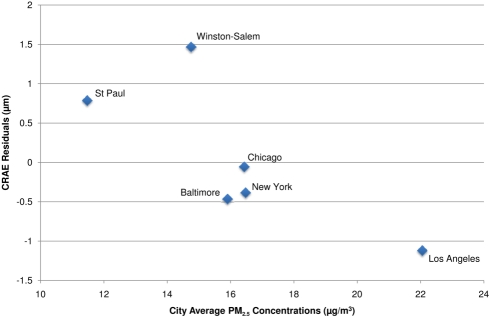
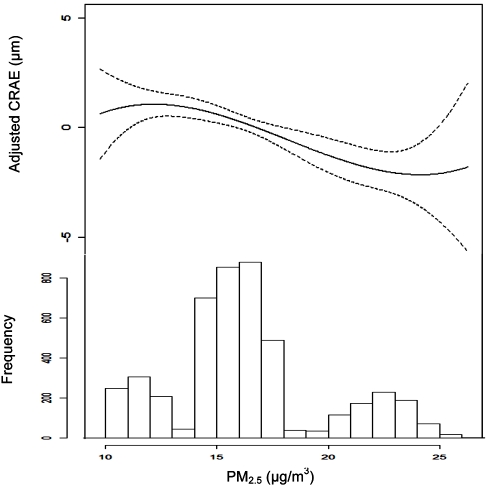
Chronic and acute associations between residential air pollution concentrations and retinal vessel diameters, expressed as central retinal arteriolar equivalents (CRAE) and central retinal venular equivalents (CRVE), were examined using digital retinal images taken in Multi-Ethnic Study of Atherosclerosis (MESA) participants between 2002 and 2003. Study participants (46 to 87 years of age) were without clinical cardiovascular disease at the baseline examination (2000-2002). Long-term outdoor concentrations of PM(2.5) were estimated at each participant's home for the 2 years preceding the clinical exam using a spatio-temporal model. Short-term concentrations were assigned using outdoor measurements on the day preceding the clinical exam. Residential proximity to roadways was also used as an indicator of long-term traffic exposures. All associations were examined using linear regression models adjusted for subject-specific age, sex, race/ethnicity, education, income, smoking status, alcohol use, physical activity, body mass index, family history of cardiovascular disease, diabetes status, serum cholesterol, glucose, blood pressure, emphysema, C-reactive protein, medication use, and fellow vessel diameter. Short-term associations were further controlled for weather and seasonality. Among the 4,607 participants with complete data, CRAE were found to be narrower among persons residing in regions with increased long- and short-term levels of PM(2.5). These relationships were observed in a joint exposure model with -0.8 µm (95% confidence interval [CI] -1.1 to -0.5) and -0.4 µm (95% CI -0.8 to 0.1) decreases in CRAE per interquartile increases in long- (3 µg/m(3)) and short-term (9 µg/m(3)) PM(2.5) levels, respectively. These reductions in CRAE are equivalent to 7- and 3-year increases in age in the same cohort. Similarly, living near a major road was also associated with a -0.7 µm decrease (95% CI -1.4 to 0.1) in CRAE. Although the chronic association with CRAE was largely influenced by differences in exposure between cities, this relationship was generally robust to control for city-level covariates and no significant differences were observed between cities. Wider CRVE were associated with living in areas of higher PM(2.5) concentrations, but these findings were less robust and not supported by the presence of consistent acute associations with PM(2.5).
Residing in regions with higher air pollution concentrations and experiencing daily increases in air pollution were each associated with narrower retinal arteriolar diameters in older individuals. These findings support the hypothesis that important vascular phenomena are associated with small increases in short-term or long-term air pollution exposures, even at current exposure levels, and further corroborate reported associations between air pollution and the development and exacerbation of clinical cardiovascular disease. Please see later in the article for the Editors' Summary.
长期和短期接触空气污染,特别是细颗粒物(PM(2.5)),与心血管发病率和死亡率有关。这些关联的一个假设机制涉及微血管效应。视网膜摄影术为研究空气污染与人体微血管变化之间的关系提供了一种新颖的、体内的方法。
使用 2002 年至 2003 年期间在动脉粥样硬化多民族研究(MESA)参与者中拍摄的数字视网膜图像,检查了住宅空气污染浓度与视网膜血管直径(表示为中央视网膜小动脉当量(CRAE)和中央视网膜小静脉当量(CRVE))之间的慢性和急性关联。研究参与者(年龄在 46 至 87 岁之间)在基线检查(2000-2002 年)时没有临床心血管疾病。使用时空模型估算了每位参与者在临床检查前 2 年内家中的 PM(2.5)的长期户外浓度。短期浓度使用临床检查前一天的户外测量值分配。靠近道路的居住位置也被用作长期交通暴露的指标。所有关联均使用线性回归模型进行检查,该模型调整了特定于主体的年龄、性别、种族/民族、教育、收入、吸烟状况、饮酒、身体活动、体重指数、心血管疾病家族史、糖尿病状况、血清胆固醇、葡萄糖、血压、肺气肿、C 反应蛋白、药物使用情况和同血管直径。短期关联进一步控制了天气和季节性因素。在具有完整数据的 4607 名参与者中,发现居住在 PM(2.5)长期和短期水平升高的地区的人 CRAE 较窄。在联合暴露模型中观察到这些关系,CRAE 每增加一个四分位距(3µg/m(3))和短期(9µg/m(3))PM(2.5)水平分别减少 0.8 µm(95%置信区间[CI] -1.1 至 -0.5)和 0.4 µm(95%CI -0.8 至 0.1)。这些 CRAE 的减少相当于同一队列中 7 至 3 年的年龄增长。同样,居住在主要道路附近也与 CRAE 减少 0.7 µm(95%CI -1.4 至 0.1)有关。虽然与 CRAE 的慢性关联主要受城市之间暴露差异的影响,但这种关系在很大程度上仍然受到城市水平协变量的控制,并且在城市之间没有观察到显著差异。较宽的 CRVE 与较高 PM(2.5)浓度区域的居住有关,但这些发现不太可靠,并且没有得到 PM(2.5)与短期或长期暴露一致的急性关联的支持。
居住在空气污染浓度较高的地区和每日空气污染增加都与老年人视网膜小动脉直径变窄有关。这些发现支持了这样一个假设,即重要的血管现象与短期或长期空气污染暴露的微小增加有关,即使在当前的暴露水平下也是如此,并进一步证实了先前报道的空气污染与临床心血管疾病的发展和恶化之间的关联。请稍后在文章中查看编辑摘要。