Centre for Environmental Sciences, Hasselt University, Diepenbeek, Belgium.
Unité de Recherche en Biologie Cellulaire (URBC) - Namur Research Institute for Life Sciences (Narilis), Namur University, Namur, Belgium.
BMC Med. 2020 May 26;18(1):128. doi: 10.1186/s12916-020-01586-x.
Particulate matter exposure during in utero life may entail adverse health outcomes later in life. The microvasculature undergoes extensive, organ-specific prenatal maturation. A growing body of evidence shows that cardiovascular disease in adulthood is rooted in a dysfunctional fetal and perinatal development, in particular that of the microcirculation. We investigate whether prenatal or postnatal exposure to PM (particulate matter with a diameter ≤ 2.5 μm) or NO is related to microvascular traits in children between the age of four and six.
We measured the retinal microvascular diameters, the central retinal arteriolar equivalent (CRAE) and central retinal venular equivalent (CRVE), and the vessel curvature by means of the tortuosity index (TI) in young children (mean [SD] age 4.6 [0.4] years), followed longitudinally within the ENVIRONAGE birth cohort. We modeled daily prenatal and postnatal PM and NO exposure levels for each participant's home address using a high-resolution spatiotemporal model.
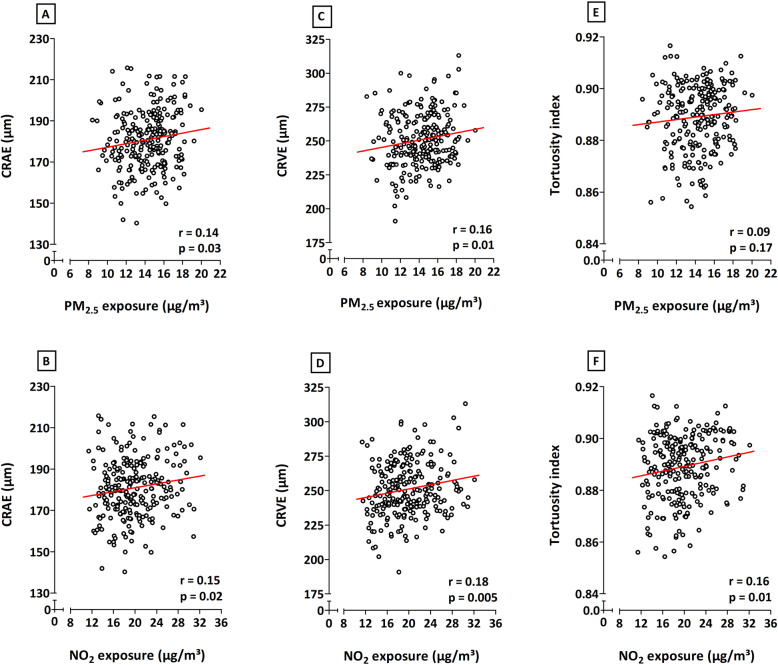
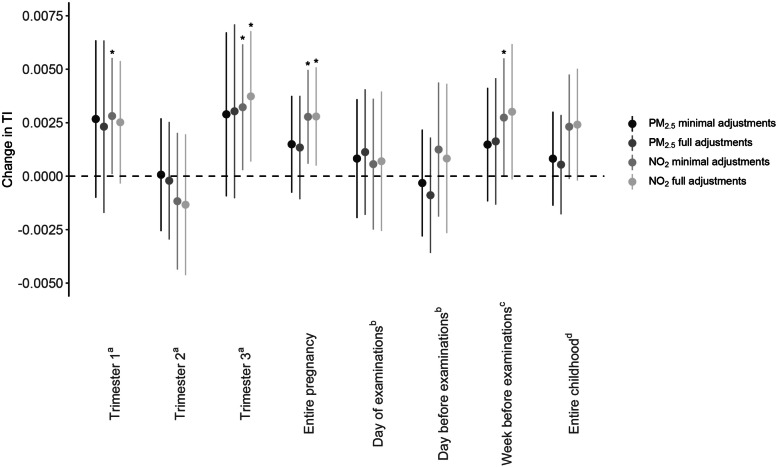
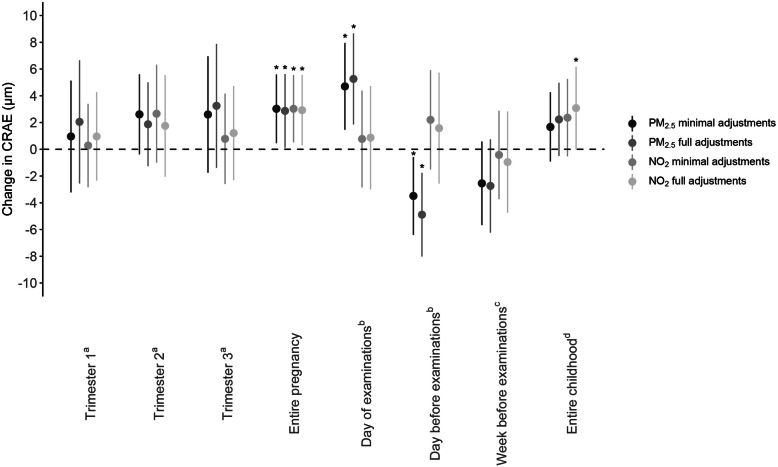
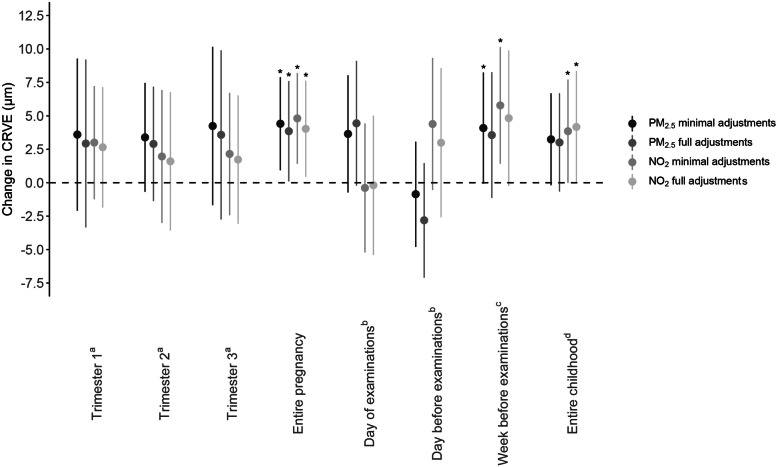
An interquartile range (IQR) increase in PM exposure during the entire pregnancy was associated with a 3.85-μm (95% CI, 0.10 to 7.60; p = 0.04) widening of the CRVE and a 2.87-μm (95% CI, 0.12 to 5.62; p = 0.04) widening of the CRAE. For prenatal NO exposure, an IQR increase was found to widen the CRVE with 4.03 μm (95% CI, 0.44 to 7.63; p = 0.03) and the CRAE with 2.92 μm (95% CI, 0.29 to 5.56; p = 0.03). Furthermore, a higher TI score was associated with higher prenatal NO exposure. We observed a postnatal effect of short-term PM exposure on the CRAE and a childhood NO exposure effect on both the CRVE and CRAE.
Our results link prenatal and postnatal air pollution exposure with changes in a child's microvascular traits as a fundamental novel mechanism to explain the developmental origin of cardiovascular disease.
胎儿期暴露于颗粒物(PM)可能会导致日后的健康问题。微血管在器官特异性方面经历广泛的产前成熟。越来越多的证据表明,成年人心血管疾病的根源在于胎儿期和围产期的发育功能障碍,尤其是微血管的发育。我们研究了儿童在 4 至 6 岁期间,产前或产后 PM(直径≤2.5μm 的颗粒物)或 NO 暴露是否与微血管特征有关。
我们对年轻人的视网膜微血管直径、视网膜中央动脉等效直径(CRAE)和视网膜中央静脉等效直径(CRVE)以及通过迂曲指数(TI)测量的血管弯曲度进行了测量,这些年轻人的平均(标准差)年龄为 4.6(0.4)岁,并在 ENVIRONAGE 出生队列中进行了纵向随访。我们使用高分辨率时空模型,针对每个参与者的家庭住址,建立了孕期和产后每日 PM 和 NO 暴露水平的模型。
妊娠期间 PM 暴露的四分位距(IQR)增加与 CRVE 增宽 3.85μm(95%置信区间,0.10 至 7.60;p=0.04)和 CRAE 增宽 2.87μm(95%置信区间,0.12 至 5.62;p=0.04)相关。对于产前 NO 暴露,IQR 增加与 CRVE 增宽 4.03μm(95%置信区间,0.44 至 7.63;p=0.03)和 CRAE 增宽 2.92μm(95%置信区间,0.29 至 5.56;p=0.03)相关。此外,较高的 TI 评分与较高的产前 NO 暴露有关。我们观察到短期 PM 暴露对 CRAE 的产后影响,以及儿童期 NO 暴露对 CRVE 和 CRAE 的影响。
我们的研究结果将产前和产后空气污染暴露与儿童微血管特征的变化联系起来,这是解释心血管疾病发育起源的一种新的基本机制。