Division of Diabetes Translation, National Center for Chronic Disease Prevention and Health Promotion, CDC, Atlanta, Georgia.
Division of Epidemiology and Clinical Applications, National Eye Institute, NIH, Bethesda.
Am J Prev Med. 2013 Jul;45(1):29-35. doi: 10.1016/j.amepre.2013.02.018.
Visual impairment is a common health-related disability in the U.S. The association between clinical measurements of age-related eye diseases and visual impairment in data from a national survey has not been reported.
To examine common eye conditions and other correlates associated with visual impairment in the U.S.
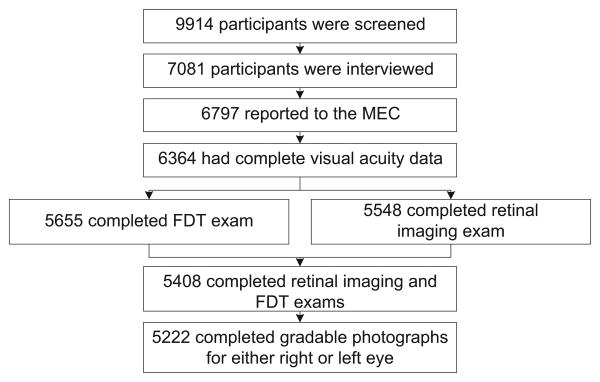
Data from the 2005-2008 National Health and Nutrition Examination Survey of 5222 Americans aged ≥40 years were analyzed in 2012 for visual impairment (presenting distance visual acuity worse than 20/40 in the better-seeing eye), and visual impairment not due to refractive error (distance visual acuity worse than 20/40 after refraction). Diabetic retinopathy (DR) and age-related macular degeneration (AMD) were assessed from retinal fundus images; glaucoma was assessed from two successive frequency-doubling tests and a cup-to-disc ratio measurement.
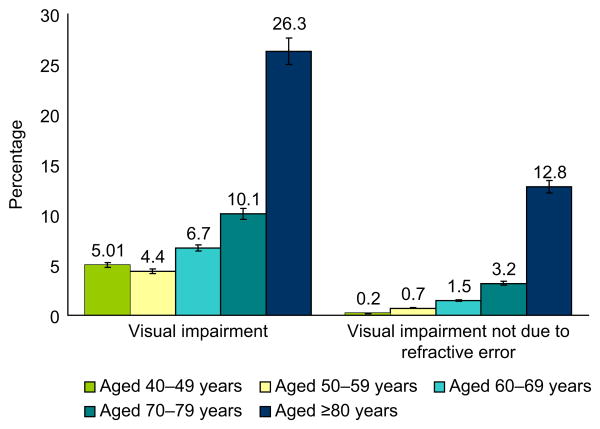
Prevalence of visual impairment and of visual impairment not due to refractive error was 7.5% (95% CI=6.9%, 8.1%) and 2.0% (1.7%, 2.3%), respectively. The prevalence of visual impairment not due to refractive error was significantly higher among people with AMD (2.2%) compared to those without AMD (0.8%), or with DR (3.5%) compared to those without DR (1.2%). Independent predictive factors of visual impairment not due to refractive error were AMD (OR=4.52, 95% CI=2.50, 8.17); increasing age (OR=1.09 per year, 95% CI=1.06, 1.13); and less than a high school education (OR=2.99, 95% CI=1.18, 7.55).
Visual impairment is a public health problem in the U.S. Visual impairment in two thirds of adults could be eliminated with refractive correction. Screening of the older population may identify adults at increased risk of visual impairment due to eye diseases.
视力障碍是美国常见的与健康相关的残疾。在全国性调查数据中,与年龄相关性眼病的临床测量结果相关的视力障碍的关联性尚未报道。
检查美国常见的眼部疾病和其他与视力障碍相关的因素。
对 2012 年分析的 2005-2008 年全国健康和营养调查中 5222 名年龄≥40 岁的美国人的数据,这些数据与视力障碍(最佳视力眼的表现距离视力低于 20/40)和因屈光不正以外的原因导致的视力障碍(矫正后距离视力低于 20/40)有关。糖尿病视网膜病变(DR)和年龄相关性黄斑变性(AMD)通过眼底图像进行评估;青光眼通过两次频率倍增测试和杯盘比测量进行评估。
视力障碍和因屈光不正以外的原因导致的视力障碍的患病率分别为 7.5%(95%置信区间=6.9%,8.1%)和 2.0%(1.7%,2.3%)。与没有 AMD 的人(0.8%)相比,AMD(2.2%)患者因屈光不正以外的原因导致的视力障碍患病率显著更高;与没有 DR 的人(1.2%)相比,DR(3.5%)患者因屈光不正以外的原因导致的视力障碍患病率显著更高。因屈光不正以外的原因导致的视力障碍的独立预测因素为 AMD(OR=4.52,95%置信区间=2.50,8.17);年龄增长(每年增加 1.09,95%置信区间=1.06,1.13);以及未完成高中学业(OR=2.99,95%置信区间=1.18,7.55)。
视力障碍是美国的一个公共卫生问题。通过屈光矫正,三分之二的成年人的视力障碍可以消除。对老年人进行筛查可能会发现因眼部疾病而视力障碍风险增加的成年人。