Department of Neurology, Academic Medical Centre, Amsterdam, The Netherlands.
BMJ Open. 2013 Jun 20;3(6):e002541. doi: 10.1136/bmjopen-2012-002541.
To assess the incremental value of MRI and cerebrospinal fluid (CSF) analysis after a short memory test for predicting progression to Alzheimer's disease from a pragmatic clinical perspective.
Diagnostic accuracy study in a multicentre prospective cohort study.
Alzheimer Disease Neuroimaging Initiative participants with complete data on neuropsychological assessment, MRI of the brain and CSF analysis.
Patients with mild cognitive impairment (MCI; n=181) were included. Mean follow-up was 38.9 months (range 5.5-75.9).
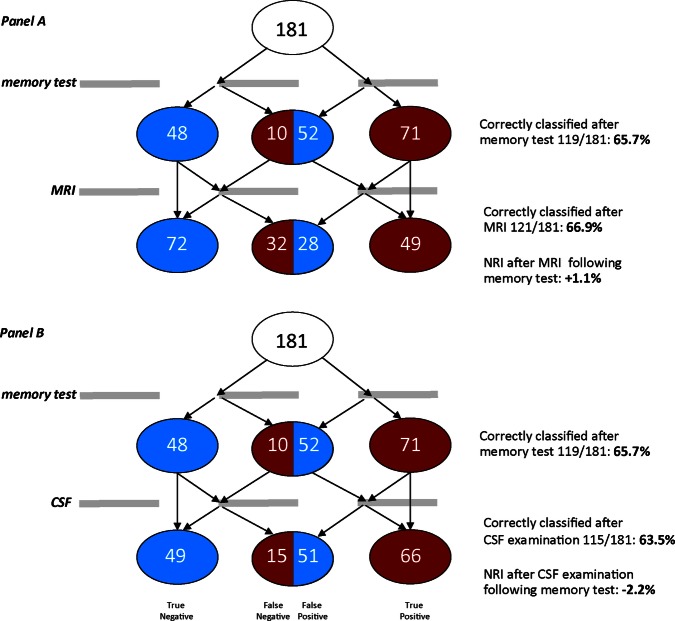
Diagnostic accuracy of individual instruments and incremental value of entorhinal cortex volume on MRI and p-τ/Aβ ration in CSF after administration of Rey's Auditory Verbal Learning Memory Test are calculated and expressed as the 'Net Reclassification Improvement' (NRI), which is the change in the percentage of individuals that are correctly diagnosed as Alzheimer or non-Alzheimer case.
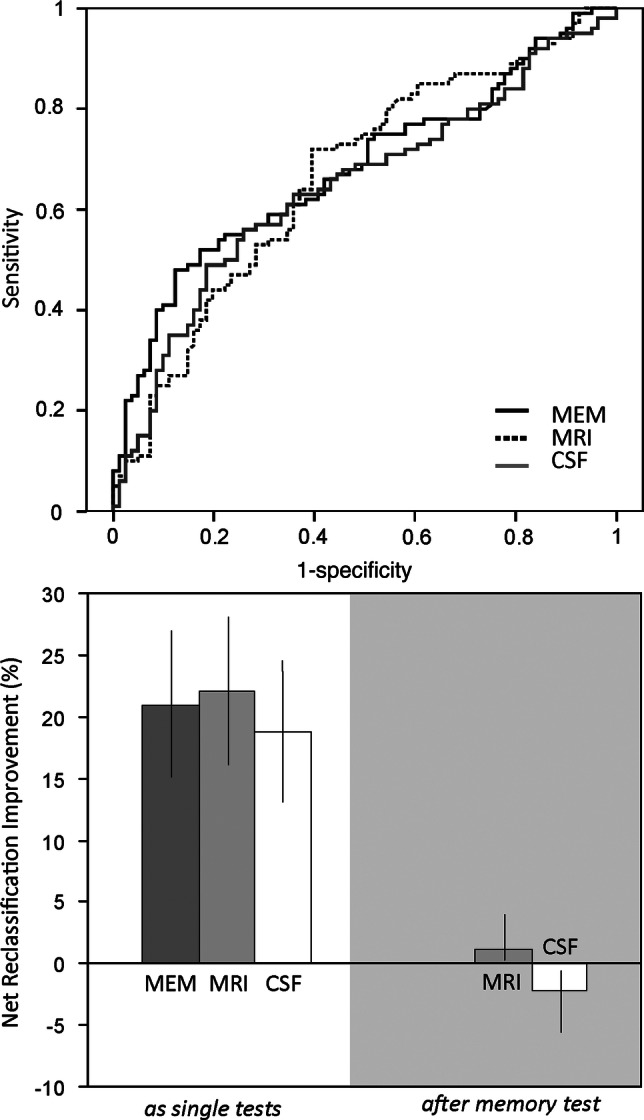
Tested in isolation, a short memory test, MRI and CSF all substantially contribute to the differentiation of those MCI patients who remain stable during follow-up from those who progress to develop Alzheimer's disease. The memory test, MRI and CSF improved the diagnostic classification by 21% (95% CI 15.1 to 26.9), 22.1% (95% CI 16.1 to 28.1) and 18.8% (95% CI 13.1 to 24.5), respectively. After administration of a short memory test, however, the NRI of MRI is +1.1% (95% CI 0.1 to 3.9) and of CSF is -2.2% (95% CI -5.6 to -0.6).
After administration of a brief test of memory, MRI or CSF do not substantially affect diagnostic accuracy for predicting progression to Alzheimer's disease in patients with MCI. The NRI is an intuitive and easy to interpret measure for evaluation of potential added value of new diagnostic instruments in daily clinical practice.
从实用临床角度评估磁共振成像(MRI)和脑脊液(CSF)分析在短期记忆测试后的附加价值,以预测向阿尔茨海默病的进展。
多中心前瞻性队列研究中的诊断准确性研究。
具有完整神经心理学评估、大脑 MRI 和 CSF 分析数据的阿尔茨海默病神经影像学倡议参与者。
纳入了轻度认知障碍(MCI)患者(n=181)。平均随访时间为 38.9 个月(范围为 5.5-75.9)。
计算单独使用仪器的诊断准确性,并在进行 Rey 听觉言语学习记忆测试后,计算 MRI 上的内嗅皮层体积和 CSF 中的 p-τ/Aβ 比率的增量价值,并表示为“净重新分类改善”(NRI),这是正确诊断为阿尔茨海默病或非阿尔茨海默病病例的个体百分比的变化。
单独测试时,短期记忆测试、MRI 和 CSF 都极大地有助于区分那些在随访期间保持稳定的 MCI 患者和那些进展为阿尔茨海默病的患者。记忆测试、MRI 和 CSF 将诊断分类分别提高了 21%(95%CI 15.1 至 26.9)、22.1%(95%CI 16.1 至 28.1)和 18.8%(95%CI 13.1 至 24.5)。然而,在进行短期记忆测试后,MRI 的 NRI 为+1.1%(95%CI 0.1 至 3.9),CSF 的 NRI 为-2.2%(95%CI -5.6 至 -0.6)。
在进行简短的记忆测试后,MRI 或 CSF 不会显著影响预测 MCI 患者向阿尔茨海默病进展的诊断准确性。NRI 是一种直观且易于解释的指标,可用于评估新诊断仪器在日常临床实践中的潜在附加价值。