Zhou Ping, Zeng Rong, Yu Lun, Feng Yabo, Chen Chuxin, Li Fang, Liu Yang, Huang Yanhui, Huang Zhongxiong
Department of PET-CT Center, Chenzhou No.1 People's Hospital, Chenzhou, China.
Front Aging Neurosci. 2021 Oct 26;13:764872. doi: 10.3389/fnagi.2021.764872. eCollection 2021.
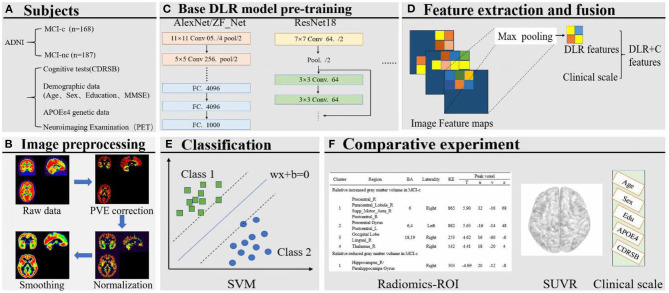
Alzheimer's disease (AD) is the most prevalent neurodegenerative disorder and the most common form of dementia in the older people. Some types of mild cognitive impairment (MCI) are the clinical precursors of AD, while other MCI forms tend to remain stable over time and do not progress to AD. To discriminate MCI patients at risk of AD from stable MCI, we propose a novel deep-learning radiomics (DLR) model based on F-fluorodeoxyglucose positron emission tomography (F-FDG PET) images and combine DLR features with clinical parameters (DLR+C) to improve diagnostic performance. F-fluorodeoxyglucose positron emission tomography (PET) data from the Alzheimer's disease Neuroimaging Initiative database (ADNI) were collected, including 168 patients with MCI who converted to AD within 3 years and 187 patients with MCI without conversion within 3 years. These subjects were randomly partitioned into 90 % for the training/validation group and 10 % for the independent test group. The proposed DLR approach consists of three steps: base DL model pre-training, network features extraction, and integration of DLR+C, where a convolution network serves as a feature encoder, and a support vector machine (SVM) operated as the classifier. In comparative experiments, we compared our DLR+C method with four other methods: the standard uptake value ratio (SUVR) method, Radiomics-ROI method, Clinical method, and SUVR + Clinical method. To guarantee the robustness, 10-fold cross-validation was processed 100 times. Under the DLR model, our proposed DLR+C was advantageous and yielded the best classification performance in the diagnosis of conversion with the accuracy, sensitivity, and specificity of 90.62 ± 1.16, 87.50 ± 0.00, and 93.39 ± 2.19%, respectively. In contrast, the respective accuracy of the other four methods reached 68.38 ± 1.27, 73.31 ± 6.93, 81.09 ± 1.97, and 85.35 ± 0.72 %. These results suggested the DLR approach could be used successfully in the prediction of conversion to AD, and that our proposed DLR-combined clinical information was effective. This study showed DLR+C could provide a novel and valuable method for the computer-assisted diagnosis of conversion to AD from MCI. This DLR+C method provided a quantitative biomarker which could predict conversion to AD in MCI patients.
阿尔茨海默病(AD)是最常见的神经退行性疾病,也是老年人中最常见的痴呆形式。某些类型的轻度认知障碍(MCI)是AD的临床前驱症状,而其他MCI形式往往随时间保持稳定,不会进展为AD。为了区分有AD风险的MCI患者和稳定的MCI患者,我们提出了一种基于F-氟脱氧葡萄糖正电子发射断层扫描(F-FDG PET)图像的新型深度学习放射组学(DLR)模型,并将DLR特征与临床参数(DLR+C)相结合,以提高诊断性能。收集了来自阿尔茨海默病神经影像倡议数据库(ADNI)的F-氟脱氧葡萄糖正电子发射断层扫描(PET)数据,包括168例在3年内转化为AD的MCI患者和187例在3年内未转化的MCI患者。这些受试者被随机分为90%作为训练/验证组,10%作为独立测试组。所提出的DLR方法包括三个步骤:基础深度学习模型预训练、网络特征提取和DLR+C整合,其中卷积网络作为特征编码器,支持向量机(SVM)作为分类器。在对比实验中,我们将我们的DLR+C方法与其他四种方法进行了比较:标准摄取值比率(SUVR)方法、放射组学-感兴趣区域(ROI)方法、临床方法和SUVR+临床方法。为了保证稳健性,进行了100次10折交叉验证。在DLR模型下,我们提出的DLR+C在诊断转化方面具有优势,其准确率、敏感性和特异性分别为90.62±1.16%、87.50±0.00%和93.39±2.19%,产生了最佳分类性能。相比之下,其他四种方法的各自准确率分别达到68.38±1.27%、73.31±6.93%、81.09±1.97%和85.35±0.72%。这些结果表明,DLR方法可以成功用于预测向AD的转化,并且我们提出的DLR与临床信息相结合是有效的。这项研究表明,DLR+C可以为从MCI向AD转化的计算机辅助诊断提供一种新颖且有价值的方法。这种DLR+C方法提供了一种定量生物标志物,可以预测MCI患者向AD的转化。