INRA, UMR CBGP (INRA/IRD/Cirad/Montpellier SupAgro), Campus international de Baillarguet, Montferrier-sur-Lez, France.
PLoS One. 2013 Jun 17;8(6):e66445. doi: 10.1371/journal.pone.0066445. Print 2013.
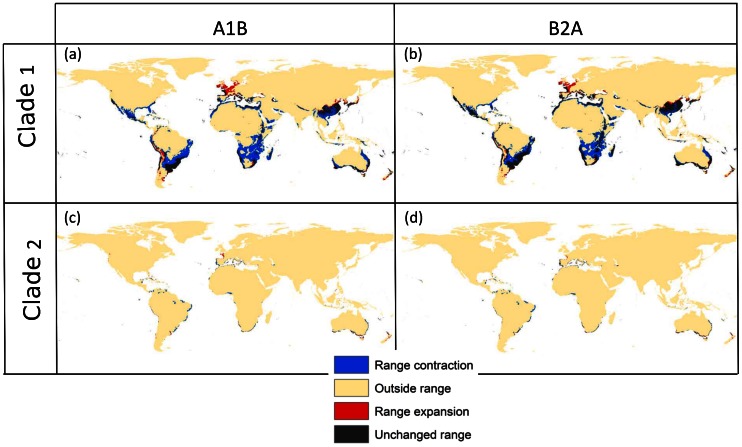
Many species are shifting their distributions due to climate change and to increasing international trade that allows dispersal of individuals across the globe. In the case of agricultural pests, such range shifts may heavily impact agriculture. Species distribution modelling may help to predict potential changes in pest distributions. However, these modelling strategies are subject to large uncertainties coming from different sources. Here we used the case of the tomato red spider mite (Tetranychus evansi), an invasive pest that affects some of the most important agricultural crops worldwide, to show how uncertainty may affect forecasts of the potential range of the species. We explored three aspects of uncertainty: (1) species prevalence; (2) modelling method; and (3) variability in environmental responses between mites belonging to two invasive clades of T. evansi. Consensus techniques were used to forecast the potential range of the species under current and two different climate change scenarios for 2080, and variance between model projections were mapped to identify regions of high uncertainty. We revealed large predictive variations linked to all factors, although prevalence had a greater influence than the statistical model once the best modelling strategies were selected. The major areas threatened under current conditions include tropical countries in South America and Africa, and temperate regions in North America, the Mediterranean basin and Australia. Under future scenarios, the threat shifts towards northern Europe and some other temperate regions in the Americas, whereas tropical regions in Africa present a reduced risk. Analysis of niche overlap suggests that the current differential distribution of mites of the two clades of T. evansi can be partially attributed to environmental niche differentiation. Overall this study shows how consensus strategies and analysis of niche overlap can be used jointly to draw conclusions on invasive threat considering different sources of uncertainty in species distribution modelling.
许多物种由于气候变化和国际贸易的增加而改变其分布范围,国际贸易使得个体在全球范围内扩散。在农业害虫的情况下,这种分布范围的变化可能会对农业造成严重影响。物种分布模型可以帮助预测害虫分布的潜在变化。然而,这些建模策略受到来自不同来源的大量不确定性的影响。在这里,我们以番茄红蜘蛛(Tetranychus evansi)为例,这种入侵害虫影响着全球一些最重要的农业作物,展示了不确定性如何影响物种潜在分布范围的预测。我们探讨了不确定性的三个方面:(1)物种流行率;(2)建模方法;(3)属于两个入侵 T. evansi 进化枝的螨虫对环境响应的变异性。共识技术用于预测在当前和 2080 年两种不同气候变化情景下物种的潜在范围,并将模型预测之间的差异映射到高不确定性区域。我们揭示了与所有因素相关的预测变化很大,尽管在选择最佳建模策略后,流行率的影响大于统计模型。在当前条件下,主要受到威胁的地区包括南美洲和非洲的热带国家,以及北美洲、地中海盆地和澳大利亚的温带地区。在未来的情景下,威胁将转向北欧和美洲的一些其他温带地区,而非洲的热带地区的风险将降低。生态位重叠分析表明,两个 T. evansi 进化枝螨虫的当前差异分布部分归因于环境生态位的分化。总体而言,这项研究表明,共识策略和生态位重叠分析如何可以联合使用,考虑物种分布模型中的不同来源的不确定性,得出关于入侵威胁的结论。