Department of Physiology, Faculty of Medicine, Mansoura University, Mansoura, Egypt.
Infect Agent Cancer. 2013 Jun 28;8(1):24. doi: 10.1186/1750-9378-8-24.
The present study was designed to determine the possible impact of hepatitis C virus (HCV) infection on the expression of telomerase (TERT), retinoblastoma (RB1), E2F3, TP53, CDKN1A (p21) and fibroblast growth factor receptor- 3 (FGFR3) genes in patients with bladder cancer (BC).
100 patients with bladder cancer (15 female and 85 male) were divided into 2 groups; Group I: 50 HCV negative subjects (age range 36-79), and Group II: 50 HCV positive subjects (age range 42-80). Expressions of the telomerase, retinoblastoma (Rb), E2F3, TP53 and FGFR3 genes were tested by immunohistochemistry and real time PCR in tumour tissues and healthy bladder tissues. Also, telomerase activity was assessed by telomeric repeats amplification protocol (TRAP).
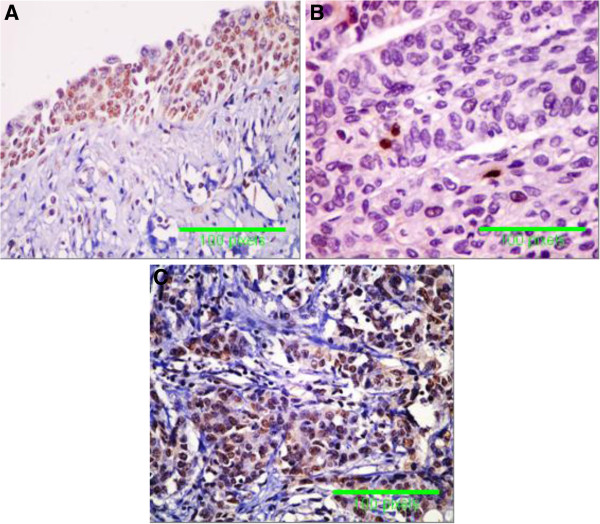
Bladder tumors associated with HCV infection were of high grade and invasive squamous cell carcinomas (SCCs). Expressions of hTERT, Rb, E2F3, TP53 and FGFR3 as well as telomerase activity were significantly higher in bladder tissues of HCV-infected patients compared with bladder tissues of non infected patients (p<0.05). On the contrary, CDKN1A (p21) expression was significantly lower in bladder tissues of HCV-infected patients compared to bladder tissues of non infected patients (p<0.05).
The expressions of hTERT, Rb, E2F3, TP53 and FGFR3 as well as the activity of telomerase were significantly high in malignant bladder tissues associated with HCV infection. On the other hand, CDKN1A (p21) expression was low in bladder tissues of HCV-infected subjects. Moreover, there was a positive correlation between HCV infection and expression of telomerase, E2F3, TP53 and FGFR3. There was a negative correlation between HCV infection and expression of Rb and p21.
本研究旨在确定丙型肝炎病毒(HCV)感染对膀胱癌(BC)患者端粒酶(TERT)、视网膜母细胞瘤(RB1)、E2F3、TP53、CDKN1A(p21)和成纤维细胞生长因子受体-3(FGFR3)基因表达的可能影响。
100 例膀胱癌患者(女性 15 例,男性 85 例)分为 2 组;第 I 组:50 例 HCV 阴性患者(年龄 36-79 岁),第 II 组:50 例 HCV 阳性患者(年龄 42-80 岁)。在肿瘤组织和正常膀胱组织中通过免疫组化和实时 PCR 检测端粒酶、视网膜母细胞瘤(Rb)、E2F3、TP53 和 FGFR3 基因的表达,并通过端粒重复扩增协议(TRAP)评估端粒酶活性。
与 HCV 感染相关的膀胱癌为高级别和侵袭性鳞状细胞癌(SCC)。与未感染患者相比,HCV 感染患者的膀胱组织中端粒酶、Rb、E2F3、TP53 和 FGFR3 的表达以及端粒酶活性明显更高(p<0.05)。相反,HCV 感染患者的膀胱组织中 CDKN1A(p21)的表达明显低于未感染患者的膀胱组织(p<0.05)。
与 HCV 感染相关的恶性膀胱组织中端粒酶、Rb、E2F3、TP53 和 FGFR3 的表达以及端粒酶活性明显升高,而 CDKN1A(p21)的表达在 HCV 感染患者的膀胱组织中较低。此外,HCV 感染与端粒酶、E2F3、TP53 和 FGFR3 的表达呈正相关,与 Rb 和 p21 的表达呈负相关。