Department of Automation and Institute for Interdisciplinary Information Sciences, Tsinghua University, Beijing 100084, China.
Bioinformatics. 2013 Jul 1;29(13):i126-34. doi: 10.1093/bioinformatics/btt234.
In silico prediction of drug-target interactions plays an important role toward identifying and developing new uses of existing or abandoned drugs. Network-based approaches have recently become a popular tool for discovering new drug-target interactions (DTIs). Unfortunately, most of these network-based approaches can only predict binary interactions between drugs and targets, and information about different types of interactions has not been well exploited for DTI prediction in previous studies. On the other hand, incorporating additional information about drug-target relationships or drug modes of action can improve prediction of DTIs. Furthermore, the predicted types of DTIs can broaden our understanding about the molecular basis of drug action.
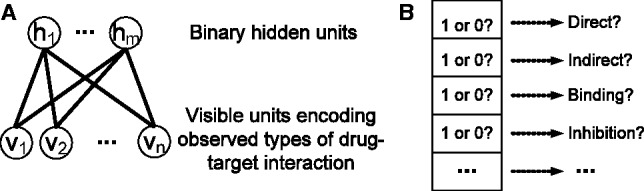
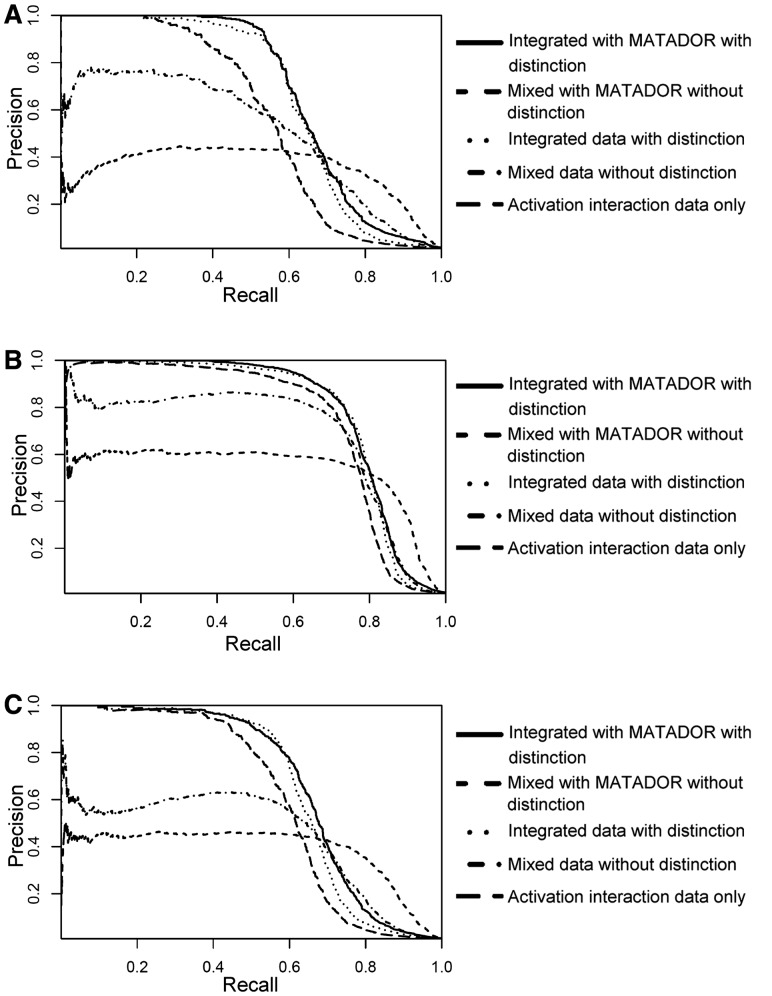
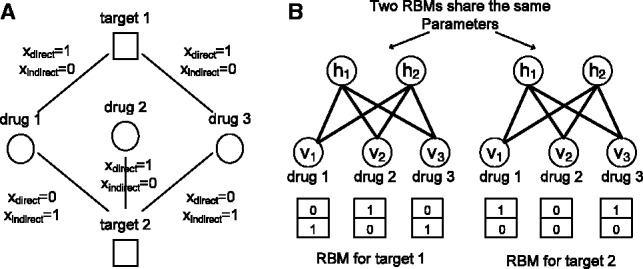
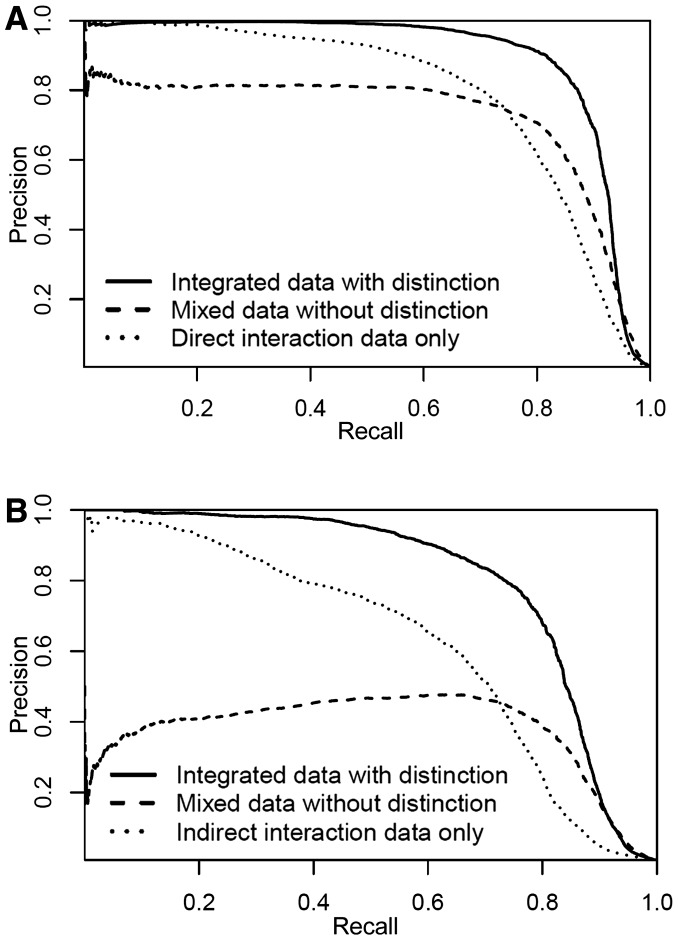
We propose a first machine learning approach to integrate multiple types of DTIs and predict unknown drug-target relationships or drug modes of action. We cast the new DTI prediction problem into a two-layer graphical model, called restricted Boltzmann machine, and apply a practical learning algorithm to train our model and make predictions. Tests on two public databases show that our restricted Boltzmann machine model can effectively capture the latent features of a DTI network and achieve excellent performance on predicting different types of DTIs, with the area under precision-recall curve up to 89.6. In addition, we demonstrate that integrating multiple types of DTIs can significantly outperform other predictions either by simply mixing multiple types of interactions without distinction or using only a single interaction type. Further tests show that our approach can infer a high fraction of novel DTIs that has been validated by known experiments in the literature or other databases. These results indicate that our approach can have highly practical relevance to DTI prediction and drug repositioning, and hence advance the drug discovery process.
Software and datasets are available on request.
Supplementary data are available at Bioinformatics online.
药物-靶点相互作用的计算预测在识别和开发现有或已废弃药物的新用途方面发挥着重要作用。基于网络的方法最近已成为发现新的药物-靶点相互作用(DTI)的流行工具。不幸的是,这些基于网络的方法大多数只能预测药物和靶点之间的二元相互作用,并且在以前的研究中,尚未充分利用有关不同类型相互作用的信息来预测 DTI。另一方面,纳入有关药物-靶点关系或药物作用方式的其他信息可以改善 DTI 的预测。此外,预测的 DTI 类型可以拓宽我们对药物作用的分子基础的理解。
我们提出了一种用于整合多种类型的 DTI 并预测未知的药物-靶点关系或药物作用方式的机器学习方法。我们将新的 DTI 预测问题转化为两层图形模型,称为受限玻尔兹曼机,并应用实用的学习算法来训练我们的模型并进行预测。在两个公共数据库上的测试表明,我们的受限玻尔兹曼机模型可以有效地捕获 DTI 网络的潜在特征,并在预测不同类型的 DTI 方面取得出色的性能,精度-召回曲线下的面积高达 89.6。此外,我们证明整合多种类型的 DTI 可以显著优于其他预测,无论是通过简单地混合多种类型的相互作用而不加区分,还是仅使用单一相互作用类型。进一步的测试表明,我们的方法可以推断出很高比例的新颖 DTI,这些新颖 DTI 已通过文献或其他数据库中的已知实验得到验证。这些结果表明,我们的方法对于 DTI 预测和药物重新定位具有高度的实际意义,从而可以推进药物发现过程。
软件和数据集可根据要求提供。
补充数据可在《生物信息学》在线获取。