Department of Anesthesiology and Pain Medicine, University of Ulsan College of Medicine, Asan Medical Center, Seoul, Korea.
Korean J Anesthesiol. 2013 Jun;64(6):517-23. doi: 10.4097/kjae.2013.64.6.517. Epub 2013 Jun 24.
Postoperative nausea and vomiting (PONV) continues to be a major problem, because PONV is associated with delayed recovery and prolonged hospital stay. Although the PONV guidelines recommended the use of 5-hydroxy-tryptamine (5-HT3) receptor antagonists as the first-line prophylactic agents in patients categorized as high-risk, there are few studies comparing the efficacies of ondansetron, ramosetron, and palonosetron. The aim of present study was to compare the prophylactic antiemetic efficacies of three 5HT3 receptor antagonists in high-risk patients after laparoscopic surgery.
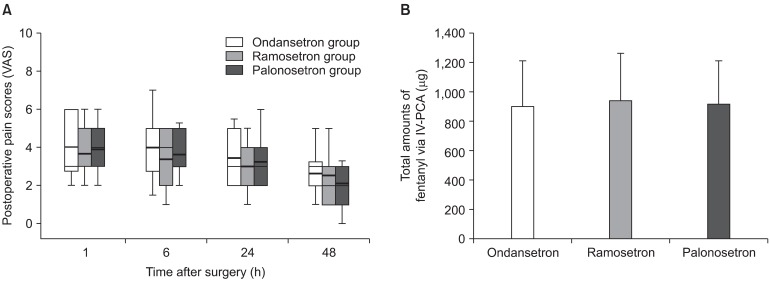
In this prospective, randomized, double-blinded trial, 109 female nonsmokers scheduled for elective laparoscopic surgery were randomized to receive intravenous 4 mg ondansetron (n = 35), 0.3 mg ramosetron (n = 38), or 75 µg palonosetron (n = 36) before anesthesia. Fentanyl-based intravenous patient-controlled analgesia was administered for 48 h after surgery. Primary antiemetic efficacy variables were the incidence and severity of nausea, the frequency of emetic episodes during the first 48 h after surgery, and the need to use a rescue antiemetic medication.
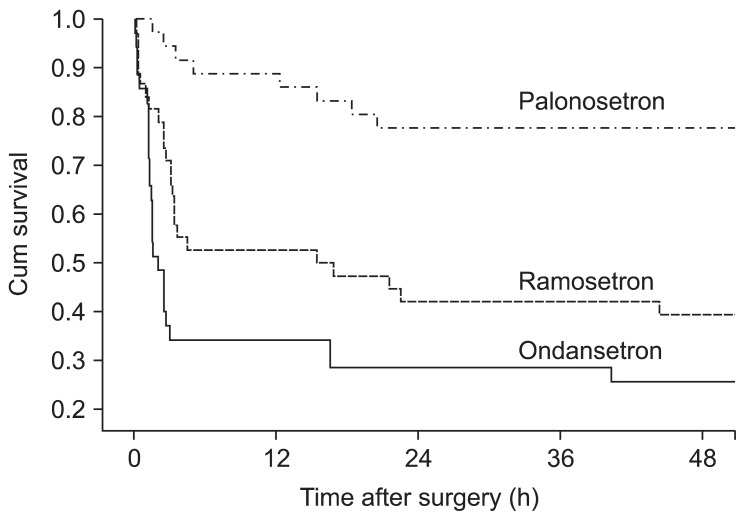
The overall incidence of nausea/retching/vomiting was lower in the palonosetron (22.2%/11.1%/5.6%) than in the ondansetron (77.1%/48.6%/28.6%) and ramosetron (60.5%/28.9%/18.4%) groups. The rescue antiemetic therapy was required less frequently in the palonosetron group than the other groups (P < 0.001). Kaplan-Meier analysis showed that the order of prophylactic efficacy in delaying the interval to use of a rescue emetic was palonosetron, ramosetron, and ondansetron.
Single-dose palonosetron is the prophylactic antiemetics of choice in high-risk patients undergoing laparoscopic surgery.
术后恶心和呕吐(PONV)仍然是一个主要问题,因为 PONV 与恢复延迟和住院时间延长有关。尽管 PONV 指南建议将 5-羟色胺(5-HT3)受体拮抗剂作为高危患者的一线预防药物,但很少有研究比较昂丹司琼、雷莫司琼和帕洛诺司琼的疗效。本研究旨在比较三种 5-HT3 受体拮抗剂在腹腔镜手术后高危患者中的预防性止吐疗效。
在这项前瞻性、随机、双盲试验中,109 名择期行腹腔镜手术的女性非吸烟者被随机分为静脉注射 4 毫克昂丹司琼(n = 35)、0.3 毫克雷莫司琼(n = 38)或 75 µg 帕洛诺司琼(n = 36)。术后 48 小时内给予芬太尼静脉患者自控镇痛。主要止吐疗效变量为恶心、呕吐、术后 48 小时内呕吐发作频率以及需要使用解救性止吐药物的发生率和严重程度。
帕洛诺司琼(22.2%/11.1%/5.6%)组的恶心/呕吐/呕吐总发生率低于昂丹司琼(77.1%/48.6%/28.6%)和雷莫司琼(60.5%/28.9%/18.4%)组。帕洛诺司琼组需要解救性止吐治疗的频率低于其他组(P < 0.001)。Kaplan-Meier 分析表明,预防疗效延迟使用解救性止吐药物的顺序为帕洛诺司琼、雷莫司琼和昂丹司琼。
单次剂量的帕洛诺司琼是腹腔镜手术高危患者预防性止吐的首选药物。