Management of Cultural Diversity, Tilburg University, Tilburg, The Netherlands.
Neuropsychiatr Dis Treat. 2013;9:823-37. doi: 10.2147/NDT.S43755. Epub 2013 Jun 19.
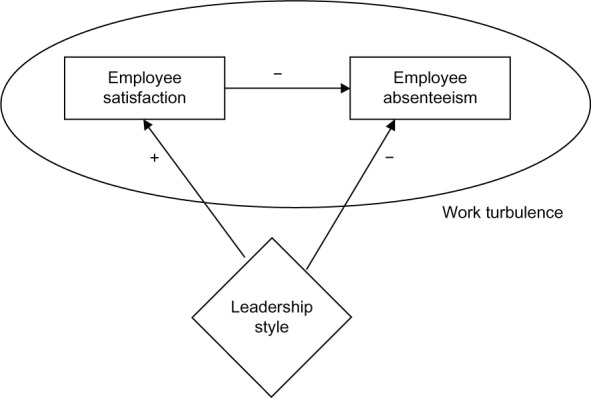
In service oriented industries, such as the health care sector, leadership styles have been suggested to influence employee satisfaction as well as outcomes in terms of service delivery. However, how this influence comes into effect has not been widely explored. Absenteeism may be a factor in this association; however, no studies are available on this subject in the mental health care setting, although this setting has been under a lot of strain lately to provide their services at lower costs. This may have an impact on employers, employees, and the delivery of services, and absenteeism due to illness of employees tends to already be rather high in this particular industry. This study explores the association between leadership style, absenteeism, and employee satisfaction in a stressful work environment, namely a post-merger specialty mental health care institution (MHCI) in a country where MHCIs are under governmental pressure to lower their costs (The Netherlands).
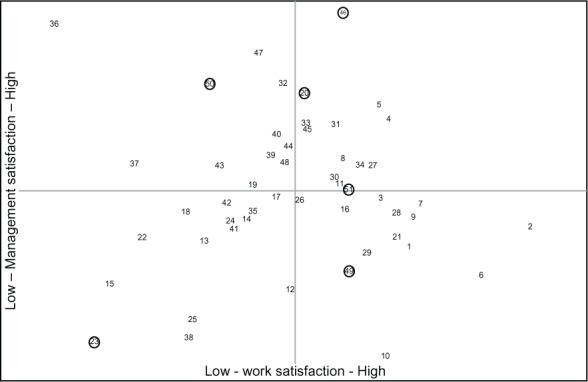
We used a mixed methods design with quantitative as well as qualitative research to explore the association between leadership style, sickness absence rates, and employee satisfaction levels in a specialty MHCI. In depth, semi-structured interviews were conducted with ten key informants and triangulated with documented research and a contrast between four departments provided by a factor analysis of the data from the employee satisfaction surveys and sickness rates. Data was analyzed thematically by means of coding and subsequent exploration of patterns. Data analysis was facilitated by qualitative analysis software.
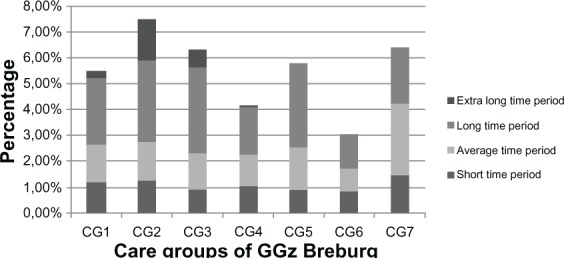
Quantitative analysis revealed sickness rates of 5.7% in 2010, which is slightly higher than the 5.2% average national sickness rate in The Netherlands in 2010. A general pattern of association between low employee satisfaction, high sickness rates, and transactional leadership style in contrast to transformational leadership style was established. The association could be described best by: (1) communication between the manager and employees; (2) the application of sickness protocols by the managers; and (3) leadership style of the manager.
We conclude that the transformational leadership style is best suited for attaining employee satisfaction, for adequate handling of sickness protocols, and for lower absenteeism, in a post-merger specialty mental health setting.
在服务型行业,如医疗保健行业,领导风格被认为会影响员工满意度以及服务交付方面的结果。然而,这种影响是如何产生的还没有被广泛探索。旷工可能是这种关联的一个因素;然而,在精神保健领域还没有关于这个主题的研究,尽管最近这个领域承受了很大的压力,要求以更低的成本提供服务。这可能会对雇主、员工和服务交付产生影响,而由于员工生病而导致的旷工在这个特定行业已经相当高。本研究探讨了在一个充满压力的工作环境中,即一个合并后的专业精神保健机构(MHCIs),领导风格、旷工和员工满意度之间的关联,在这种环境下,MHCIs 面临着来自政府的降低成本的压力(荷兰)。
我们使用混合方法设计,结合定量和定性研究,来探索专业 MHCIs 中领导风格、旷工率和员工满意度之间的关联。我们对 10 名关键信息提供者进行了深入的半结构化访谈,并与文件研究进行了三角分析,并通过对员工满意度调查和旷工率的数据进行因子分析,提供了四个部门之间的对比。通过编码和随后对模式的探索,对数据进行了主题分析。数据分析得到了定性分析软件的支持。
定量分析显示,2010 年的旷工率为 5.7%,略高于荷兰 2010 年 5.2%的全国平均旷工率。我们建立了一种低员工满意度、高旷工率和事务型领导风格与变革型领导风格之间的一般关联模式。这种关联可以用以下三个方面来描述:(1)经理与员工之间的沟通;(2)经理对病假协议的应用;和(3)经理的领导风格。
我们得出结论,在合并后的专业精神保健环境中,变革型领导风格最适合实现员工满意度、适当处理病假协议和降低旷工率。