Gatsby Computational Neuroscience Unit, University College London, London, United Kingdom.
PLoS Comput Biol. 2013;9(6):e1003099. doi: 10.1371/journal.pcbi.1003099. Epub 2013 Jun 27.
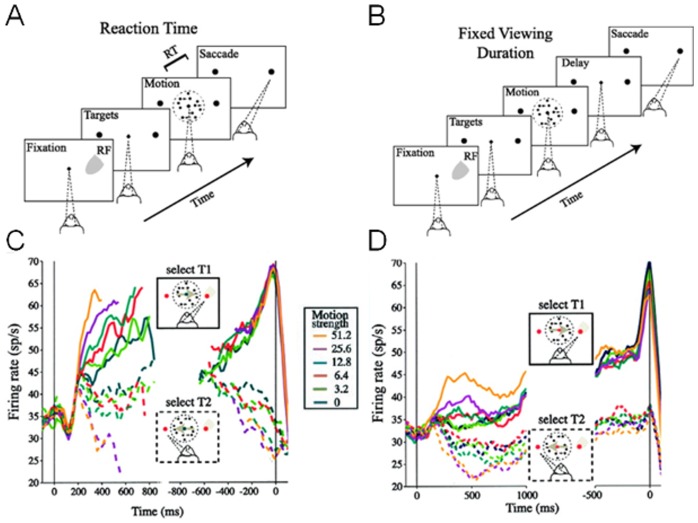
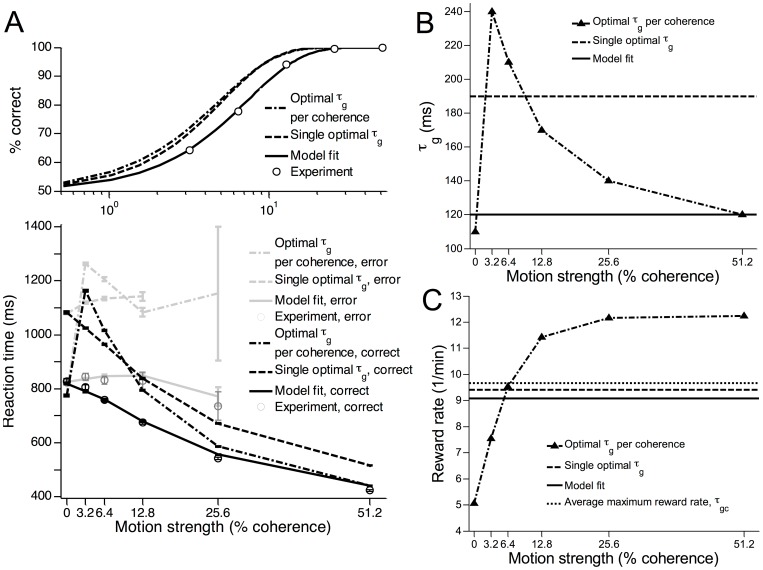
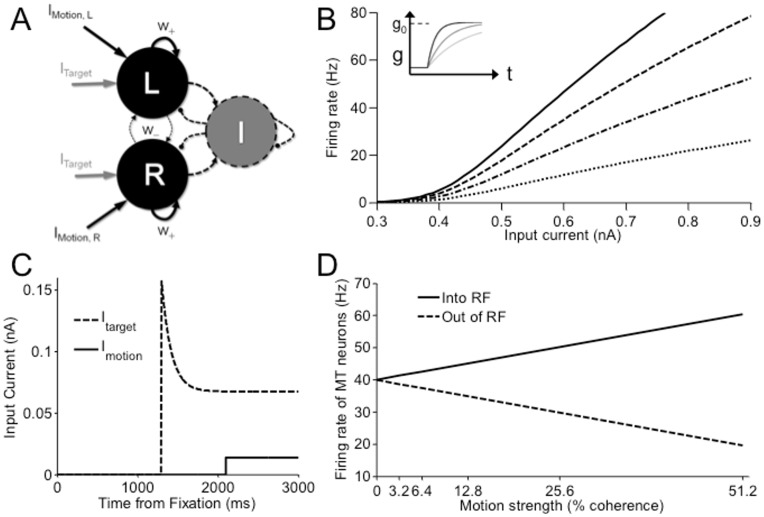
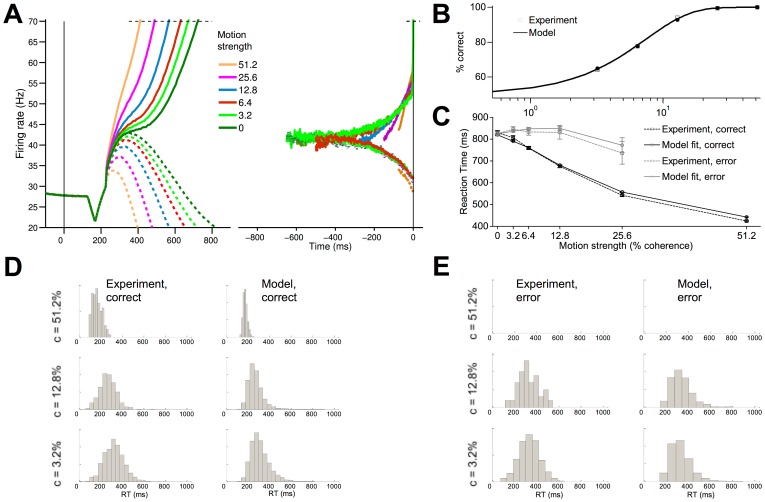
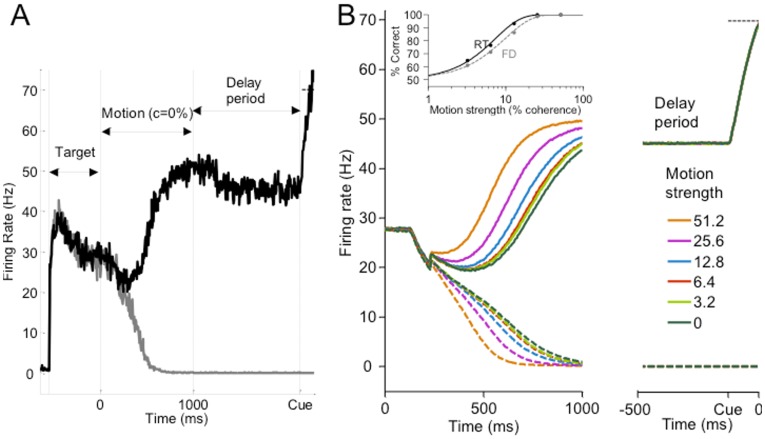
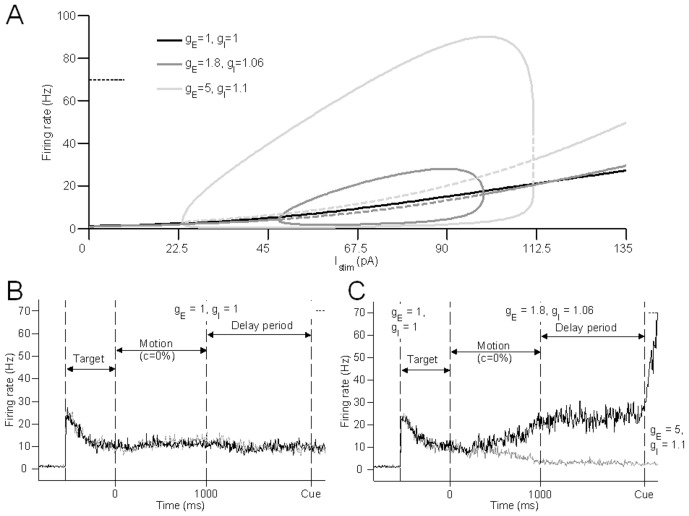
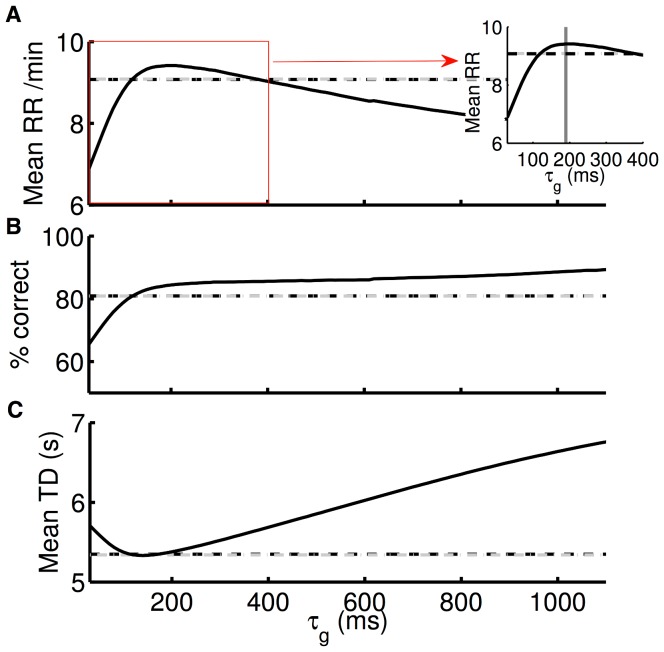
Behavioural and neurophysiological studies in primates have increasingly shown the involvement of urgency signals during the temporal integration of sensory evidence in perceptual decision-making. Neuronal correlates of such signals have been found in the parietal cortex, and in separate studies, demonstrated attention-induced gain modulation of both excitatory and inhibitory neurons. Although previous computational models of decision-making have incorporated gain modulation, their abstract forms do not permit an understanding of the contribution of inhibitory gain modulation. Thus, the effects of co-modulating both excitatory and inhibitory neuronal gains on decision-making dynamics and behavioural performance remain unclear. In this work, we incorporate time-dependent co-modulation of the gains of both excitatory and inhibitory neurons into our previous biologically based decision circuit model. We base our computational study in the context of two classic motion-discrimination tasks performed in animals. Our model shows that by simultaneously increasing the gains of both excitatory and inhibitory neurons, a variety of the observed dynamic neuronal firing activities can be replicated. In particular, the model can exhibit winner-take-all decision-making behaviour with higher firing rates and within a significantly more robust model parameter range. It also exhibits short-tailed reaction time distributions even when operating near a dynamical bifurcation point. The model further shows that neuronal gain modulation can compensate for weaker recurrent excitation in a decision neural circuit, and support decision formation and storage. Higher neuronal gain is also suggested in the more cognitively demanding reaction time than in the fixed delay version of the task. Using the exact temporal delays from the animal experiments, fast recruitment of gain co-modulation is shown to maximize reward rate, with a timescale that is surprisingly near the experimentally fitted value. Our work provides insights into the simultaneous and rapid modulation of excitatory and inhibitory neuronal gains, which enables flexible, robust, and optimal decision-making.
灵长类动物的行为和神经生理学研究越来越多地表明,在感知决策中对感觉证据进行时间整合时,紧迫性信号会参与其中。在顶叶皮层中发现了这些信号的神经元相关性,在单独的研究中,证明了兴奋性和抑制性神经元的注意力诱导增益调制。尽管先前的决策计算模型已经包含了增益调制,但它们的抽象形式不允许理解抑制性增益调制的贡献。因此,兴奋性和抑制性神经元增益的共同调制对决策动态和行为表现的影响仍不清楚。在这项工作中,我们将兴奋性和抑制性神经元增益的时变共同调制纳入到我们之前基于生物学的决策电路模型中。我们的计算研究基于在动物中进行的两个经典运动辨别任务的背景。我们的模型表明,通过同时增加兴奋性和抑制性神经元的增益,可以复制各种观察到的动态神经元放电活动。特别是,该模型可以表现出具有更高放电率的全有或全无决策行为,并且在显著更稳健的模型参数范围内。即使在接近动态分岔点的情况下,它也表现出短尾的反应时间分布。该模型还表明,神经元增益调制可以补偿决策神经电路中较弱的递归兴奋,支持决策形成和存储。在更具认知挑战性的反应时间中,神经元增益更高,而不是在任务的固定延迟版本中。使用来自动物实验的确切时间延迟,快速招募增益共同调制可使奖励率最大化,其时间尺度与实验拟合值惊人地接近。我们的工作提供了对兴奋性和抑制性神经元增益的同时和快速调制的深入了解,这使得决策变得灵活、稳健和优化。