Fouquet Céline, Babayan Bénédicte M, Watilliaux Aurélie, Bontempi Bruno, Tobin Christine, Rondi-Reig Laure
CNRS-Université Pierre et Marie Curie-P6, ENMVI team, UMR7102, Paris, France.
PLoS One. 2013 Jun 27;8(6):e67232. doi: 10.1371/journal.pone.0067232. Print 2013.
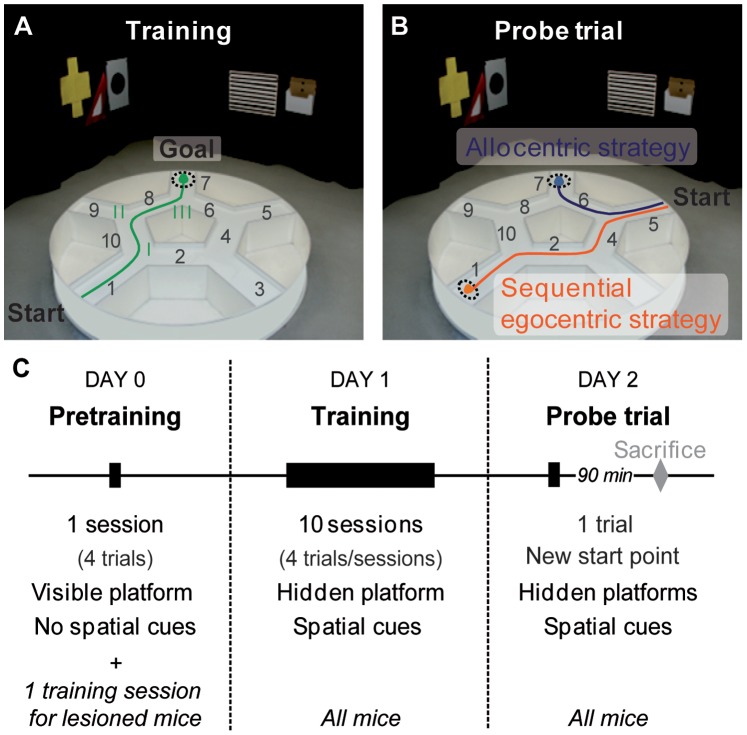
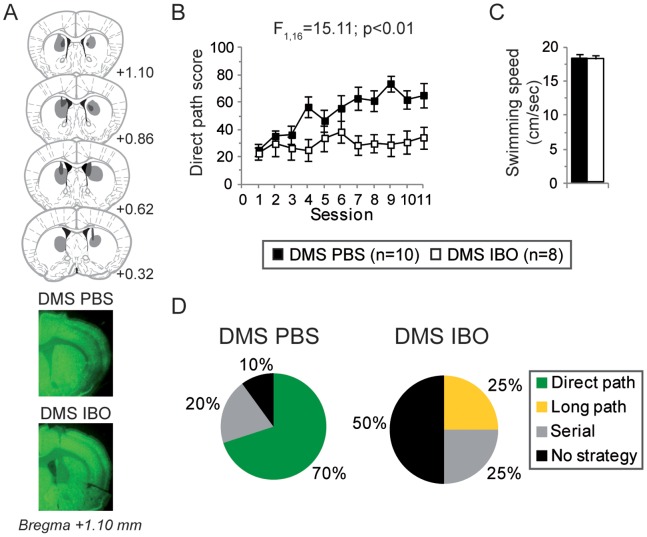
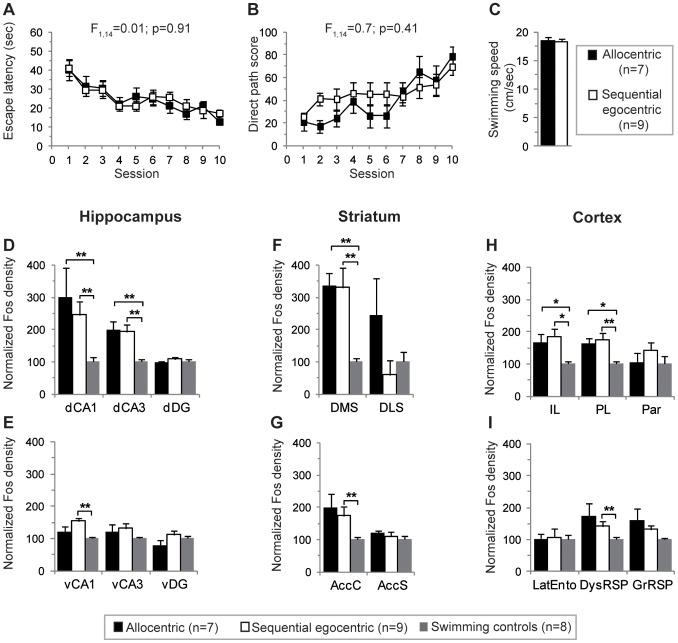
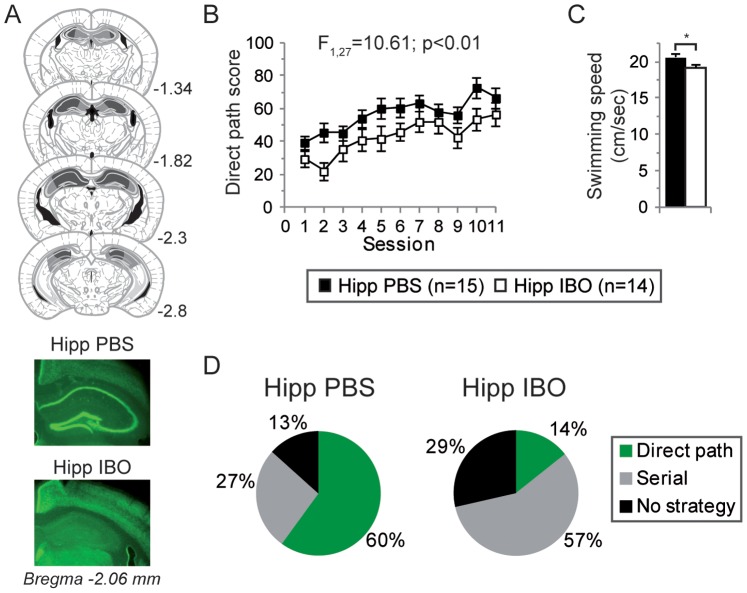
We investigated the neural bases of navigation based on spatial or sequential egocentric representation during the completion of the starmaze, a complex goal-directed navigation task. In this maze, mice had to swim along a path composed of three choice points to find a hidden platform. As reported previously, this task can be solved by using two hippocampal-dependent strategies encoded in parallel i) the allocentric strategy requiring encoding of the contextual information, and ii) the sequential egocentric strategy requiring temporal encoding of a sequence of successive body movements associated to specific choice points. Mice were trained during one day and tested the following day in a single probe trial to reveal which of the two strategies was spontaneously preferred by each animal. Imaging of the activity-dependent gene c-fos revealed that both strategies are supported by an overlapping network involving the dorsal hippocampus, the dorsomedial striatum (DMS) and the medial prefrontal cortex. A significant higher activation of the ventral CA1 subregion was observed when mice used the sequential egocentric strategy. To investigate the potential different roles of the dorsal hippocampus and the DMS in both types of navigation, we performed region-specific excitotoxic lesions of each of these two structures. Dorsal hippocampus lesioned mice were unable to optimally learn the sequence but improved their performances by developing a serial strategy instead. DMS lesioned mice were severely impaired, failing to learn the task. Our data support the view that the hippocampus organizes information into a spatio-temporal representation, which can then be used by the DMS to perform goal-directed navigation.
我们研究了在完成星状迷宫(一种复杂的目标导向导航任务)过程中,基于空间或顺序自我中心表征的导航神经基础。在这个迷宫中,小鼠必须沿着一条由三个选择点组成的路径游泳,以找到一个隐藏的平台。如先前报道,该任务可以通过并行编码的两种海马体依赖策略来解决:i)需要对情境信息进行编码的非自我中心策略,以及ii)需要对与特定选择点相关的一系列连续身体运动进行时间编码的顺序自我中心策略。小鼠在一天内接受训练,并在第二天进行单次探测试验,以揭示每只动物自发偏好的是两种策略中的哪一种。对活性依赖基因c-fos的成像显示,两种策略都由一个重叠网络支持,该网络包括背侧海马体、背内侧纹状体(DMS)和内侧前额叶皮层。当小鼠使用顺序自我中心策略时,观察到腹侧CA1亚区域有显著更高的激活。为了研究背侧海马体和DMS在两种导航类型中的潜在不同作用,我们对这两个结构分别进行了区域特异性兴奋性毒性损伤。背侧海马体损伤的小鼠无法最佳地学习序列,但通过发展一种序列策略提高了它们的表现。DMS损伤的小鼠严重受损,未能学会该任务。我们的数据支持这样一种观点,即海马体将信息组织成时空表征,然后DMS可以利用这种表征进行目标导向导航。