Danforth David N
Breast Cancer Res. 2013 Jun 27;15(3):208. doi: 10.1186/bcr3429.
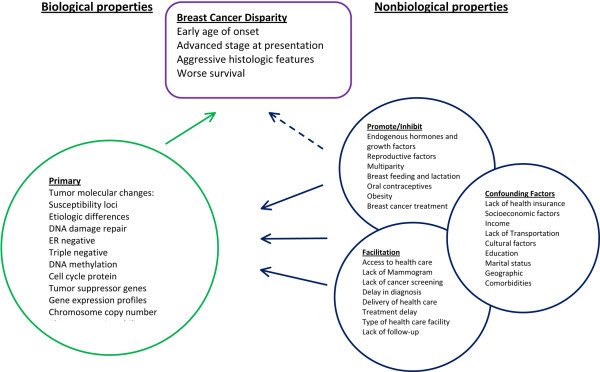
Breast cancer is the most common malignancy in women in the United States but significant disparities exist for African American women compared to Caucasian women. African American women present with breast cancer at a younger age and with a greater incidence under the age of 50 years, develop histologically more aggressive tumors that are at a more advanced stage at presentation, and have a worse disease-free and overall survival than Caucasian women. The biological characteristics of the primary tumor play an important role in determining the outcome of the disparity, and significant differences have been identified between African American and Caucasian breast cancer in steroid receptor and growth factor receptor content, mutations in cell cycle components, chromosomal abnormalities, and tumor suppressor and other cancer genes. The consequences of the biological factors are influenced by a variety of nonbiological factors, including socioeconomic, health care access, reproductive, and confounding factors. The nonbiological factors may act directly to enhance (or inhibit) the consequences of the biological changes, indirectly to facilitate outcome of the disparity, or as a cofounding factor, driving the association between the biological factors and the disparity. The prevention and management of the disparities will require an understanding of the relationship of biological and nonbiological factors. The present review was undertaken to promote this understanding by describing the biological basis of the four major disparities - early age of onset, more advanced stage of disease, more aggressive histologic changes, and worse survival - and the important relationship to the nonbiological factors. A model is proposed to provide a comprehensive view of this relationship, with the goal of facilitating an understanding of each disparity and the issues that need to be addressed to eliminate the disparity.
乳腺癌是美国女性中最常见的恶性肿瘤,但与白人女性相比,非裔美国女性存在显著差异。非裔美国女性患乳腺癌的年龄较轻,50岁以下的发病率更高,组织学上发展出更具侵袭性的肿瘤,就诊时处于更晚期阶段,并且与白人女性相比,无病生存期和总生存期更差。原发肿瘤的生物学特征在决定这种差异的结果方面起着重要作用,并且在非裔美国人和白人乳腺癌的类固醇受体和生长因子受体含量、细胞周期成分突变、染色体异常以及肿瘤抑制基因和其他癌症基因方面已发现显著差异。生物学因素的后果受到多种非生物学因素的影响,包括社会经济、医疗保健可及性、生殖和混杂因素。这些非生物学因素可能直接作用以增强(或抑制)生物学变化的后果,间接促进差异的结果,或作为混杂因素,推动生物学因素与差异之间的关联。差异的预防和管理需要了解生物学和非生物学因素之间的关系。本综述旨在通过描述四个主要差异——发病年龄早、疾病阶段更晚期、组织学变化更具侵袭性以及生存期更差——的生物学基础以及与非生物学因素的重要关系来促进这种理解。提出了一个模型以提供这种关系的全面视图,目的是促进对每个差异以及消除差异需要解决的问题的理解。