Pradels Antoine, Pradon Didier, Hlavačková Petra, Diot Bruno, Vuillerme Nicolas
Université Grenoble-Alpes, FRE 3405 AGIM Laboratory, CNRS-UJF-UPMF-EPHE, La Tronche, France ; Université Versailles Saint Quentin en Yvelines, EA 4497, CIC-IT 805, APHP Service de physiologie et d'exploration fonctionnelle, Hôpital Raymond Poincaré, Garches, France ; Centre de Podologie de l'Estacade, Grenoble, France.
PLoS One. 2013 Jun 26;8(6):e65510. doi: 10.1371/journal.pone.0065510. Print 2013.
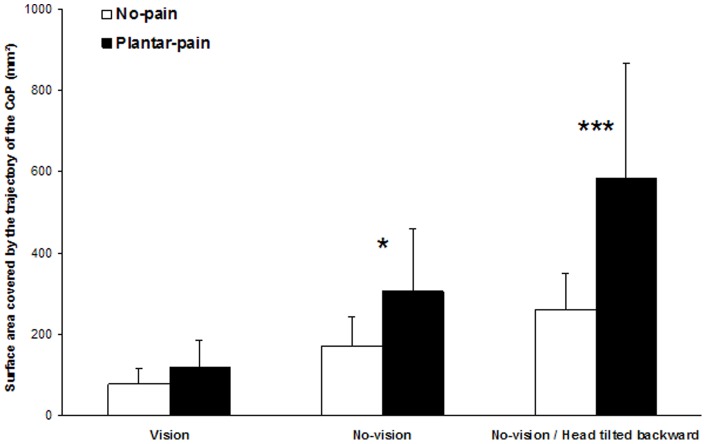
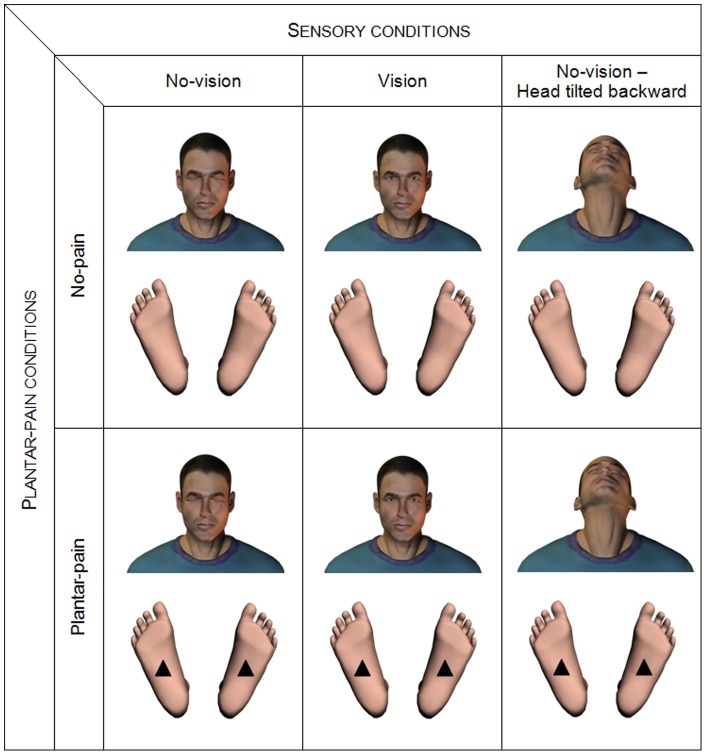
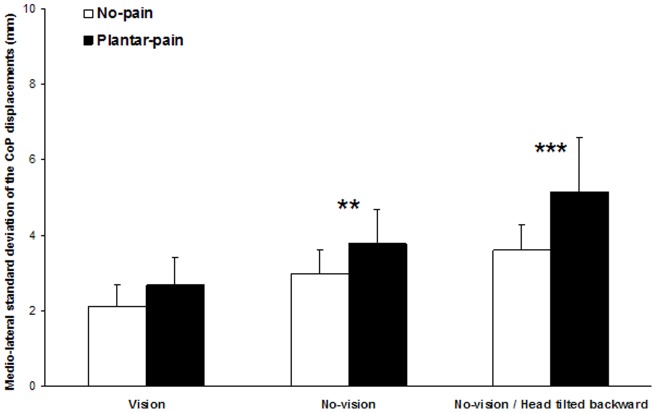
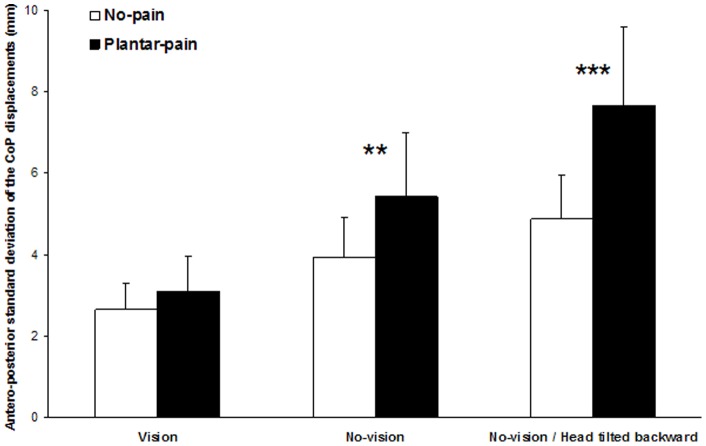
The present study was designed to assess the effects of experimentally-induced plantar pain on the displacement of centre of foot pressure during unperturbed upright stance in different sensory conditions of availability and/or reliability of visual input and somatosensory input from the vestibular system and neck. To achieve this goal, fourteen young healthy adults were asked to stand as still as possible in three sensory conditions: (1) No-vision, (2) Vision, and (3) No-vision - Head tilted backward, during two experimental conditions: (1) a No-pain condition, and (2) a condition when a painful stimulation was applied to the plantar surfaces of both feet (Plantar-pain condition). Centre of foot pressure (CoP) displacements were recorded using a force platform. Results showed that (1) experimentally-induced plantar pain increased CoP displacements in the absence of vision (No-vision condition), (2) this deleterious effect was more accentuated when somatosensory information from the vestibular and neck was altered (No-vision - Head tilted backward condition) and (3) this deleterious effect was suppressed when visual information was available (Vision condition). From a fundamental point of view, these results lend support to the sensory re-weighting hypothesis whereby the central nervous system dynamically and selectively adjusts the relative contributions of sensory inputs (i.e. the sensory weightings) in order to maintain balance when one or more sensory channels are altered by the task (novel or challenging), environmental or individual conditions. From a clinical point of view, the present findings further suggest that prevention and treatment of plantar pain may be relevant for the preservation or improvement of balance control, particularly in situations (or individuals) in which information provided by the visual, neck proprioceptive and vestibular systems is unavailable or disrupted.
本研究旨在评估实验诱导的足底疼痛对在不同感觉条件下(视觉输入以及来自前庭系统和颈部的本体感觉输入的可用性和/或可靠性)安静直立站立时足底压力中心位移的影响。为实现这一目标,14名年轻健康成年人被要求在三种感觉条件下尽可能静止站立:(1)无视觉,(2)有视觉,以及(3)无视觉 - 头部向后倾斜,同时处于两种实验条件下:(1)无疼痛条件,以及(2)对双脚足底表面施加疼痛刺激的条件(足底疼痛条件)。使用测力平台记录足底压力中心(CoP)位移。结果表明:(1)实验诱导的足底疼痛在无视觉(无视觉条件)时增加了CoP位移;(2)当前庭和颈部的本体感觉信息改变时(无视觉 - 头部向后倾斜条件),这种有害影响更加明显;(3)当有视觉信息时(有视觉条件),这种有害影响受到抑制。从基础研究的角度来看,这些结果支持了感觉重新加权假说,即中枢神经系统动态且选择性地调整感觉输入的相对贡献(即感觉权重),以便在一项任务(新颖或具有挑战性)、环境或个体条件改变一个或多个感觉通道时维持平衡。从临床角度来看,目前的研究结果进一步表明,足底疼痛的预防和治疗可能与平衡控制的维持或改善相关,特别是在视觉、颈部本体感觉和前庭系统提供的信息不可用或受到干扰的情况(或个体)中。