
环境臭氧浓度与穿孔性和非穿孔性阑尾炎风险的关系:一项多城市病例交叉研究。
Ambient ozone concentrations and the risk of perforated and nonperforated appendicitis: a multicity case-crossover study.
机构信息
Department of Medicine, Environmental Health Research Group, Institute of Public Health, University of Calgary, Calgary, Alberta, Canada.
出版信息
Environ Health Perspect. 2013 Aug;121(8):939-43. doi: 10.1289/ehp.1206085. Epub 2013 Jul 11.
BACKGROUND
Environmental determinants of appendicitis are poorly understood. Past work suggests that air pollution may increase the risk of appendicitis.
OBJECTIVES
We investigated whether ambient ground-level ozone (O3) concentrations were associated with appendicitis and whether these associations varied between perforated and nonperforated appendicitis.
METHODS
We based this time-stratified case-crossover study on 35,811 patients hospitalized with appendicitis from 2004 to 2008 in 12 Canadian cities. Data from a national network of fixed-site monitors were used to calculate daily maximum O3 concentrations for each city. Conditional logistic regression was used to estimate city-specific odds ratios (ORs) relative to an interquartile range (IQR) increase in O3 adjusted for temperature and relative humidity. A random-effects meta-analysis was used to derive a pooled risk estimate. Stratified analyses were used to estimate associations separately for perforated and nonperforated appendicitis.
RESULTS
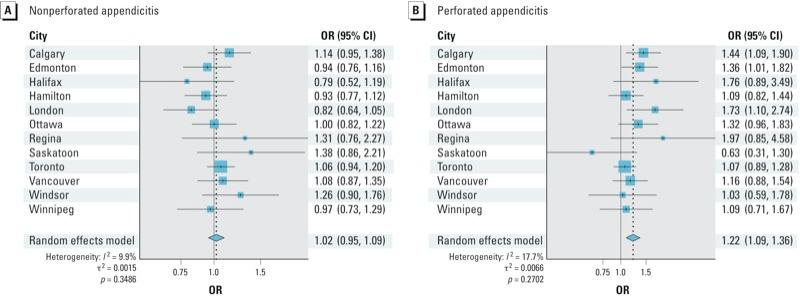
Overall, a 16-ppb increase in the 7-day cumulative average daily maximum O3 concentration was associated with all appendicitis cases across the 12 cities (pooled OR = 1.07; 95% CI: 1.02, 1.13). The association was stronger among patients presenting with perforated appendicitis for the 7-day average (pooled OR = 1.22; 95% CI: 1.09, 1.36) when compared with the corresponding estimate for nonperforated appendicitis [7-day average (pooled OR = 1.02, 95% CI: 0.95, 1.09)]. Heterogeneity was not statistically significant across cities for either perforated or nonperforated appendicitis (p > 0.20).
CONCLUSIONS
Higher levels of ambient O3 exposure may increase the risk of perforated appendicitis.
背景
阑尾炎的环境决定因素尚未被充分了解。过去的研究表明,空气污染可能会增加阑尾炎的风险。
目的
我们研究了环境地面臭氧(O3)浓度是否与阑尾炎有关,以及这些关联是否在穿孔性和非穿孔性阑尾炎之间存在差异。
方法
我们基于这项时间分层病例交叉研究,纳入了 2004 年至 2008 年期间在加拿大 12 个城市因阑尾炎住院的 35811 名患者。使用全国固定站点监测网络的数据计算每个城市的每日最大 O3 浓度。使用条件逻辑回归估计城市特异性比值比(OR),与 O3 每增加一个四分位距(IQR)相对于温度和相对湿度调整后的 OR 相比。使用随机效应荟萃分析得出汇总风险估计值。分层分析用于分别估计穿孔性和非穿孔性阑尾炎的关联。
结果
总体而言,12 个城市中,7 天累积平均每日最大 O3 浓度增加 16 个 ppb 与所有阑尾炎病例相关(汇总 OR = 1.07;95%CI:1.02,1.13)。与非穿孔性阑尾炎相比,穿孔性阑尾炎患者的 7 天平均 O3 浓度(汇总 OR = 1.22;95%CI:1.09,1.36)的关联更强。对于穿孔性或非穿孔性阑尾炎,各城市之间的异质性均无统计学意义(p > 0.20)。
结论
较高水平的环境 O3 暴露可能会增加穿孔性阑尾炎的风险。
 Zotero 插件