Tang Tso-Hao, Chang Chiung-Tan, Wang Hsiu-Jen, Erickson Joshua D, Reichard Rhett A, Martin Alexis G, Shannon Erica K, Martin Adam L, Huang Yue-Wern, Aronstam Robert S
J Biomed Sci. 2013 Jul 12;20(1):48. doi: 10.1186/1423-0127-20-48.
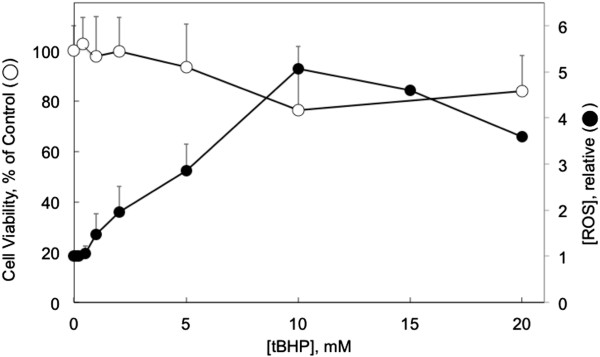
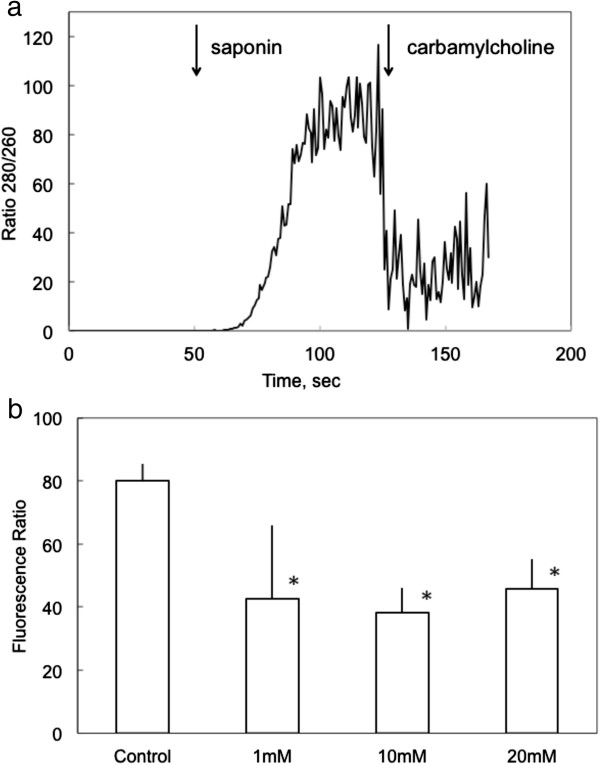
Oxidative stress increases the cytosolic content of calcium in the cytoplasm through a combination of effects on calcium pumps, exchangers, channels and binding proteins. In this study, oxidative stress was produced by exposure to tert-butyl hydroperoxide (tBHP); cell viability was assessed using a dye reduction assay; receptor binding was characterized using [3H]N-methylscopolamine ([3H]MS); and cytosolic and luminal endoplasmic reticulum (ER) calcium concentrations ([Ca2+]i and [Ca2+]L, respectively) were measured by fluorescent imaging.
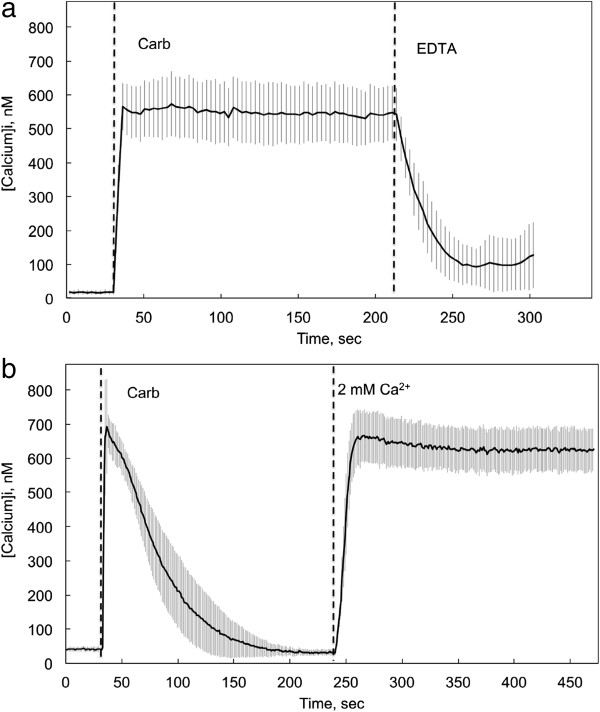
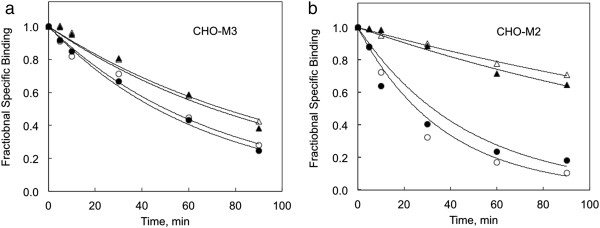
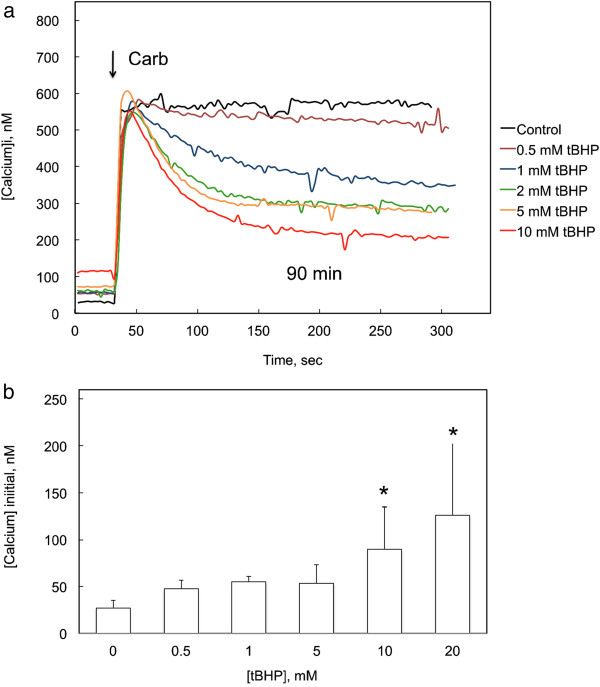
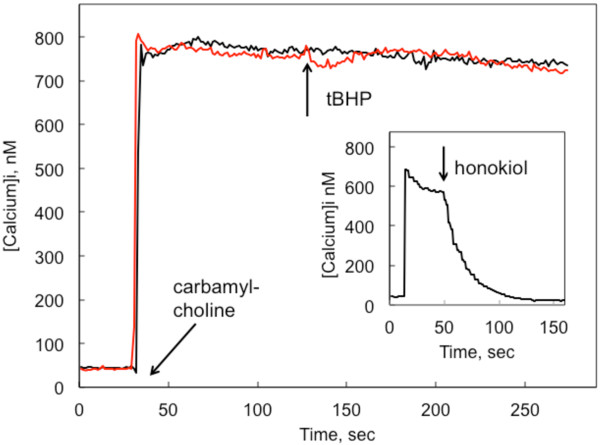
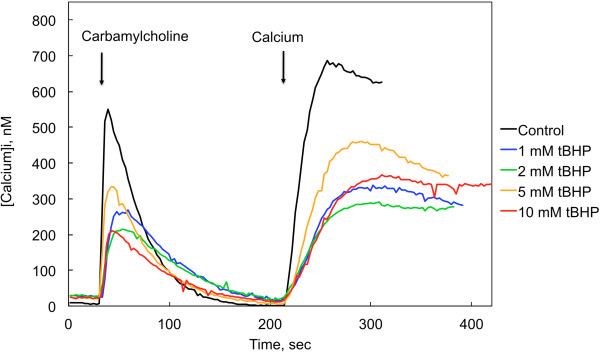
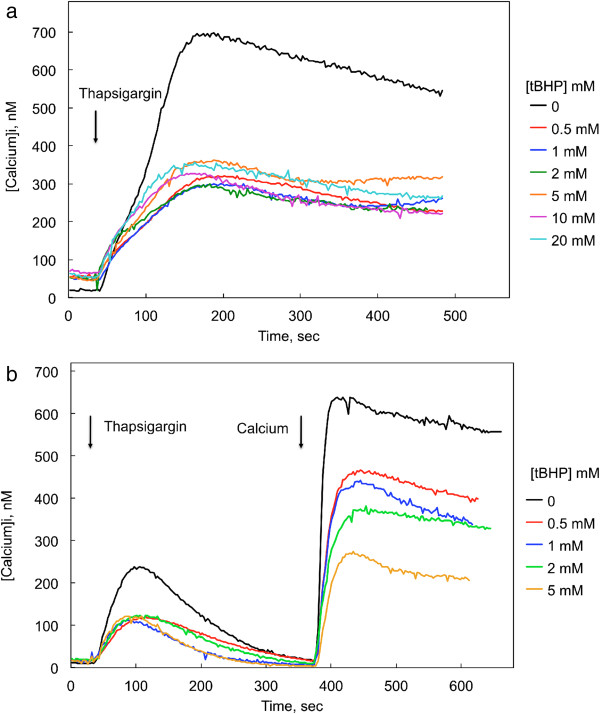
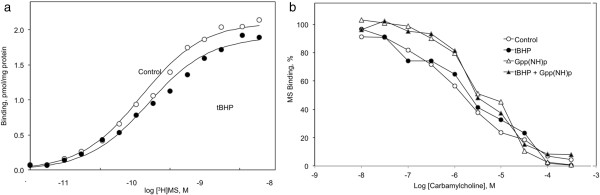
Activation of M3 muscarinic receptors induced a biphasic increase in [Ca2+]i: an initial, inositol trisphosphate (IP3)-mediated release of Ca2+ from endoplasmic reticulum (ER) stores followed by a sustained phase of Ca2+ entry (i.e., store-operated calcium entry; SOCE). Under non-cytotoxic conditions, tBHP increased resting [Ca2+]i; a 90 minute exposure to tBHP (0.5-10 mM ) increased [Ca2+]i from 26 to up to 127 nM and decreased [Ca2+]L by 55%. The initial response to 10 μM carbamylcholine was depressed by tBHP in the absence, but not the presence, of extracellular calcium. SOCE, however, was depressed in both the presence and absence of extracellular calcium. Acute exposure to tBHP did not block calcium influx through open SOCE channels. Activation of SOCE following thapsigargin-induced depletion of ER calcium was depressed by tBHP exposure. In calcium-free media, tBHP depressed both SOCE and the extent of thapsigargin-induced release of Ca2+ from the ER. M3 receptor binding parameters (ligand affinity, guanine nucleotide sensitivity, allosteric modulation) were not affected by exposure to tBHP.
Oxidative stress induced by tBHP affected several aspects of M3 receptor signaling pathway in CHO cells, including resting [Ca2+]i, [Ca2+]L, IP3 receptor mediated release of calcium from the ER, and calcium entry through the SOCE. tBHP had little effect on M3 receptor binding or G protein coupling. Thus, oxidative stress affects multiple aspects of calcium homeostasis and calcium dependent signaling.
氧化应激通过对钙泵、交换体、通道和结合蛋白的综合作用,增加细胞质中钙的胞质含量。在本研究中,通过暴露于叔丁基过氧化氢(tBHP)产生氧化应激;使用染料还原试验评估细胞活力;使用[3H]N-甲基东莨菪碱([3H]MS)表征受体结合;并通过荧光成像测量细胞质和内质网(ER)腔中的钙浓度(分别为[Ca2+]i和[Ca2+]L)。
M3毒蕈碱受体的激活诱导[Ca2+]i双相增加:最初是由肌醇三磷酸(IP3)介导的内质网(ER)钙库中Ca2+的释放,随后是Ca2+持续内流阶段(即储存-操作性钙内流;SOCE)。在非细胞毒性条件下,tBHP增加静息[Ca2+]i;暴露于tBHP(0.5-10 mM)90分钟使[Ca2+]i从26 nM增加至高达127 nM,并使[Ca2+]L降低55%。在无细胞外钙存在但有细胞外钙存在时,10 μM氨甲酰胆碱的初始反应均被tBHP抑制。然而,无论有无细胞外钙,SOCE均被抑制。急性暴露于tBHP不会阻断通过开放的SOCE通道的钙内流。tBHP暴露会抑制毒胡萝卜素诱导的内质网钙耗竭后SOCE的激活。在无钙培养基中,tBHP会抑制SOCE以及毒胡萝卜素诱导的内质网Ca2+释放程度。M3受体结合参数(配体亲和力、鸟嘌呤核苷酸敏感性、变构调节)不受tBHP暴露的影响。
tBHP诱导的氧化应激影响CHO细胞中M3受体信号通路的多个方面,包括静息[Ca2+]i、[Ca2+]L、IP3受体介导的内质网钙释放以及通过SOCE的钙内流。tBHP对M3受体结合或G蛋白偶联影响很小。因此,氧化应激会影响钙稳态和钙依赖性信号传导的多个方面。