Key Laboratory for Space Bioscience and Biotechnology, School of Life Sciences, Northwestern Polytechnical University, Xi'an, Shaanxi, People's Republic of China.
Int J Nanomedicine. 2013;8:2351-60. doi: 10.2147/IJN.S42617. Epub 2013 Jun 28.
Pseudomonas aeruginosa represents a good model of antibiotic resistance. These organisms have an outer membrane with a low level of permeability to drugs that is often combined with multidrug efflux pumps, enzymatic inactivation of the drug, or alteration of its molecular target. The acute and growing problem of antibiotic resistance of Pseudomonas to conventional antibiotics made it imperative to develop new liposome formulations to overcome these mechanisms, and investigate the fusion between liposome and bacterium.
The rigidity, stability and charge properties of phospholipid vesicles were modified by varying the cholesterol, 1,2-dioleoyl-sn-glycero-3-phosphatidylethanolamine (DOPE), and negatively charged lipids 1,2-dimyristoyl-sn-glycero-3-phosphoglycerol sodium salt (DMPG), 1,2-dimyristoyl-sn-glycero-3-phopho-L-serine sodium salt (DMPS), 1,2-dimyristoyl-sn-glycero-3-phosphate monosodium salt (DMPA), nature phosphatidylserine sodium salt from brain and nature phosphatidylinositol sodium salt from soybean concentrations in liposomes. Liposomal fusion with intact bacteria was monitored using a lipid-mixing assay.
It was discovered that the fluid liposomes-bacterium fusion is not dependent on liposomal size and lamellarity. A similar degree of fusion was observed for liposomes with a particle size from 100 to 800 nm. The fluidity of liposomes is an essential pre-request for liposomes fusion with bacteria. Fusion was almost completely inhibited by incorporation of cholesterol into fluid liposomes. The increase in the amount of negative charges in fluid liposomes reduces fluid liposomes-bacteria fusion when tested without calcium cations due to electric repulsion, but addition of calcium cations brings the fusion level of fluid liposomes to similar or higher levels. Among the negative phospholipids examined, DMPA gave the highest degree of fusion, DMPS and DMPG had intermediate fusion levels, and PI resulted in the lowest degree of fusion. Furthermore, the fluid liposomal encapsulated tobramycin was prepared, and the bactericidal effect occurred more quickly when bacteria were cultured with liposomal encapsulated tobramycin.
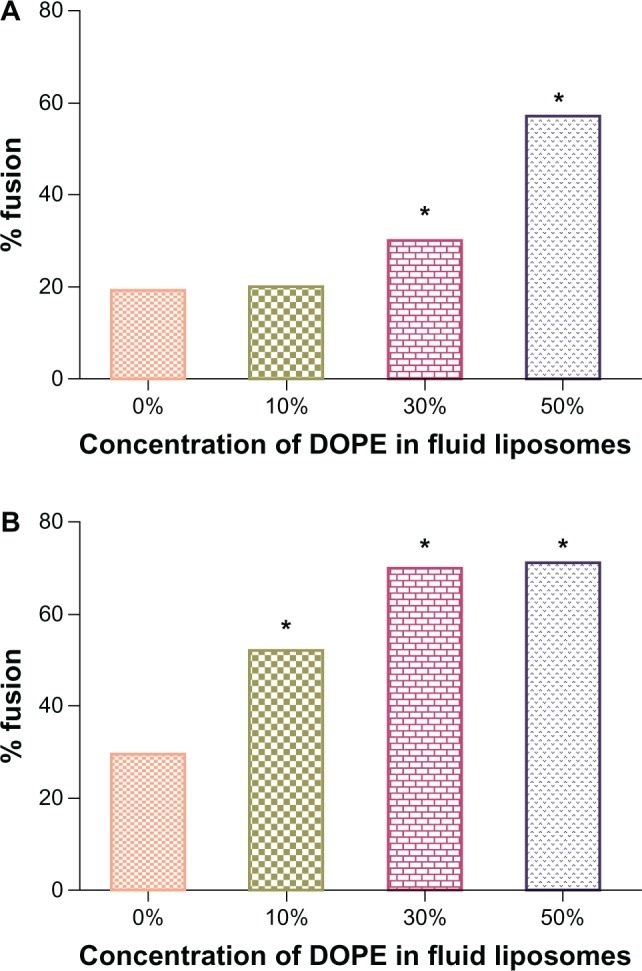
The bactericidal potency of fluid liposomes is dramatically enhanced with respect to fusion ability when the fusogenic lipid, DOPE, is included. Regardless of changes in liposome composition, fluid liposomes-bacterium fusion is universally enhanced by calcium ions. The information obtained in this study will increase our understanding of fluid liposomal action mechanisms, and help in optimizing the new generation of fluid liposomal formulations for the treatment of pulmonary bacterial infections.
铜绿假单胞菌是抗生素耐药性的一个很好的模型。这些生物体的外膜对药物的通透性较低,通常与多药外排泵、药物的酶失活或其分子靶标改变相结合。铜绿假单胞菌对抗生素的耐药性日益严重,迫切需要开发新的脂质体制剂来克服这些机制,并研究脂质体与细菌的融合。
通过改变胆固醇、1,2-二油酰基-sn-甘油-3-磷酸乙醇胺(DOPE)和带负电荷的脂质 1,2-二肉豆蔻酰基-sn-甘油-3-磷酸甘油钠盐(DMPG)、1,2-二肉豆蔻酰基-sn-甘油-3-磷酸-L-丝氨酸钠盐(DMPS)、1,2-二肉豆蔻酰基-sn-甘油-3-磷酸单钠盐(DMPA)、天然脑磷脂酸钠和天然大豆磷脂酸钠的浓度来修饰磷脂囊泡的刚性、稳定性和电荷特性。使用脂质混合测定法监测完整细菌与脂质体的融合。
发现流体脂质体-细菌融合不依赖于脂质体的大小和层状结构。粒径为 100 至 800nm 的脂质体观察到相似程度的融合。脂质体的流动性是脂质体与细菌融合的基本前提。在流体脂质体中加入胆固醇几乎完全抑制了融合。当在没有钙离子的情况下测试时,带负电荷的脂质体数量的增加由于电排斥而降低了流体脂质体-细菌融合,但加入钙离子会使流体脂质体的融合水平达到相似或更高的水平。在所检查的带负电荷的磷脂中,DMPA 产生的融合程度最高,DMPS 和 DMPG 的融合水平居中,而 PI 的融合程度最低。此外,制备了流体脂质体包裹妥布霉素,当用脂质体包裹妥布霉素培养细菌时,杀菌效果更快。
当包含融合脂质 DOPE 时,流体脂质体的杀菌效力大大增强。无论脂质体组成如何变化,钙离子普遍增强流体脂质体-细菌的融合。本研究获得的信息将提高我们对流体脂质体作用机制的理解,并有助于优化新一代用于治疗肺部细菌感染的流体脂质体制剂。