Department of Ecology and Evolutionary Biology, University of Colorado Boulder, CO, USA.
Front Plant Sci. 2013 Jul 5;4:240. doi: 10.3389/fpls.2013.00240. eCollection 2013.
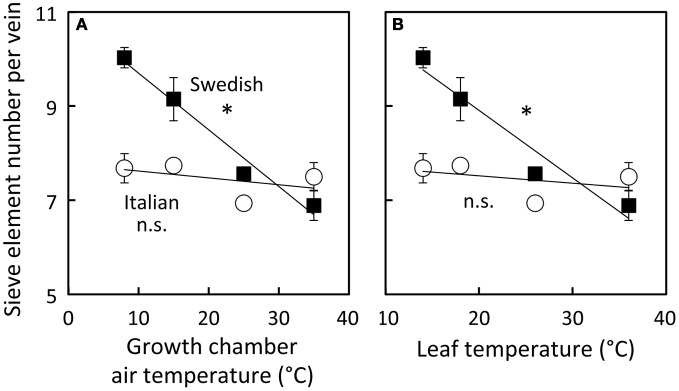
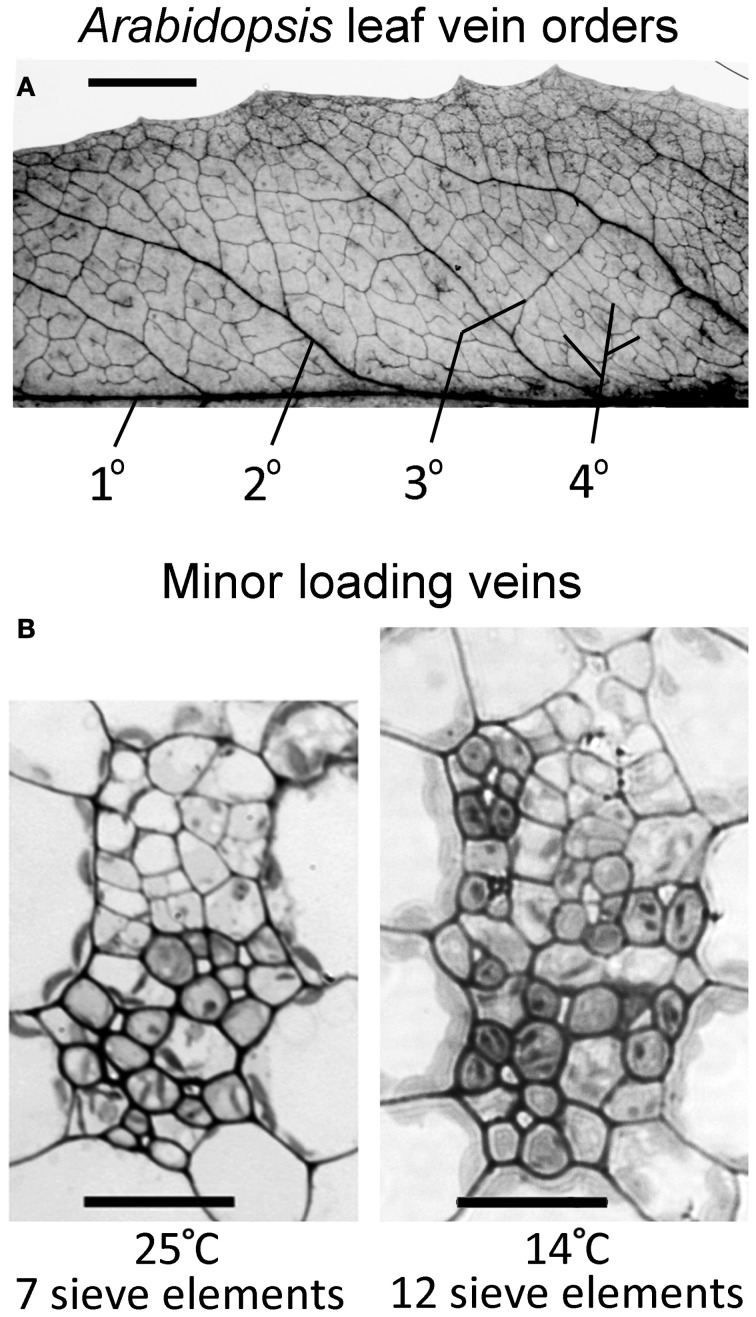
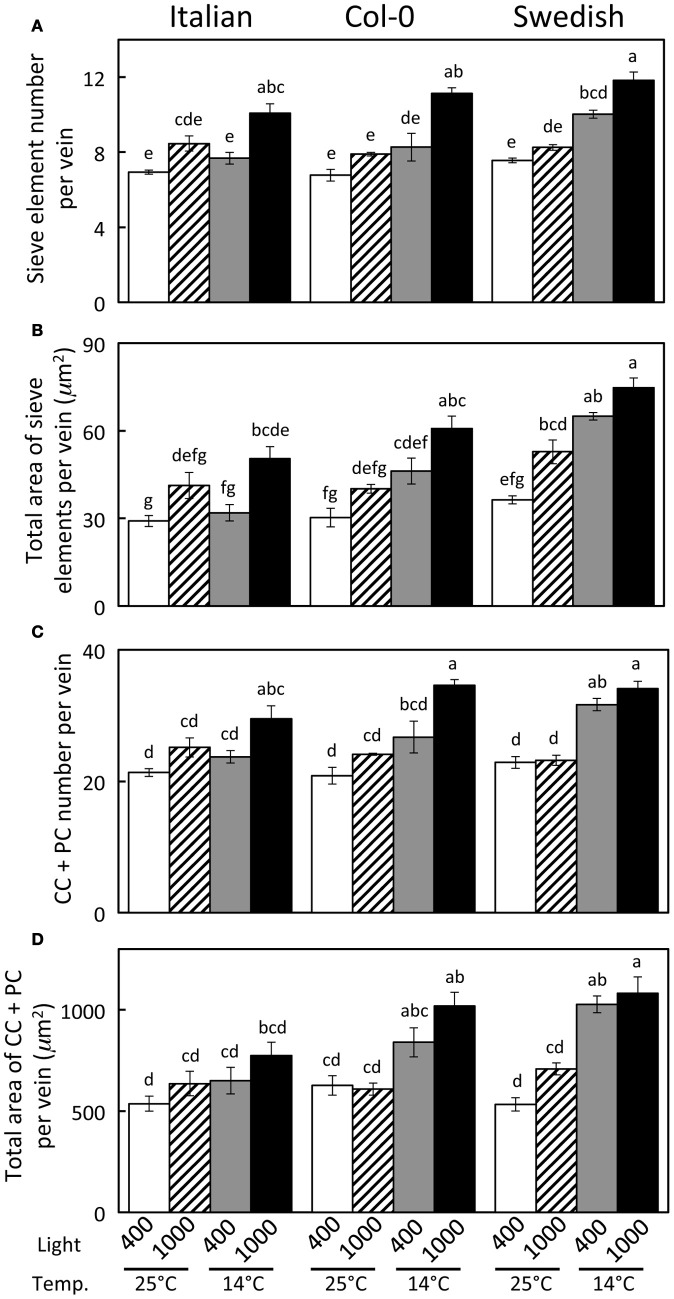
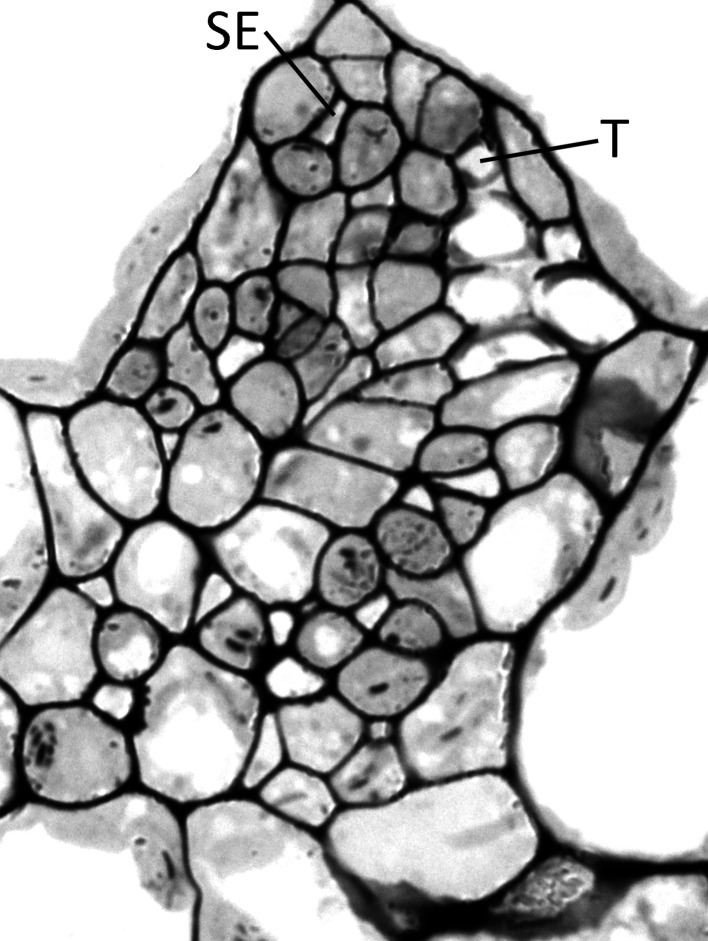
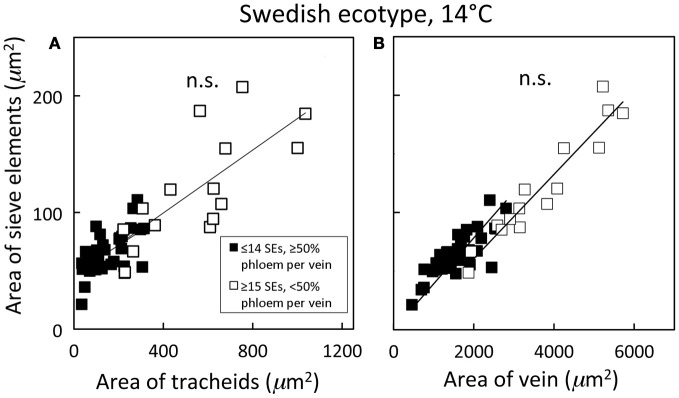
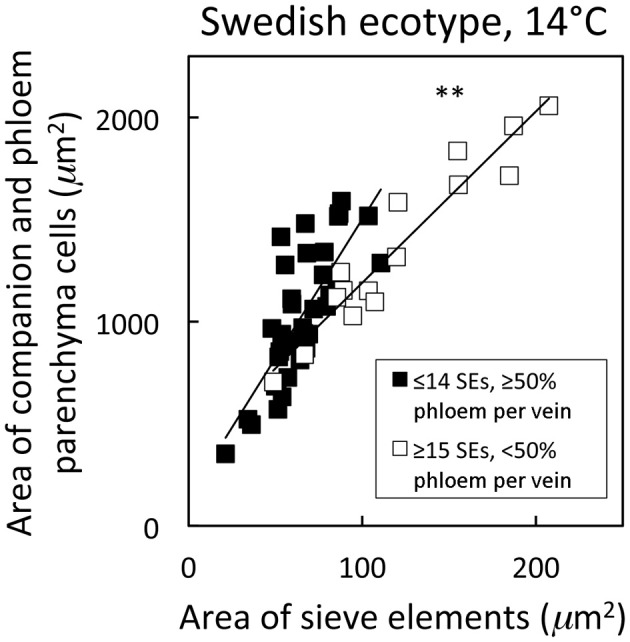
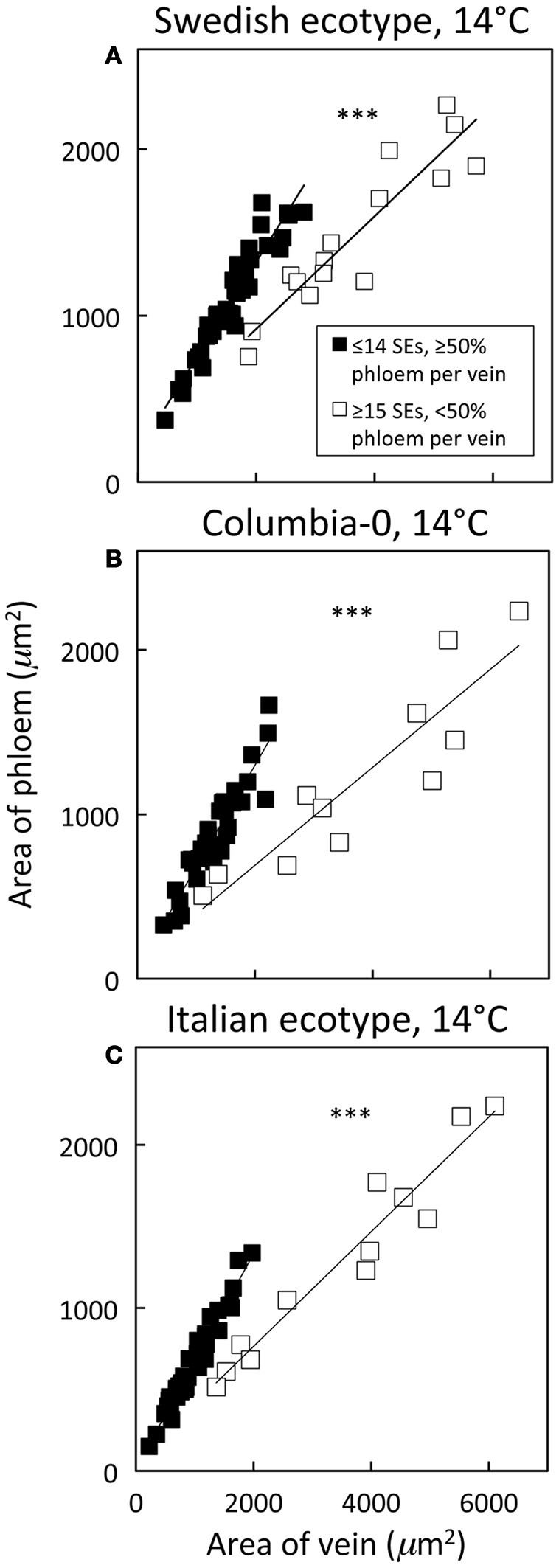
In light of the important role of foliar phloem as the nexus between energy acquisition through photosynthesis and distribution of the products of photosynthesis to the rest of the plant, as well as communication between the whole plant and its leaves, we examined whether foliar minor loading veins in three Arabidopsis thaliana ecotypes undergo acclimation to the growth environment. As a winter annual exhibiting higher rates of photosynthesis in response to cooler vs. warmer temperatures, this species might be expected to adjust the structure of its phloem to accommodate greater fluxes of sugars in response to growth at low temperature. Minor (fourth- and third-order) veins had 14 or fewer sieve elements and phloem tissue comprised 50% or more of the cross-sectional area. The number of phloem cells per minor loading vein was greater in leaves grown under cool temperature and high light vs. warm temperature and moderate light. This effect was greatest in an ecotype from Sweden, in which growth under cool temperature and high light resulted in minor veins with an even greater emphasis on phloem (50% more phloem cells with more than 100% greater cross-sectional area of phloem) compared to growth under warm temperature and moderate light. Likewise, the number of sieve elements per minor vein increased linearly with growth temperature under moderate light, almost doubling over a 27°C temperature range (21°C leaf temperature range) in the Swedish ecotype. Increased emphasis on cells involved in sugar loading and transport may be critical for maintaining sugar export from leaves of an overwintering annual such as A. thaliana, and particularly for the ecotype from the northern-most population experiencing the lowest temperatures.
鉴于叶片韧皮部作为光合作用获取能量与光合作用产物分配到植物其余部分的连接点,以及整株植物与其叶片之间的通讯的重要作用,我们研究了三个拟南芥生态型的叶片次生小脉是否适应生长环境。作为一种在较冷和较暖温度下表现出更高光合作用速率的冬季一年生植物,人们可能期望该物种调整其韧皮部结构,以适应低温生长时糖通量的增加。小(第四和第三级)脉的筛管数量为 14 个或更少,韧皮组织占横截面积的 50%或更多。与在温暖温度和中等光照下生长的叶片相比,在凉爽温度和高光下生长的叶片中,每条次生装载小脉的韧皮细胞数量更多。这种效应在来自瑞典的生态型中最大,在凉爽温度和高光下生长导致小脉甚至更强调韧皮部(韧皮部细胞增加 50%,韧皮部横截面积增加超过 100%),而在温暖温度和中等光照下生长的小脉则更小。同样,在中等光照下,每条次生小脉的筛管数量随生长温度呈线性增加,在瑞典生态型中,27°C 的温度范围内(叶片温度范围为 21°C)几乎增加了一倍。增加对参与糖装载和运输的细胞的重视可能对维持像拟南芥这样的越冬一年生植物的糖输出至关重要,特别是对来自最北种群、经历最低温度的生态型来说更是如此。