Sredar Nripun, Ivers Kevin M, Queener Hope M, Zouridakis George, Porter Jason
Department of Computer Science, University of Houston, Houston, TX 77004, USA.
Biomed Opt Express. 2013 Jun 14;4(7):1153-65. doi: 10.1364/BOE.4.001153. Print 2013 Jul 1.
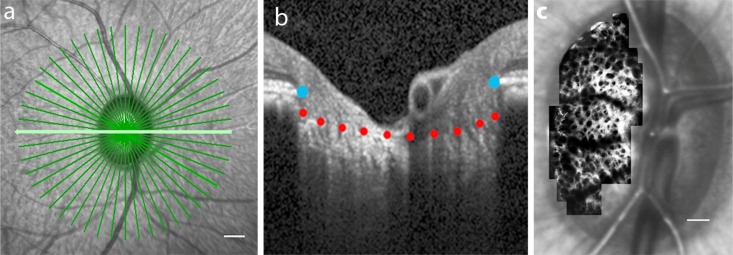
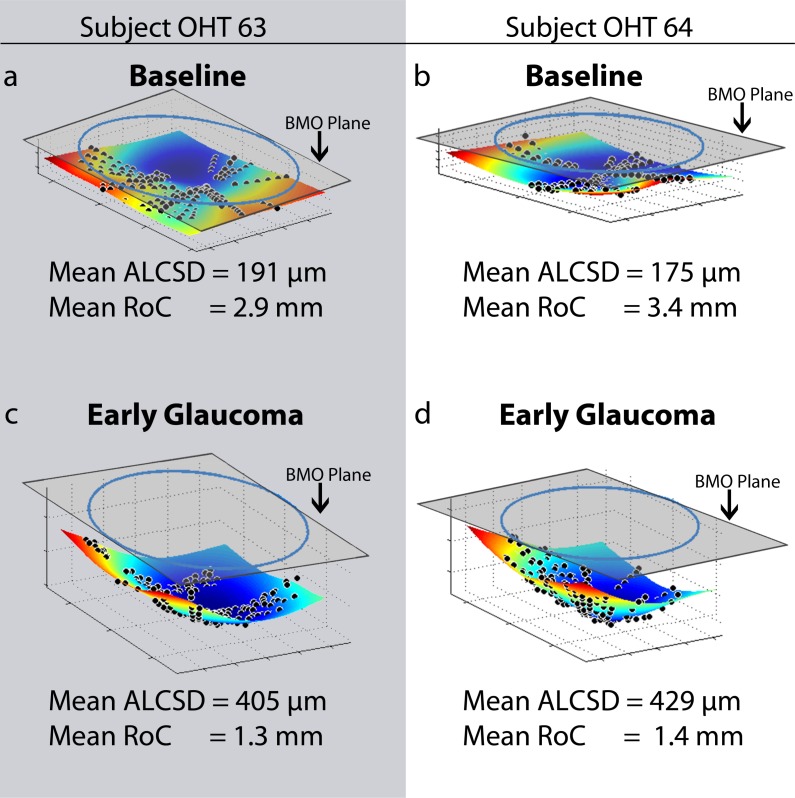
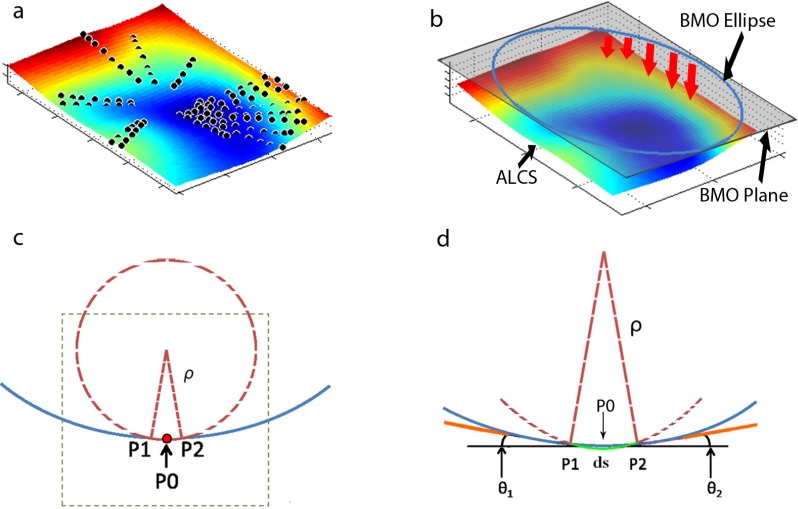
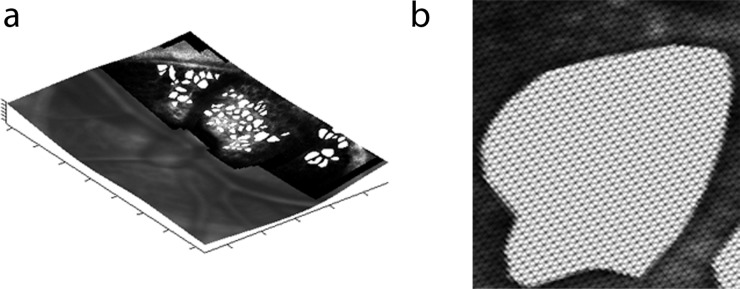
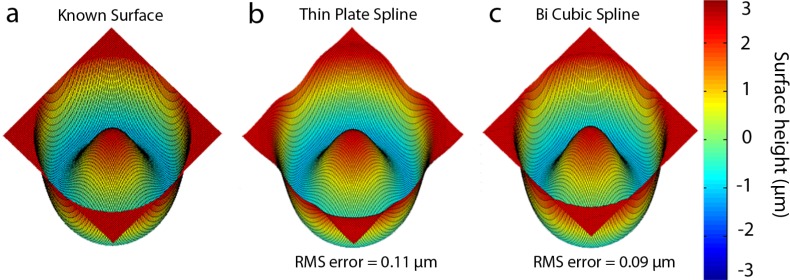
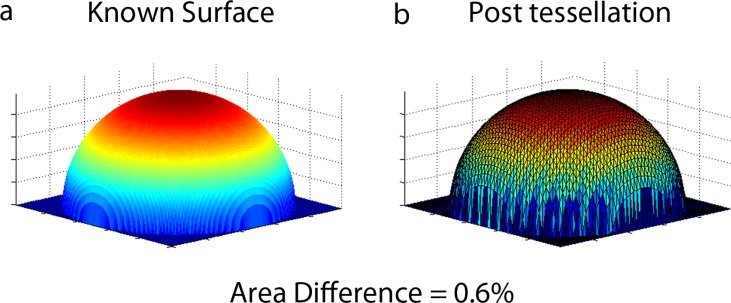
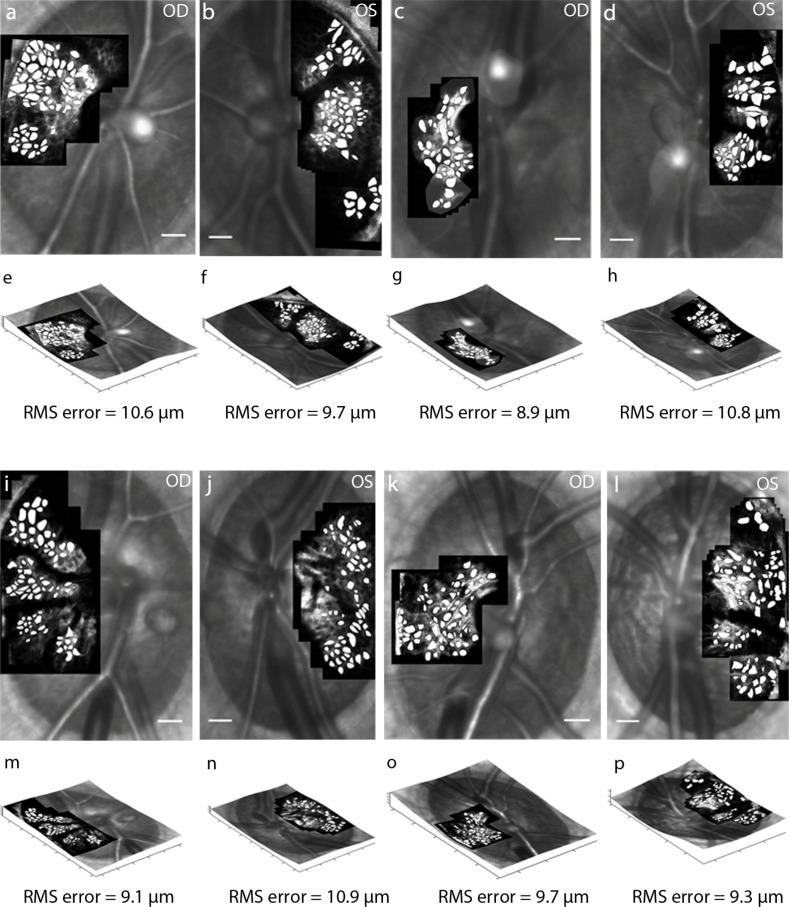
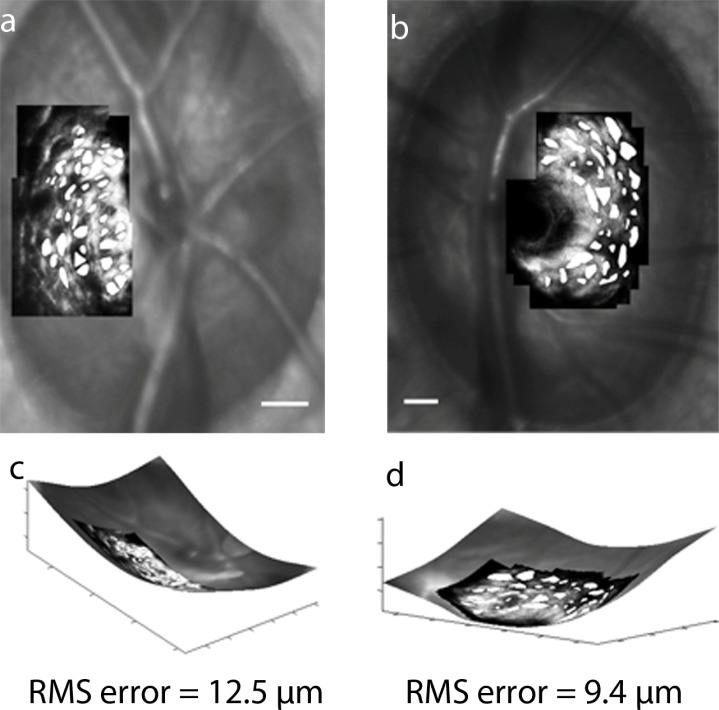
En face adaptive optics scanning laser ophthalmoscope (AOSLO) images of the anterior lamina cribrosa surface (ALCS) represent a 2D projected view of a 3D laminar surface. Using spectral domain optical coherence tomography images acquired in living monkey eyes, a thin plate spline was used to model the ALCS in 3D. The 2D AOSLO images were registered and projected onto the 3D surface that was then tessellated into a triangular mesh to characterize differences in pore geometry between 2D and 3D images. Following 3D transformation of the anterior laminar surface in 11 normal eyes, mean pore area increased by 5.1 ± 2.0% with a minimal change in pore elongation (mean change = 0.0 ± 0.2%). These small changes were due to the relatively flat laminar surfaces inherent in normal eyes (mean radius of curvature = 3.0 ± 0.5 mm). The mean increase in pore area was larger following 3D transformation in 4 glaucomatous eyes (16.2 ± 6.0%) due to their more steeply curved laminar surfaces (mean radius of curvature = 1.3 ± 0.1 mm), while the change in pore elongation was comparable to that in normal eyes (-0.2 ± 2.0%). This 3D transformation and tessellation method can be used to better characterize and track 3D changes in laminar pore and surface geometries in glaucoma.
筛板前表面(ALCS)的正面自适应光学扫描激光检眼镜(AOSLO)图像代表三维层状表面的二维投影视图。利用在活体猴眼中获取的光谱域光学相干断层扫描图像,使用薄板样条对ALCS进行三维建模。将二维AOSLO图像配准并投影到三维表面上,然后将该表面细分为三角形网格,以表征二维和三维图像之间孔隙几何形状的差异。在对11只正常眼睛的前层状表面进行三维变换后,平均孔隙面积增加了5.1±2.0%,孔隙伸长率变化最小(平均变化=0.0±0.2%)。这些微小变化是由于正常眼睛固有的相对平坦的层状表面(平均曲率半径=3.0±0.5毫米)。在4只青光眼眼睛中进行三维变换后,平均孔隙面积增加更大(16.2±6.0%),这是因为它们的层状表面弯曲更陡峭(平均曲率半径=1.3±0.1毫米),而孔隙伸长率的变化与正常眼睛相当(-0.2±2.0%)。这种三维变换和细分方法可用于更好地表征和跟踪青光眼中层状孔隙和表面几何形状的三维变化。