Department of Epidemiology and Public Health, University College London, , London, UK.
J Epidemiol Community Health. 2013 Oct;67(10):868-74. doi: 10.1136/jech-2013-202609. Epub 2013 Jul 13.
Sedentary behaviour is an emerging cardiometabolic risk factor in young people. Little is known about how socioeconomic position (SEP) and sedentary behaviour are associated in children and adolescents. This study examines associations between SEP and sedentary behaviour in school-age children and adolescents.
The core sample comprised 3822 Health Survey for England 2008 participants aged 5-15 years with complete information on SEP (household income, head of household occupational social class and area deprivation) and self-reported sedentary time (television viewing and other sitting during non-school times). Accelerometer-measured total sedentary time was measured in a subsample (N=587). We examined multivariable associations between SEP (including a composite SEP score) and sedentary time using generalised linear models, adjusting for age, sex, body mass index, physical activity, accelerometer wear time and mutually adjusting for the other SEP indicators.
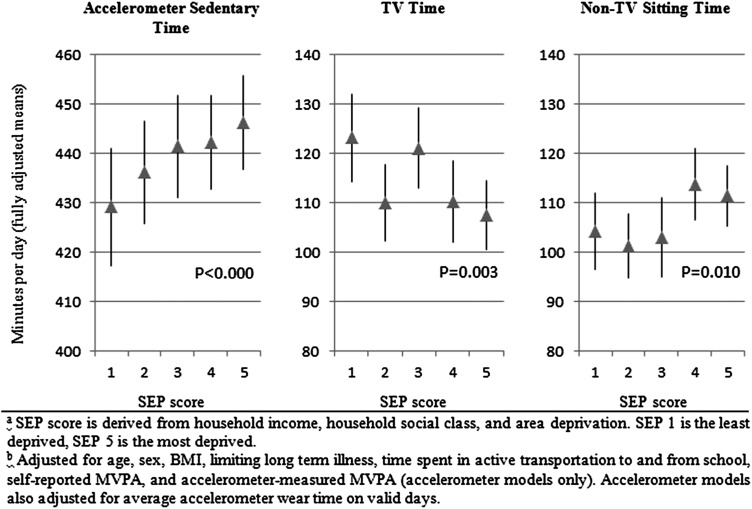
Participants in the highest SEP category spent 16 min/day less (95% CI 6 to 25, p=0.003) watching TV than participants in the lowest SEP category; yet they spent 7 (2 to 16, p=0.010) and 17 (5 to 29, p<0.000) min/day more in non-TV sitting and total (accelerometry-measured) sedentary time, respectively. Associations across individual SEP components varied in strength. Area deprivation was not associated with sedentary time.
Low SEP is linked with higher television times but with lower total (accelerometer-measured) sedentary time, and non-TV sitting during non-school time in children and adolescents. Associations between sedentary time and SEP differ by type of sedentary behaviour. TV viewing is not a good proxy for total sedentary time in children.
久坐行为是年轻人新兴的代谢心血管危险因素。关于社会经济地位(SEP)和久坐行为之间的关系,在儿童和青少年中知之甚少。本研究旨在探讨儿童和青少年的 SEP 与久坐行为之间的关系。
核心样本包括 3822 名参加 2008 年英格兰健康调查的 5-15 岁儿童和青少年,他们的 SEP(家庭收入、家庭户主职业社会阶层和地区贫困程度)和自我报告的久坐时间(非上学时间的电视观看和其他坐姿)信息完整。在子样本(N=587)中测量了加速计测量的总久坐时间。我们使用广义线性模型,在调整了年龄、性别、体重指数、体力活动、加速计佩戴时间以及相互调整了其他 SEP 指标的情况下,检验了 SEP(包括 SEP 综合得分)与久坐时间之间的多变量关系。
处于最高 SEP 类别的参与者每天看电视的时间少 16 分钟(95%CI 6 到 25,p=0.003);但他们每天在非电视坐姿和总(加速计测量)久坐时间上多坐 7 分钟(2 到 16,p=0.010)和 17 分钟(5 到 29,p<0.000)。各个 SEP 成分的关联强度不同。地区贫困程度与久坐时间无关。
低 SEP 与较高的电视时间相关,但与较低的总(加速计测量)久坐时间和非上学时间的非电视坐姿相关。久坐时间和 SEP 之间的关联因久坐行为的类型而异。电视观看不能作为儿童总久坐时间的良好替代指标。