Department of Biomedical Sciences, Institute of Tropical Medicine, Antwerp, Belgium.
Parasit Vectors. 2013 Jul 15;6:207. doi: 10.1186/1756-3305-6-207.
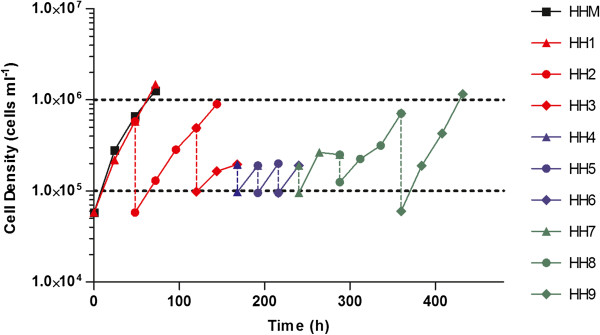
New compounds for the treatment of human African trypanosomiasis (HAT) are urgently required. Trypanosoma brucei (T.b.) gambiense is the leading cause of HAT, yet T.b. gambiense is often not the prime target organism in drug discovery. This may be attributed to the difficulties in handling this subspecies and the lack of an efficient viability assay to monitor drug efficacy.
In this study, a T.b. gambiense strain, recently isolated in the D.R. Congo, was made bioluminescent by transfection with Renilla luciferase (RLuc) without altering its in vitro and in vivo growth characteristics. A luminescent multiplex viability assay (LMVA), based on measurement of the Renilla luciferase activity and the ATP content of the cells within the same experiment, was investigated as an alternative to the standard fluorimetric resazurin viability assay for drug sensitivity testing of T.b. gambiense.
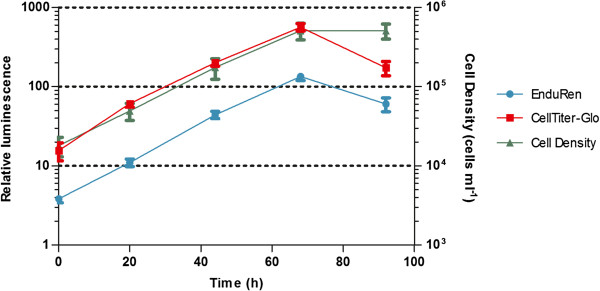
In a 96-well format, the RLuc transfected strain showed a detection limit of 2 × 10(4) cells ml(-1) for the Renilla luciferase measurement and 5 × 10(3) cells ml(-1) for the ATP measurement. Both assays of the LMVA showed linearity up to 10(6) cells ml(-1) and correlated well with the cell density during exponential growth of the long slender bloodstream forms. The LMVA was compared to the fluorimetric resazurin viability assay for drug sensitivity testing of pentamidine, eflornithine, nifurtimox and melarsoprol with both the wild type and the RLuc transfected population. For each drug, the IC50 value of the RLuc population was similar to that of the wild type when determined with either the fluorimetric resazurin method or the LMVA. For eflornithine, nifurtimox and melarsoprol we found no difference between the IC50 values in both viability assays. In contrast, the IC50 value of pentamidine was higher when determined with the fluorimetric resazurin method than in both assays of the LMVA.
LMVA has some advantages for viability measurement of T.b. gambiense: it requires less incubation time for viability detection than the fluorimetric resazurin assay and in LMVA, two sensitive and independent viability assays are performed in the same experiment.
目前急需研发新型化合物以治疗人类非洲锥虫病(HAT)。布氏冈比亚锥虫(T.b. gambiense)是 HAT 的主要致病源,但它通常不是药物研发的首选目标生物。这可能归因于处理这种亚种的困难以及缺乏有效监测药物疗效的生存力检测方法。
在本研究中,通过转染海肾荧光素酶(RLuc)使刚在刚果民主共和国分离出的布氏冈比亚锥虫株发光,而不改变其体外和体内生长特性。研究了一种基于同一实验中测量海肾荧光素酶活性和细胞内 ATP 含量的发光多重生存力检测法(LMVA),以替代标准荧光法检测海肾荧光素酶活性的方法,用于检测布氏冈比亚锥虫对药物的敏感性。
在 96 孔格式中,转染 RLuc 的菌株对海肾荧光素酶测量的检测下限为 2×10(4)细胞/ml(-1),对 ATP 测量的检测下限为 5×10(3)细胞/ml(-1)。LMVA 的两种检测方法均在 10(6)细胞/ml(-1)以内呈线性,并且与长而细的血腔形式指数生长期间的细胞密度密切相关。使用荧光法检测法和 LMVA 对戊烷脒、依氟鸟氨酸、硝呋莫司和米替福新对野生型和转染 RLuc 群体的药物敏感性进行了比较。对于每种药物,当用荧光法检测法或 LMVA 测定时,转染 RLuc 的群体的 IC50 值与野生型相似。对于依氟鸟氨酸、硝呋莫司和米替福新,我们发现两种生存力检测方法的 IC50 值之间没有差异。相比之下,当用荧光法检测法测定时,戊烷脒的 IC50 值高于 LMVA 的两种检测方法。
LMVA 在布氏冈比亚锥虫生存力检测方面具有一些优势:它比荧光法检测法需要更少的孵育时间进行生存力检测,并且在 LMVA 中,在同一实验中进行了两种敏感且独立的生存力检测。