Cognitive Neuroimaging Unit, Institut National de la Santé et de la Recherche Médicale, U992, F-91191 Gif/Yvette, France; NeuroSpin Center, Institute of BioImaging Commissariat à l'Energie Atomique, F-91191 Gif/Yvette, France; Institut du Cerveau et de la Moelle Épinière Research Center, Institut National de la Santé et de la Recherche Médicale, U975 Paris, France.
Neuroimage. 2013 Dec;83:726-38. doi: 10.1016/j.neuroimage.2013.07.013. Epub 2013 Jul 13.
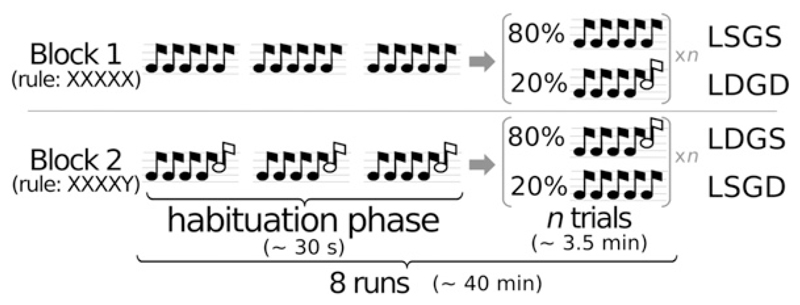
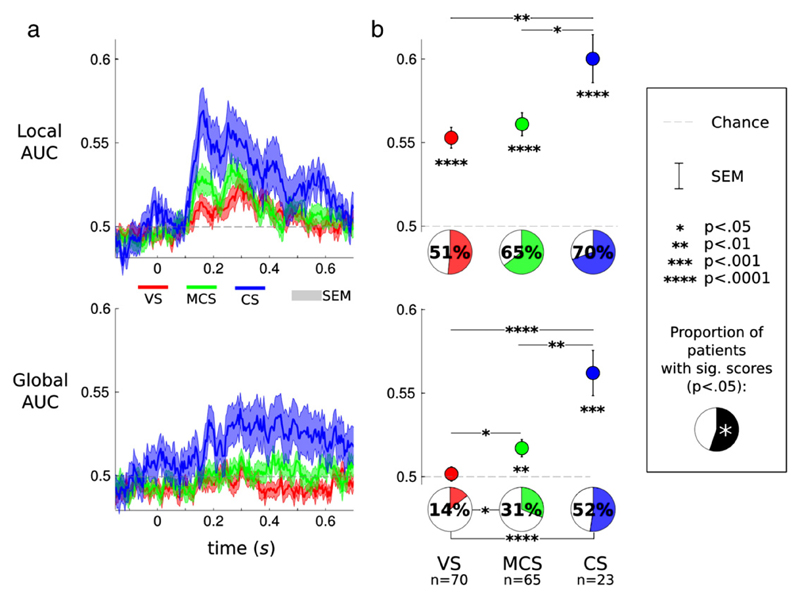
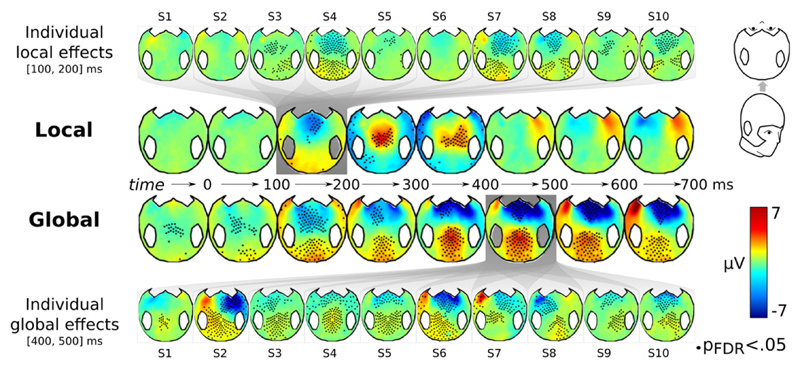
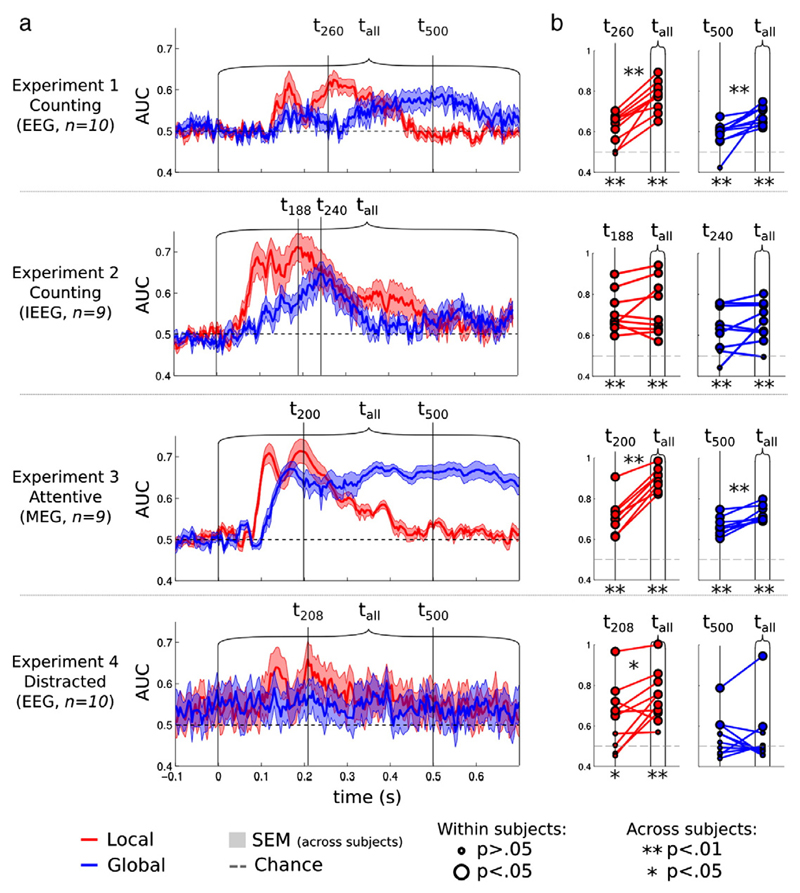
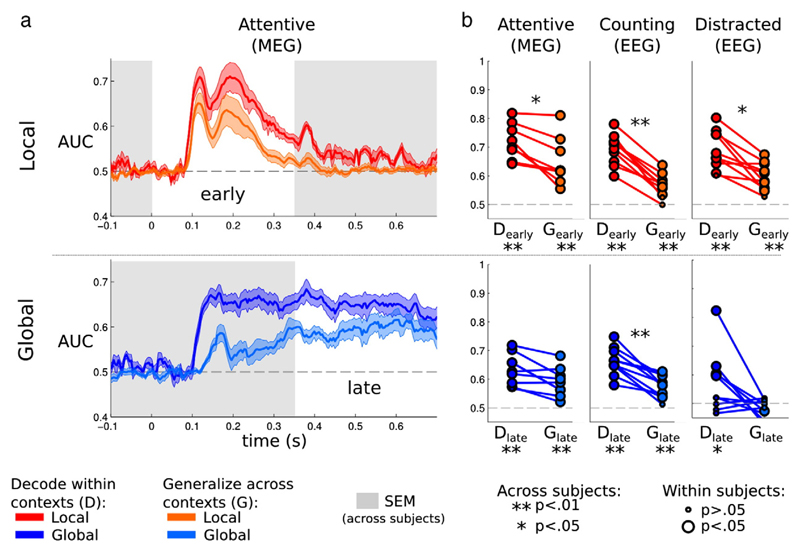
Detecting residual consciousness in unresponsive patients is a major clinical concern and a challenge for theoretical neuroscience. To tackle this issue, we recently designed a paradigm that dissociates two electro-encephalographic (EEG) responses to auditory novelty. Whereas a local change in pitch automatically elicits a mismatch negativity (MMN), a change in global sound sequence leads to a late P300b response. The latter component is thought to be present only when subjects consciously perceive the global novelty. Unfortunately, it can be difficult to detect because individual variability is high, especially in clinical recordings. Here, we show that multivariate pattern classifiers can extract subject-specific EEG patterns and predict single-trial local or global novelty responses. We first validate our method with 38 high-density EEG, MEG and intracranial EEG recordings. We empirically demonstrate that our approach circumvents the issues associated with multiple comparisons and individual variability while improving the statistics. Moreover, we confirm in control subjects that local responses are robust to distraction whereas global responses depend on attention. We then investigate 104 vegetative state (VS), minimally conscious state (MCS) and conscious state (CS) patients recorded with high-density EEG. For the local response, the proportion of significant decoding scores (M=60%) does not vary with the state of consciousness. By contrast, for the global response, only 14% of the VS patients' EEG recordings presented a significant effect, compared to 31% in MCS patients' and 52% in CS patients'. In conclusion, single-trial multivariate decoding of novelty responses provides valuable information in non-communicating patients and paves the way towards real-time monitoring of the state of consciousness.
检测无反应患者的残留意识是临床关注的主要问题,也是理论神经科学的挑战。为了解决这个问题,我们最近设计了一种范式,该范式分离了对听觉新颖性的两种脑电图(EEG)反应。虽然局部音高变化会自动引起失匹配负波(MMN),但整体声音序列的变化会导致晚期 P300b 反应。人们认为只有当受试者有意识地感知到整体新颖性时,才会出现后一个成分。不幸的是,由于个体差异很大,特别是在临床记录中,因此很难检测到。在这里,我们表明,多元模式分类器可以提取特定于受试者的 EEG 模式,并预测单个试验的局部或整体新颖性反应。我们首先使用 38 个高密度 EEG、MEG 和颅内 EEG 记录验证了我们的方法。我们从经验上证明,我们的方法可以避免与多次比较和个体差异相关的问题,同时提高统计学意义。此外,我们在对照受试者中证实,局部反应对分心具有鲁棒性,而全局反应则取决于注意力。然后,我们研究了 104 名使用高密度 EEG 记录的植物状态(VS)、最小意识状态(MCS)和意识状态(CS)患者。对于局部反应,显著解码分数的比例(M=60%)不会随意识状态而变化。相比之下,对于全局反应,只有 14%的 VS 患者 EEG 记录表现出显著影响,而 MCS 患者为 31%,CS 患者为 52%。总之,新颖性反应的单次试验多元解码为非交流患者提供了有价值的信息,并为实时监测意识状态铺平了道路。