Department of Radiology and Radiological Sciences, Vanderbilt University Institute of Imaging Science, Nashville, Tennessee, USA.
J Nucl Med. 2013 Sep;54(9):1564-9. doi: 10.2967/jnumed.112.116137. Epub 2013 Jul 17.
Evaluating the symptomatic progression of mild cognitive impairment (MCI) caused by Alzheimer disease (AD) is practically accomplished by tracking performance on cognitive tasks, such as the Alzheimer Disease Assessment Scale's cognitive subscale (ADAS_cog), the Mini-Mental Status Examination (MMSE), and the Functional Activities Questionnaire (FAQ). The longitudinal relationships between cognitive decline and metabolic function as assessed using (18)F-FDG PET are needed to address both the cognitive and the biologic progression of disease state in individual subjects. We conducted an exploratory investigation to evaluate longitudinal changes in brain glucose metabolism of individual subjects and their relationship to the subject's changes of cognitive status.
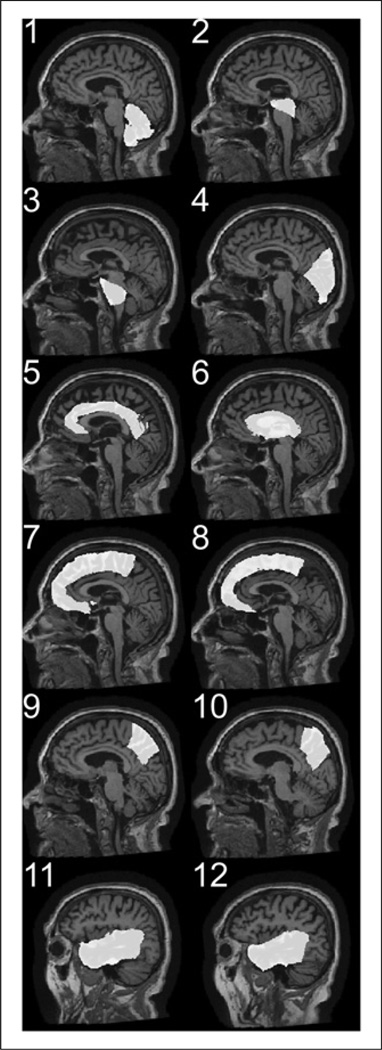
We describe a method to determine correlations in (18)F-FDG spatial distribution over time. This parameter is termed the regional (18)F-FDG time correlation coefficient (rFTC). By using linear mixed-effects models, we determined the difference in the rFTC decline rate between controls and subjects at high risk of developing AD, such as individuals with MCI or the presence of apolipoprotein E (APOE)-ε4 allele. The association between each subject's rFTC and performance on cognitive tests (ADAS_cog, MMSE, and FAQ) was determined with 2 different correlation methods. All subject data were downloaded from the Alzheimer Disease Neuroimaging Initiative.
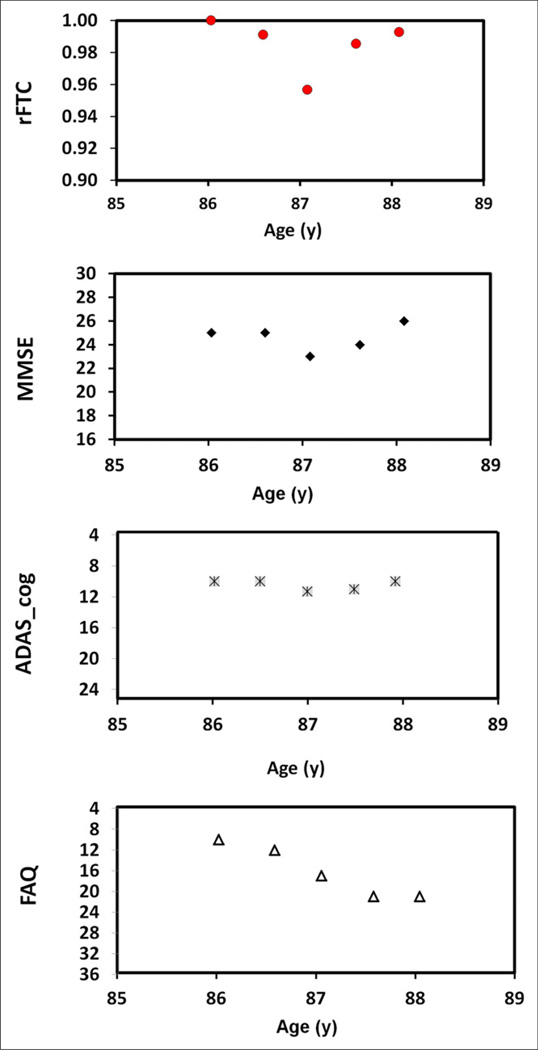
The rFTC values of controls remained fairly constant over time (-0.003 annual change; 95% confidence interval, -0.010-0.004). In MCI patients, the rFTC declined faster than in controls by an additional annual change of -0.02 (95% confidence interval, -0.030 to -0.010). In MCI patients, the decline in rFTC was associated with cognitive decline (ADAS_cog, P = 0.011; FAQ, P = 0.0016; MMSE, P = 0.004). After a linear effect of time was accounted for, visit-to-visit changes in rFTC correlated with visit-to-visit changes in all 3 cognitive tests.
Longitudinal changes in rFTC detect subtle metabolic changes in individuals associated with variations in their cognition. This analytic tool may be useful for a patient-based monitoring of cognitive decline.
评估由阿尔茨海默病(AD)引起的轻度认知障碍(MCI)的症状进展实际上是通过跟踪认知任务的表现来完成的,例如阿尔茨海默病评估量表的认知子量表(ADAS_cog)、简易精神状态检查(MMSE)和功能活动问卷(FAQ)。需要评估使用(18)F-FDG PET 评估的认知下降与代谢功能之间的纵向关系,以解决个体受试者的认知和疾病状态的生物学进展。我们进行了一项探索性研究,以评估个体受试者的大脑葡萄糖代谢的纵向变化及其与受试者认知状态变化的关系。
我们描述了一种确定(18)F-FDG 空间分布随时间变化的相关性的方法。该参数称为区域(18)F-FDG 时间相关系数(rFTC)。通过使用线性混合效应模型,我们确定了 AD 高风险(如 MCI 患者或载脂蛋白 E(APOE)-ε4 等位基因的存在)个体与对照组之间 rFTC 下降率的差异。使用 2 种不同的相关方法确定了每个受试者的 rFTC 与认知测试(ADAS_cog、MMSE 和 FAQ)的表现之间的关联。所有受试者的数据均从阿尔茨海默病神经影像学倡议中下载。
对照组的 rFTC 值随时间的变化相当稳定(每年变化-0.003;95%置信区间,-0.010-0.004)。在 MCI 患者中,rFTC 的下降速度比对照组快,每年额外下降-0.02(95%置信区间,-0.030 至-0.010)。在 MCI 患者中,rFTC 的下降与认知能力下降相关(ADAS_cog,P = 0.011;FAQ,P = 0.0016;MMSE,P = 0.004)。在考虑了时间的线性影响后,rFTC 的随访间变化与所有 3 项认知测试的随访间变化相关。
rFTC 的纵向变化可检测与认知变化相关的个体代谢的细微变化。这种分析工具可能对基于患者的认知下降监测有用。