Scottish Fish Immunology Research Centre, School of Biological Sciences, University of Aberdeen, Tillydrone Avenue, Aberdeen AB24 2TZ, UK.
Vet Res. 2013 Jul 16;44(1):55. doi: 10.1186/1297-9716-44-55.
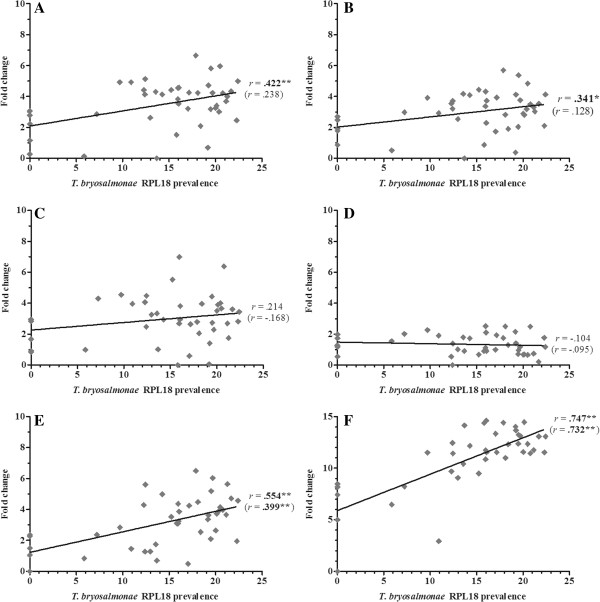
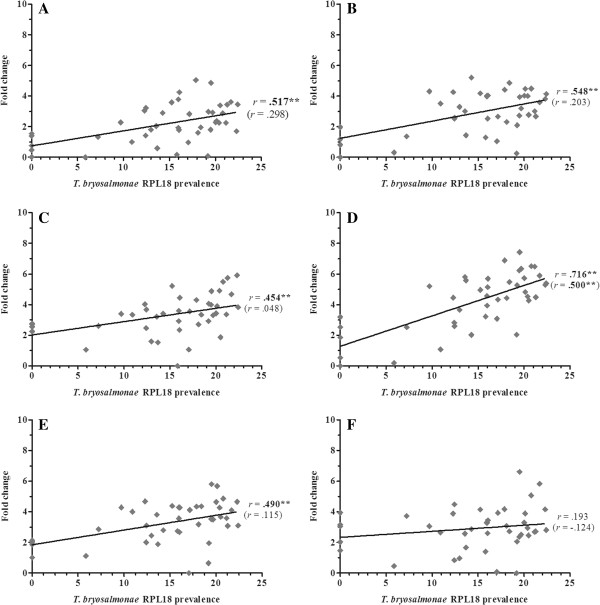
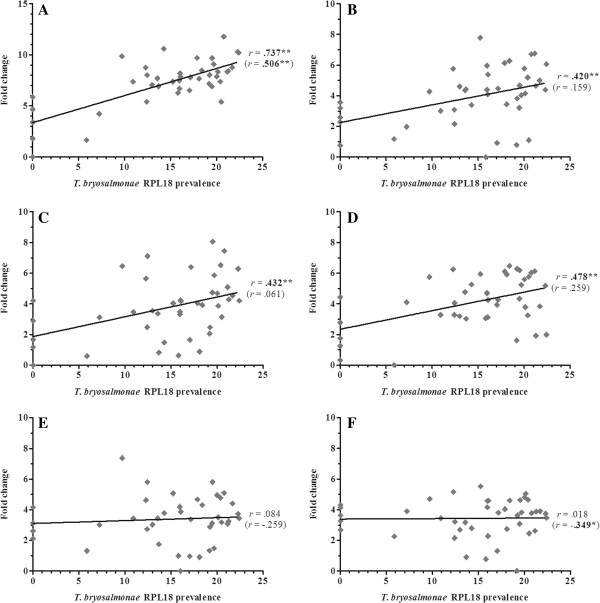
The myxozoan Tetracapsuloides bryosalmonae is the causative agent of Proliferative Kidney Disease (PKD) targeting primarily the kidney of infected fish where it causes a chronic lymphoid immunopathology. Although known to be associated with suppression of some cellular aspects of innate immunity and a prominent lymphocytic hyperplasia, there remains a considerable knowledge gap in our understanding of the underlying immune mechanisms driving PKD pathogenesis. To provide further insights, the expression profiles of a panel of innate/inflammatory and adaptive immune molecules were examined in rainbow trout Oncorhynchus mykiss following a natural exposure to the parasite. Relative to controls, fish with early to advanced stages of kidney pathology exhibited up-regulation of the inflammatory cytokines interleukin (IL)-6 and IL-11, although remaining refractory towards genes indicative of macrophage activity. Antimicrobial peptides (AMPs) and anti-inflammatory markers, including cathelicidin (CATH) and IL-10 were markedly up-regulated during clinical disease. Up-regulation of adaptive immune molecules, including cell markers and antibody genes reflect the lymphocytic dominance of this disease and the likely importance of lymphocyte subsets in PKD pathogenesis. Up-regulation of T helper (TH) cell-like response genes and transcription factors implies that T. bryosalmonae may elicit a complex interplay between TH cell subsets. This work, for the first time in the study of fish-myxozoan interactions, suggests that PKD pathogenesis is shaped by an anti-inflammatory phenotype, a profound B cell/antibody response and dysregulated TH cell-like activities. A better understanding of the functional roles of fish immune cells and molecules in PKD pathogenesis may facilitate future development of control measures against this disease.
粘孢子虫 Tetracapsuloides bryosalmonae 是增殖性肾病 (PKD) 的病原体,主要针对感染鱼类的肾脏,在那里它引起慢性淋巴免疫病理学。尽管已知与某些先天免疫细胞方面的抑制和明显的淋巴细胞增生有关,但我们对驱动 PKD 发病机制的潜在免疫机制的理解仍然存在相当大的知识差距。为了提供进一步的见解,在虹鳟 Oncorhynchus mykiss 中自然暴露于寄生虫后,检查了一组先天/炎症和适应性免疫分子的表达谱。与对照组相比,具有肾脏病理学早期至晚期阶段的鱼类表现出炎症细胞因子白细胞介素 (IL)-6 和 IL-11 的上调,尽管对指示巨噬细胞活性的基因仍然具有抗性。抗菌肽 (AMP) 和抗炎标志物,包括 cathelicidin (CATH) 和 IL-10 在临床疾病期间明显上调。适应性免疫分子的上调,包括细胞标记物和抗体基因,反映了这种疾病的淋巴细胞优势,以及淋巴细胞亚群在 PKD 发病机制中的可能重要性。T 辅助 (TH) 样反应基因和转录因子的上调意味着 T. bryosalmonae 可能引发 TH 细胞亚群之间的复杂相互作用。这项工作首次在鱼类-粘孢子虫相互作用的研究中表明,PKD 的发病机制由抗炎表型、深刻的 B 细胞/抗体反应和失调的 TH 样活性塑造。更好地了解鱼类免疫细胞和分子在 PKD 发病机制中的功能作用可能有助于未来开发针对这种疾病的控制措施。