Centre de Recherche de l'Institut Universitaire de Santé Mentale de Montréal , Montréal, QC , Canada ; Department of Psychiatry, Faculty of Medicine, University of Montreal , Montreal, QC , Canada.
Front Psychiatry. 2013 Jul 16;4:67. doi: 10.3389/fpsyt.2013.00067. eCollection 2013.
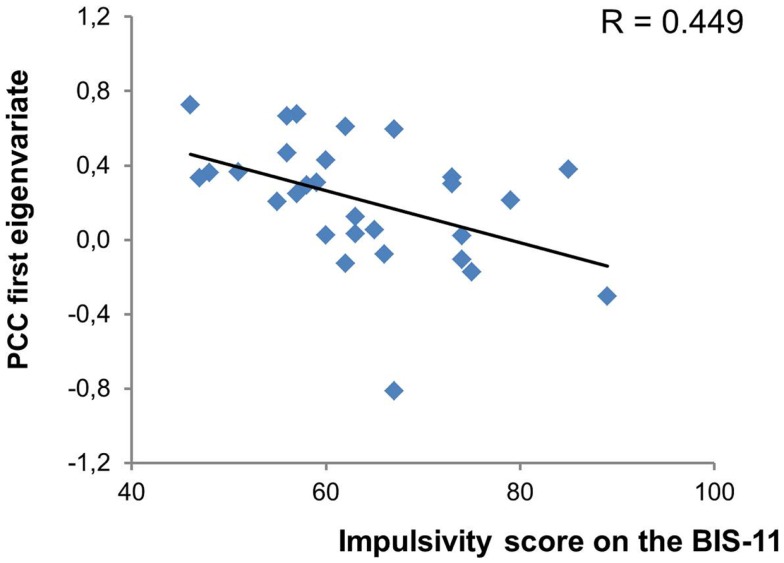
Impulsivity has been shown to play a pivotal role in the onset, pattern of consumption, relapse and, most notably, craving of illicit and licit drugs such as cigarette smoking. The goal of this study was to examine the neurobiological influence of trait impulsivity during cue-induced cigarette craving. Thirty-one chronic smokers passively viewed appetitive smoking-related and neutral images while being scanned and reported their feelings of craving. They completed the Barratt Impulsiveness Scale, a measure of trait impulsivity. We conducted functional connectivity analyses using the psycho-physiological interaction method. During the processing of smoking stimuli, participants presented increased activations in the cingulate and prefrontal cortices. We observed a significant positive relationship between impulsivity scores and reported craving. A negative correlation was observed between the impulsivity score and activity in the posterior cingulate cortex (PCC). The insula, dorsal anterior cingulate cortex (dACC) as well as the dorsolateral prefrontal cortex (DLPFC) presented a negative connectivity with the PCC. Consistent with the view that the PCC is related to the ability to resist cigarette craving, our results suggest that high impulsive smokers have greater difficulty in controlling their cravings, and that this weakness may be mediated by lower PCC activity. Moreover, we argue that the less PCC activity, the greater the probability of a stronger emotional, physiological, and biased attentional response to smoking cues mediated by insula, dACC, and DLPFC activity. This is the first study on this topic, and so, results will need to be replicated in both licit and illicit drug abusers. Our findings also highlight a need for more emphasis on the PCC in drug addiction research, as it is one of the most consistently activated regions in functional magnetic resonance imaging studies examining the neural correlates of cue-induced alcohol, drug, and tobacco cravings.
冲动性已被证明在非法和合法药物(如吸烟)的发作、消费模式、复发,尤其是渴望方面起着关键作用。本研究的目的是检查特质冲动性在线索诱发吸烟渴望期间对神经生物学的影响。31 名慢性吸烟者在被扫描的同时被动地观看了有吸引力的吸烟相关和中性图像,并报告了他们的渴望感。他们完成了巴瑞特冲动量表,这是一种衡量特质冲动的量表。我们使用心理生理相互作用方法进行了功能连接分析。在处理吸烟刺激时,参与者的扣带和前额叶皮层的活动增加。我们观察到冲动得分与报告的渴望之间存在显著的正相关关系。冲动得分与后扣带皮层(PCC)的活动呈负相关。岛叶、背侧前扣带皮层(dACC)和背外侧前额叶皮层(DLPFC)与 PCC 呈负连接。与 PCC 与抵抗吸烟渴望的能力有关的观点一致,我们的结果表明,高冲动吸烟者更难控制他们的渴望,而这种弱点可能是由较低的 PCC 活动介导的。此外,我们认为 PCC 活动越低,对吸烟线索的情绪、生理和偏向注意力反应就越强,这种反应是由岛叶、dACC 和 DLPFC 活动介导的。这是该主题的第一项研究,因此,结果需要在合法和非法药物滥用者中得到复制。我们的研究结果还强调了需要在药物成瘾研究中更加重视 PCC,因为它是研究线索诱发酒精、药物和烟草渴望的功能磁共振成像研究中最常激活的区域之一。