Soleimani Ghazaleh, Towhidkhah Farzad, Oghabian Mohammad Ali, Ekhtiari Hamed
Department of Biomedical Engineering, Amirkabir University of Technology, Tehran, Iran.
Iranian National Center for Addiction Studies, Tehran University of Medical Science, Tehran, Iran.
Front Syst Neurosci. 2022 Oct 6;16:956315. doi: 10.3389/fnsys.2022.956315. eCollection 2022.
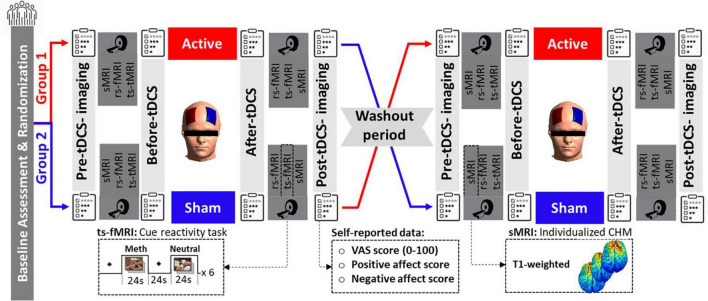
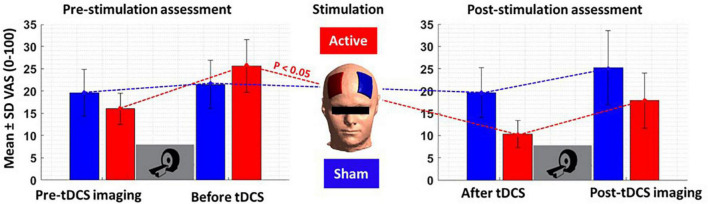
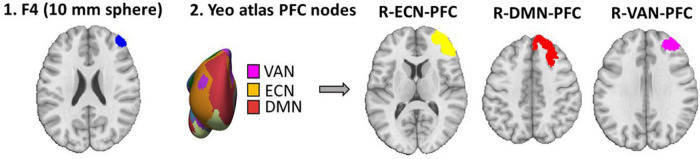
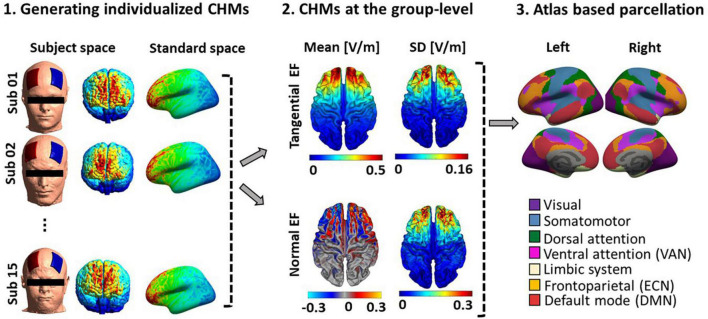
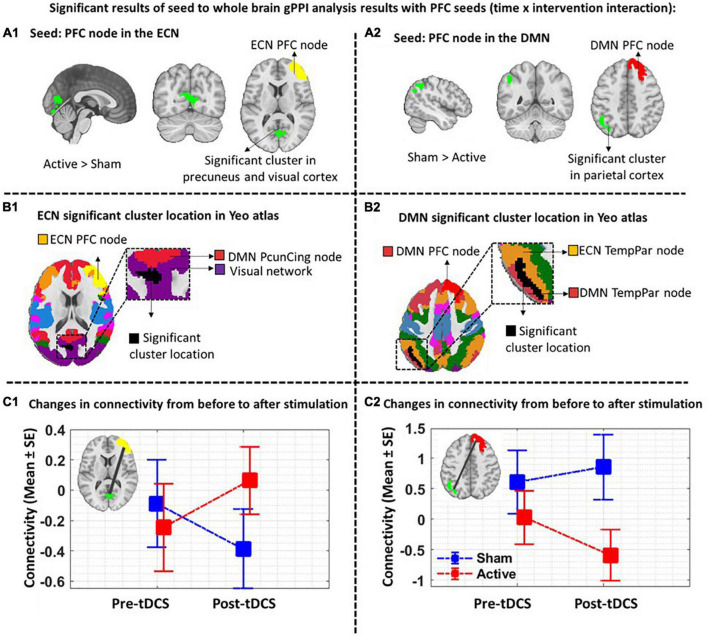
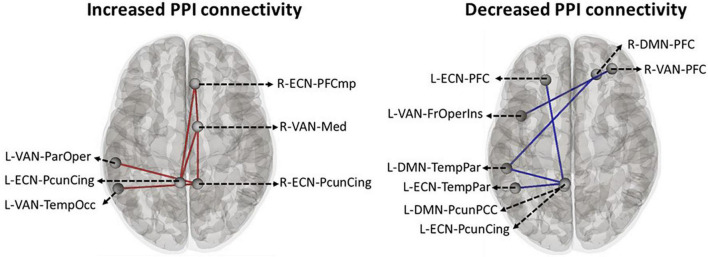
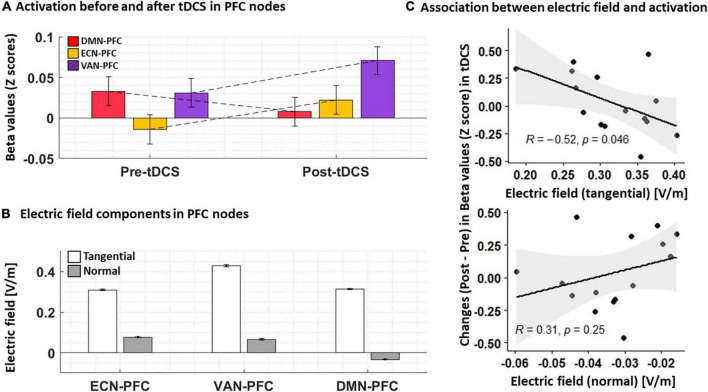
Transcranial direct current stimulation (tDCS) is a promising intervention for reducing craving/consumption in individuals with substance use disorders. However, its exact mechanism of action has not yet been well explored. We aimed to examine the network-based effects of tDCS while people with methamphetamine use disorders (MUDs) were exposed to drug cues. In a randomized, double-blind sham-controlled trial with a crossover design, 15 participants with MUDs were recruited to receive 20 min of active/sham tDCS with an anode/cathode over F4/F3. MRI data, including structural and task-based functional MRI during a standard drug cue-reactivity task, were collected immediately before and after stimulation sessions. Craving scores were also recorded before and after MRI scans. Individualized head models were generated to determine brain regions with strong electric fields (EFs). Using atlas-based parcellation of head models, averaged EFs were extracted from the main nodes of three large-scale networks that showed abnormalities in MUDs; executive control (ECN), default mode (DMN), and ventral attention (VAN) networks. Main nodes with high EF intensity were used as seed regions for task-based functional connectivity (FC) [using generalized psychophysiological interaction (gPPI)] and activity [using a general linear model (GLM)] calculations. Subjective craving showed a significant reduction in immediate craving after active (-15.42 ± 5.42) compared to sham (-1 ± 2.63). In seed-to-whole brain results, the PFC node in ECN showed an enhanced PPI connectivity with precuneus and visual cortex; the cluster center in MNI (6, -84, -12); the PFC node in DMN showed a decreased PPI connectivity with contralateral parietal cortex;(-48, -60, 46). ROI-to-ROI results showed increased PPI connectivity within/between ECN-VAN while connectivity between ECN-DMN decreased. In line with connectivity, functional activity in the right PFC node in DMN decreased after tDCS while activity in PFC nodes of ECN/VAN increased. EF calculations in PFC nodes revealed that EF in DMN was outward, while the direction of EFs was inward in ECN/VAN. This study provides new insight into neural circuitry underlying MUDs that can be modulated by tDCS at the network level and specifically suggests that bilateral tDCS increases cortical excitability in ECN and VAN, while it has opposite effects on DMN that may be related to the direction of EFs.
经颅直流电刺激(tDCS)是一种很有前景的干预措施,可减少物质使用障碍患者的渴望/药物使用量。然而,其确切的作用机制尚未得到充分探索。我们旨在研究在甲基苯丙胺使用障碍(MUD)患者接触毒品线索时tDCS基于网络的效应。在一项采用交叉设计的随机、双盲、假刺激对照试验中,招募了15名MUD患者,接受20分钟的主动/假tDCS,阳极/阴极置于F4/F3上方。在刺激 sessions 前后立即收集MRI数据,包括标准毒品线索反应任务期间的结构和基于任务的功能MRI。在MRI扫描前后也记录了渴望分数。生成个性化头部模型以确定具有强电场(EFs)的脑区。使用基于图谱的头部模型分割,从在MUD中显示异常的三个大规模网络的主要节点中提取平均EFs;执行控制(ECN)、默认模式(DMN)和腹侧注意(VAN)网络。将具有高EF强度的主要节点用作基于任务的功能连接(FC)[使用广义心理生理交互作用(gPPI)]和活动[使用一般线性模型(GLM)]计算的种子区域。与假刺激(-1±2.63)相比,主动刺激后(-15.42±5.42)主观渴望的即时渴望显著降低。在种子到全脑的结果中,ECN中的PFC节点与楔前叶和视觉皮层的PPI连接增强;MNI中的簇中心(6,-84,-12);DMN中的PFC节点与对侧顶叶皮层的PPI连接减少;(-48,-60,46)。ROI到ROI的结果显示ECN-VAN内/之间的PPI连接增加,而ECN-DMN之间的连接减少。与连接性一致,tDCS后DMN中右侧PFC节点的功能活动降低,而ECN/VAN的PFC节点活动增加。PFC节点中的EF计算表明,DMN中的EF向外,而ECN/VAN中的EF方向向内。本研究为MUD潜在的神经回路提供了新的见解,表明tDCS可在网络水平上对其进行调节,具体而言,双侧tDCS增加了ECN和VAN中的皮质兴奋性,而对DMN有相反的影响,这可能与EF的方向有关。