Liao Yanhui, Johnson Maritza, Qi Chang, Wu Qiuxia, Xie An, Liu Jianbin, Yang Mei, Huang Maifang, Zhang Yan, Liu Tieqiao, Hao Wei, Tang Jinsong
Department of Psychiatry, The Second Xiangya Hospital, Central South University, Changsha, China.
Mental Health Institute, The Second Xiangya Hospital, Central South University, Changsha, China.
Front Psychiatry. 2018 Mar 21;9:88. doi: 10.3389/fpsyt.2018.00088. eCollection 2018.
Observations of drug-related cues may induce craving in drug-dependent patients, prompting compulsive drug-seeking behavior. Sexual dysfunction is common in drug users. The aim of the study was to examine regional brain activation to drug (ketamine, cigarette smoking) associated cues and natural (sexual) rewards.
A sample of 129 [40 ketamine use smokers (KUS), 45 non-ketamine use smokers (NKUS) and 44 non-ketamine use non-smoking healthy controls (HC)] participants underwent functional magnetic resonance imaging (fMRI) while viewing ketamine use related, smoking and sexual films.
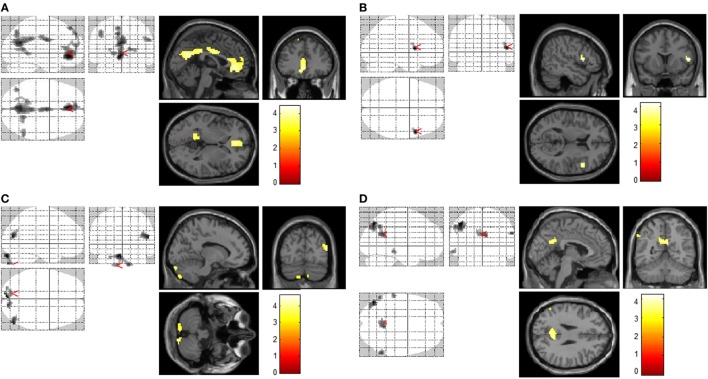
We found that KUS showed significant increased activation in anterior cingulate cortex and precuneus in response to ketamine cues. Ketamine users (KUS) showed lower activation in cerebellum and middle temporal cortex compared with non-ketamine users (NKUS and HC) in response to sexual cues. Smokers (KUS and NKUS) showed higher activation in the right precentral frontal cortex in response to smoking cues. Non-ketamine users (NKUS and HC) showed significantly increased activation of cerebellum and middle temporal cortex while viewing sexual cues.
These findings clearly show the engagement of distinct neural circuitry for drug-related stimuli in chronic ketamine users. While smokers (both KUS and NKUS) showed overlapping differences in activation for smoking cues, the former group showed a specific neural response to relevant (i.e., ketamine-related) cues. In particular, the heightened response in anterior cingulate cortex may have important implications for how attentionally salient such cues are in this group. Ketamine users (KUS) showed lower activation in response to sexual cues may partly reflect the neural basis of sexual dysfunction.
对与药物相关线索的观察可能会诱发药物依赖患者的渴望,促使其产生强迫性的觅药行为。性功能障碍在吸毒者中很常见。本研究的目的是检查大脑区域对与药物(氯胺酮、吸烟)相关线索和自然(性)奖励的激活情况。
129名参与者[40名使用氯胺酮的吸烟者(KUS)、45名不使用氯胺酮的吸烟者(NKUS)和44名不使用氯胺酮的非吸烟健康对照者(HC)]在观看与氯胺酮使用相关、吸烟和性的影片时接受功能磁共振成像(fMRI)检查。
我们发现,KUS组在对氯胺酮线索的反应中,前扣带回皮质和楔前叶的激活显著增加。与非氯胺酮使用者(NKUS和HC)相比,氯胺酮使用者(KUS)在对性线索的反应中,小脑和颞中皮质的激活较低。吸烟者(KUS和NKUS)在对吸烟线索的反应中,右侧中央前回额叶皮质的激活较高。非氯胺酮使用者(NKUS和HC)在观看性线索时,小脑和颞中皮质的激活显著增加。
这些发现清楚地表明,慢性氯胺酮使用者中与药物相关刺激的不同神经回路被激活。虽然吸烟者(KUS和NKUS)在对吸烟线索的激活方面表现出重叠的差异,但前一组对相关(即与氯胺酮相关)线索表现出特定的神经反应。特别是,前扣带回皮质的反应增强可能对该组中此类线索在注意力上的显著性具有重要意义。氯胺酮使用者(KUS)对性线索的激活较低可能部分反映了性功能障碍的神经基础。