Department of Cardiology, Leiden University Medical Center, Leiden, The Netherlands.
PLoS One. 2013 Jul 10;8(7):e67936. doi: 10.1371/journal.pone.0067936. Print 2013.
Significant obstructive coronary artery disease (CAD) is common in asymptomatic dialysis patients. Identifying these high risk patients is warranted and may improve the prognosis of this vulnerable patient group. Routine catheterization of incident dialysis patients has been proposed, but is considered too invasive. CT-angiography may therefore be more appropriate. However, extensive coronary calcification, often present in this patient group, might hamper adequate lumen evaluation. The objective of this study was to assess the feasibility of CT-angiography in this patient group.
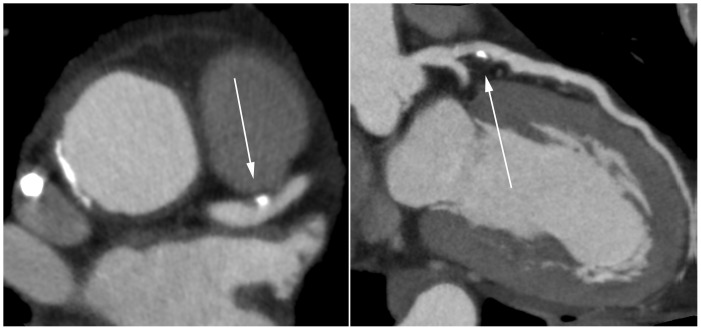
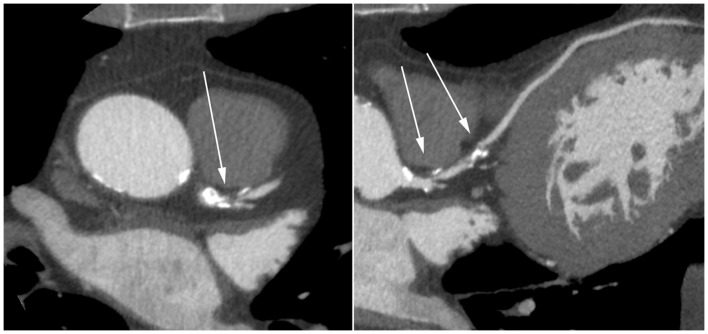
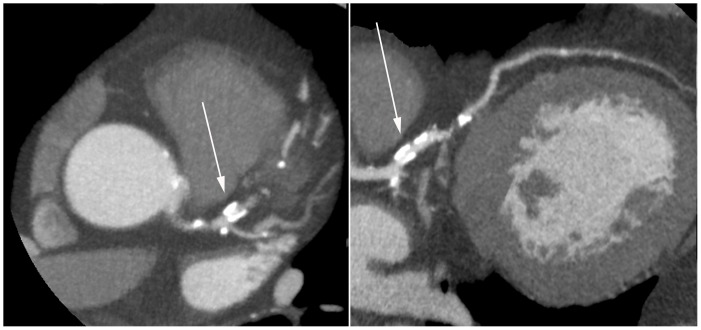
For this analysis all patients currently participating in the ICD2 trial (ISRCTN20479861), with no history of PCI or CABG were included. The major epicardial vessels were evaluated on a segment basis (segment 1-3, 5-8, 11 and 13) by a team consisting of an interventional and an imaging specialist. Segments were scored as not significant, significant and not interpretable.
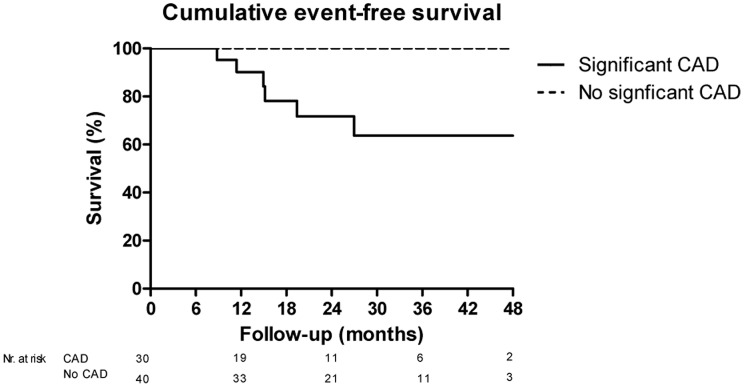
A total of 70 dialysis patients, with a mean age of 66±8 yrs and predominantly male (70%) were included. The median calcium score was 623 [79, 1619]. Over 90% of the analyzed segments were considered interpretable. The incidence of significant CAD on CT was 43% and was associated with cardiovascular events during follow-up. The incidence of cardiovascular events after 2-years follow-up: 36% vs. 0% in patients with no significant CAD (p<0.01).
Despite the high calcium scores CT-angiography is feasible for the evaluation of the extent of CAD in dialysis patients. Moreover the presence of significant CAD on CT was associated with events during follow-up.
无症状透析患者中常存在严重的冠状动脉疾病(CAD)。确定这些高危患者是合理的,可能会改善这一脆弱患者群体的预后。有人建议对新出现的透析患者进行常规导管插入术,但被认为过于侵入性。因此,CT 血管造影可能更合适。然而,在该患者群体中,广泛存在的冠状动脉钙化可能会妨碍对管腔进行充分评估。本研究的目的是评估 CT 血管造影在该患者群体中的可行性。
对目前正在参与 ICD2 试验(ISRCTN20479861)且无 PCI 或 CABG 病史的所有患者进行此分析。一个由介入和影像学专家组成的团队对主要心外膜血管进行节段性评估(节段 1-3、5-8、11 和 13)。将节段分为无意义、有意义和不可解释。
共纳入 70 名透析患者,平均年龄为 66±8 岁,主要为男性(70%)。中位钙评分 623[79,1619]。分析的节段中超过 90%被认为是可解释的。CT 上 CAD 的发生率为 43%,与随访期间的心血管事件相关。2 年随访后的心血管事件发生率:无意义 CAD 患者为 36%,而无意义 CAD 患者为 0%(p<0.01)。
尽管钙评分较高,但 CT 血管造影术可用于评估透析患者 CAD 的严重程度。此外,CT 上存在有意义的 CAD 与随访期间的事件有关。