Dalla Lana School of Public Health, University of Toronto, Toronto, Ontario, Canada.
PLoS Negl Trop Dis. 2013 Jul 11;7(7):e2312. doi: 10.1371/journal.pntd.0002312. Print 2013.
Gender remains a recognized but relatively unexamined aspect of the potential challenges for treatment programmes for Neglected Tropical Diseases (NTDs). We sought to explore the role of gender in access to treatment in the Uganda National Neglected Tropical Disease Control Programme.
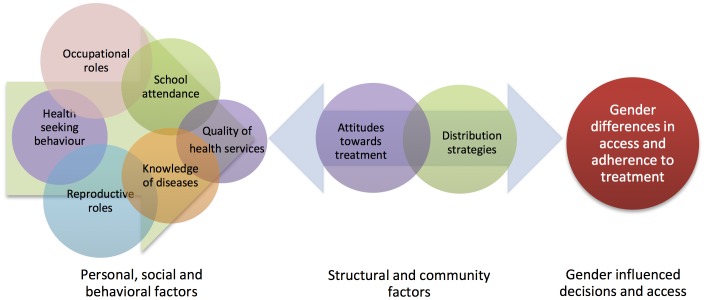
METHODOLOGY/PRINCIPAL FINDINGS: Quantitative and qualitative data was collected in eight villages in Buyende and Kamuli districts, Eastern Uganda. Quantitative data on the number of persons treated by age and gender was identified from treatment registers in each village. Qualitative data was collected through semi-structured interviews with sub-county supervisors, participant observation and from focus group discussions with community leaders, community medicine distributors (CMDs), men, women who were pregnant or breastfeeding at the time of mass-treatment, and adolescent males and females. Findings include the following: (i) treatment registers are often incomplete making it difficult to obtain accurate estimates of the number of persons treated; (ii) males face more barriers to accessing treatment than women due to occupational roles which keep them away from households or villages for long periods, and males may be more distrustful of treatment; (iii) CMDs may be unaware of which medicines are safe for pregnant and breastfeeding women, resulting in women missing beneficial treatments.
CONCLUSIONS/SIGNIFICANCE: Findings highlight the need to improve community-level training in drug distribution which should include gender-specific issues and guidelines for treating pregnant and breastfeeding women. Accurate age and sex disaggregated measures of the number of community members who swallow the medicines are also needed to ensure proper monitoring and evaluation of treatment programmes.
性别仍然是被认可但相对未被充分研究的影响因素之一,可能会对被忽视的热带病(NTDs)治疗方案产生挑战。我们试图探讨性别在乌干达国家被忽视的热带病控制规划中获得治疗方面的作用。
方法/主要发现:在乌干达东部的布耶ende 和卡穆利区的八个村庄收集了定量和定性数据。每个村庄的治疗登记册中都确定了按年龄和性别划分的接受治疗人数的定量数据。定性数据通过与县以下主管、参与观察以及与社区领导人、社区医药分销商(CMD)、在大规模治疗时怀孕或哺乳的男性和女性以及青少年男性和女性进行半结构化访谈收集。研究结果包括以下内容:(i)治疗登记册通常不完整,难以准确估计接受治疗的人数;(ii)由于职业角色使男性长时间远离家庭或村庄,男性获得治疗的障碍比女性更多,而且男性可能对治疗更不信任;(iii)CMD 可能不知道哪些药物对孕妇和哺乳期妇女是安全的,导致妇女错过有益的治疗。
结论/意义:研究结果强调需要改进社区一级的药物分发培训,培训应包括性别特定问题以及为孕妇和哺乳期妇女治疗的准则。还需要准确按年龄和性别分类的社区成员服用药物的数量的衡量措施,以确保对治疗方案进行适当的监测和评估。