Laboratory of Molecular Biology, Institute of Medical Laboratory Sciences, Jinling Hospital, School of Medicine, Nanjing University, Nanjing 210002, PR China.
BMC Infect Dis. 2013 Jul 22;13:337. doi: 10.1186/1471-2334-13-337.
Bloodstream infections due to Candida species cause significant morbidity and mortality, and the epidemiology of Candida infection is changing. Surveillance for candidemia is necessary to detect trends in species distribution and antifungal resistance.
The medical and electronic records of all patients who had candidemia at the authors' hospital from 2009 to 2011 were reviewed for demographic data and clinical information, including the infecting Candida species, resistance to antifungals and survival, and the presence of risk factors associated with candidemia.
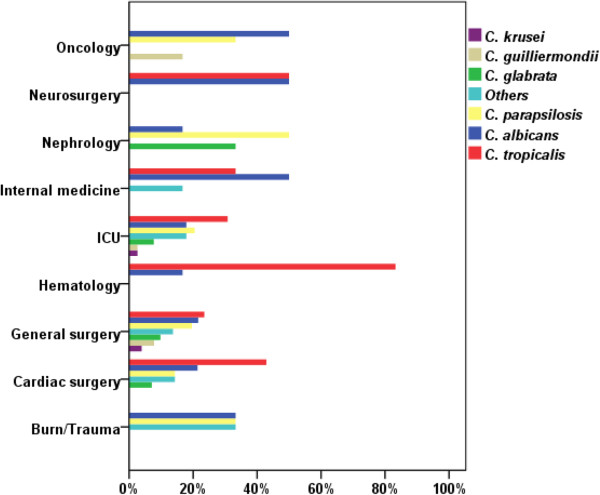
A total of 133 distinct episodes of candidemia were identified over the study period. The annual incidence of candidemia ranged between 0.71 and 0.85 cases/1000 hospital discharges. The most frequent Candida species were C. tropicalis (28.6%), followed by C. albicans (23.3%) and C. parapsilosis (19.5%). The rates of susceptibility to antifungal agents were as followed: voriconazole (97.8%), itraconazole (69.5%), fluconazole (46.1%), ketoconazole (38.9%). Out of 131 evaluable patients, 34 (26.0%) died within 30 days from the onset of candidemia. C. tropicalis candidemia was associated with the highest mortality rate (44.7%). Regarding the crude mortality in the different units, patients in Hemato-Oncology ward had the highest mortality rate (66.7%), followed by patients in cardiovascular wards and ICU (57.1% and 25.6%, respectively). Predictors of 30-day mortality were identified by uni- and multivariate analyses. Complicated abdominal surgery, presence of central venous catheter (CVC), neutropenia, candidemia due to C. tropicalis and poor treatment with fluconazole were significantly associated with the 30-day mortality. Presence of CVC (odds ratio[OR] = 4.177; 95% confidence interval [CI] = 1.698 to 10.278; P = 0.002) was the only independent predictor for mortality in the multivariate analysis.
This report provides baseline data for future epidemiological and susceptibility studies and for the mortality rates associated with candidemia in our hospital. The knowledge of the local epidemiological trends in Candida species isolated in blood cultures is important to guide therapeutic choices.
念珠菌属引起的血流感染会导致严重的发病率和死亡率,且念珠菌感染的流行病学正在发生变化。进行念珠菌血症监测对于检测菌种分布和抗真菌药物耐药性的趋势是必要的。
作者回顾了 2009 年至 2011 年期间该院所有念珠菌血症患者的医疗和电子病历,以获取人口统计学数据和临床信息,包括感染的念珠菌菌种、对抗真菌药物的耐药性和生存情况,以及与念珠菌血症相关的危险因素。
研究期间共发现 133 例不同的念珠菌血症发作。念珠菌血症的年发病率在 0.71 至 0.85 例/1000 例住院患者之间。最常见的念珠菌菌种为热带念珠菌(28.6%),其次是白念珠菌(23.3%)和近平滑念珠菌(19.5%)。抗真菌药物的敏感性率如下:伏立康唑(97.8%)、伊曲康唑(69.5%)、氟康唑(46.1%)、酮康唑(38.9%)。在 131 例可评估患者中,有 34 例(26.0%)在念珠菌血症发病后 30 天内死亡。热带念珠菌血症与最高的死亡率(44.7%)相关。关于不同科室的粗死亡率,血液肿瘤科的患者死亡率最高(66.7%),其次是心血管科和 ICU 的患者(57.1%和 25.6%)。单因素和多因素分析确定了 30 天死亡率的预测因素。复杂的腹部手术、中央静脉导管(CVC)的存在、中性粒细胞减少症、热带念珠菌引起的念珠菌血症和氟康唑治疗效果不佳与 30 天死亡率显著相关。CVC 的存在(比值比[OR] = 4.177;95%置信区间 [CI] = 1.698 至 10.278;P = 0.002)是多因素分析中死亡的唯一独立预测因素。
本报告为未来的流行病学和药敏研究以及我们医院念珠菌血症相关死亡率提供了基线数据。了解血液培养中分离的念珠菌菌种的本地流行病学趋势对于指导治疗选择很重要。